
Thailand Launches Laem Chabang-Nong Khai Freight Rail Trial to Slash Logistics Costs and Power ASEAN Hub Ambitions
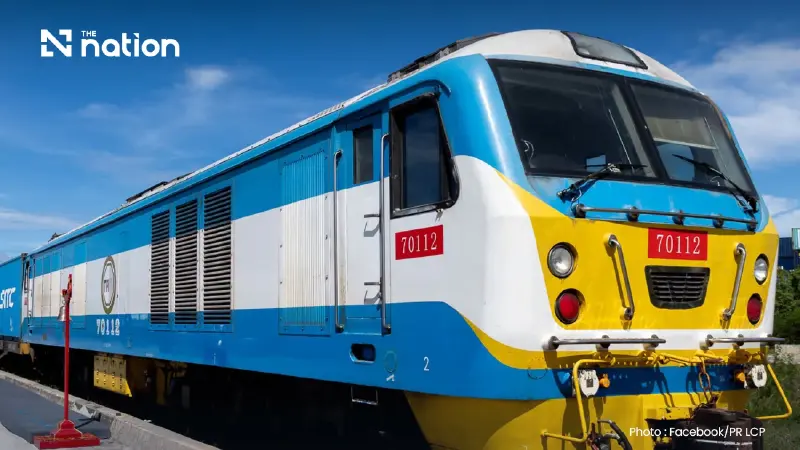


Thailand tests inaugural Laem Chabang-Nong Khai freight route under the new Railway Transport Act to cut logistics costs and establish an ASEAN hub
- Thailand has launched a trial freight train on the Laem Chabang-Nong Khai route, a key project aimed at reducing national logistics costs and establishing the country as an ASEAN transportation hub.
- The initiative is expected to cut logistics costs by approximately 10% by shifting freight from road to rail, with potential savings increasing to 20-30% with a future transition to electric locomotives.
- Operating under a new Railway Transport Act, the trial tests an "Open Access" model that allows private companies to use state rail infrastructure, aiming to lower business costs and create new revenue for the state railway.
- The rail corridor is strategically positioned to enhance cross-border trade with southern China via Laos, supporting Thailand's ambition to become a central logistics hub for the region.
Thailand tests the inaugural Laem Chabang-Nong Khai freight route under the new Railway Transport Act to cut logistics costs and establish an ASEAN hub.
The Ministry of Transport, in partnership with private sector stakeholders, has officially launched a trial freight train operation along the strategic Laem Chabang Port–Nong Khai corridor, aiming to modernise Thailand’s railway network and lower national logistics expenditures.

The inaugural trial run—presided over at Container Yard Side C (Port C), Laem Chabang Port, Sriracha District, Chonburi Province—was led by Deputy Prime Minister and Minister of Transport Phiphat Ratchakitprakarn.
The initiative represents a joint collaboration involving the Office of Transport and Traffic Policy and Planning (OTP), the Department of Rail Transport (DRT), the State Railway of Thailand (SRT), the Federation of Thai Industries, the Thai Chamber of Commerce and the Board of Trade of Thailand, along with private sector partners.

Open Access Model and Private Sector Partnership
Serving as a flagship pilot project under the newly enacted Railway Transport Act B.E. 2568 (2025), the trial marks a major step toward inviting private sector participation in state rail infrastructure.
For the inaugural round-trip test between Laem Chabang and Nong Khai, TPI Polene Public Company Limited (TPIPL) provided a locomotive to pull SRT flat waggons loaded with natural rubber supplied by Sri Trang Logistics Company Limited.
Operating at full haulage capacity, the train pulled 24 flat waggons carrying 48 TEUs (twenty-foot equivalent units).
According to SRT Governor Anan Phonimdang, the test run allows officials to collect operational data on fuel consumption, track access charges, locomotive fees, and cargo handling costs across the supply chain.
These insights will be used to review rate structures before introducing a full "Open Access" framework, enabling private firms to lease SRT tracks.
This approach aims to reduce operational cost barriers for businesses while creating new track-usage revenue streams for the SRT.

Cost Reduction and Green Logistics Strategy
Transitioning freight from road to rail forms a core pillar of the government's green logistics strategy.
Cost Efficiency: Transporting goods via existing diesel locomotives is projected to cut logistics costs by approximately 10 per cent. Transitioning to an electric locomotive network in the long term could increase overall savings to 20–30 per cent.
Modal Shift: The Ministry of Transport plans to establish rail as Thailand's primary national freight spine, using road transport primarily as a feeder network to distribute goods to regional destinations.
To address fleet limitations, the SRT currently operates approximately 120 functional locomotives out of a 200-unit fleet, with roughly 60 units exceeding 40 years of service.
Plans are underway to procure 50 to 60 replacement locomotives, with future freight capacity expansions heavily reliant on co-operations with private partners.

Regional Network Expansion and ASEAN Hub Vision
The Laem Chabang–Nong Khai corridor is positioned to strengthen cross-border trade routes into southern China via the Lao PDR.
To support long-term volume growth, the Ministry of Transport is expediting regional infrastructure developments:
North-Eastern Double-Track Rail: Complete dual-track conversion is expected by 2027.
Southern Trunk Line: Modernisation from Chumphon to Su-ngai Kolok is scheduled for completion by 2030.
Longer-term logistics plans include expanding rail connectivity southwards into Malaysia and Singapore, alongside feasibility studies for an Andaman Sea corridor connecting Thailand to the Indian Ocean.
Officials emphasise that leveraging Thailand’s central geopolitical location and low exposure to severe natural storms will solidify its position as a regional transportation and logistics hub.
