
Four controversies put Anutin government under pressure before censure debate
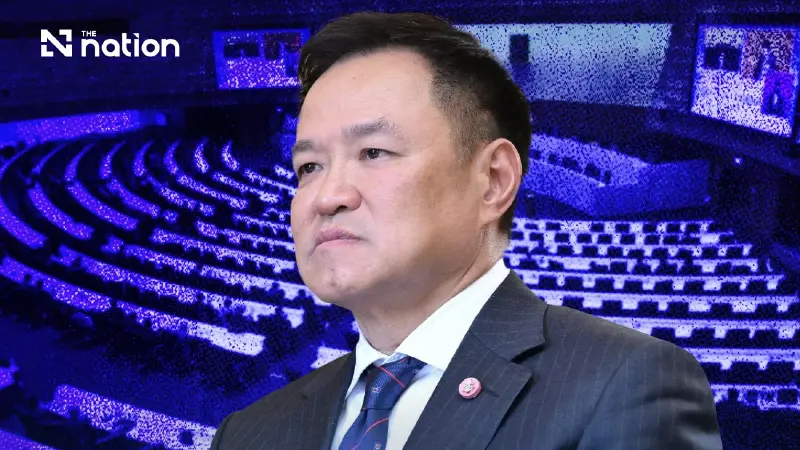


Thailand’s opposition is preparing to challenge the Anutin government over four controversies as Parliament reopens on August 25.
- The Anutin government is under pressure from the opposition over allegations of widespread collusion in the recent Senate election, with figures from the Bhumjaithai party reportedly implicated.
- Scrutiny is focused on suspected fraud in local government recruitment examinations, a controversy that directly impacts the Bhumjaithai-led Interior Ministry.
- The opposition is targeting the TH-AI Passport project, raising concerns about the winning consortium's alleged links to politically powerful figures and monopolistic business groups.
- The government's 400-billion-baht emergency borrowing decree is being questioned, with critics challenging whether the proposed spending, such as on tourism programs, meets the requirement of urgency.
Thailand’s Parliament is due to reopen on August 25, setting the stage for the first no-confidence battle facing the Anutin II government as the opposition prepares to target four controversies surrounding the Bhumjaithai-led administration.
With several politically sensitive issues placing the government under pressure, opposition parties see an opportunity to weaken public confidence in the administration. Their scrutiny is expected to focus on allegations surrounding the Senate election, suspected fraud in local government recruitment examinations, the TH-AI Passport project and the government’s 400-billion-baht emergency borrowing decree, including spending connected with the energy transition.
Parit Wacharasindhu, a People’s Party list MP and chief opposition whip, has identified the four issues as potential grounds for a no-confidence motion after Parliament reopens.
The opposition has already been holding weekly discussions outside Parliament on alleged collusion in the Senate election, laying the groundwork for scrutiny in the chamber.

Prime Minister and Interior Minister Anutin Charnvirakul has sought to play down the prospect of a censure debate, describing it as a normal part of the opposition’s responsibilities and insisting that the Cabinet does not need a group of MPs assigned to defend it.
“As long as the government does nothing wrong, there is nothing to worry about. This government has done nothing wrong,” Anutin told reporters on August 3.
Despite his confident response, the government remains surrounded by issues that could become politically damaging, particularly the investigation into alleged Senate election collusion.
Senate election case remains a major political risk
The case has drawn attention to allegations involving 138 senators and 91 political figures. Those named in the wider controversy reportedly include Anutin and Newin Chidchob, an influential figure within Bhumjaithai, as well as ministers, party leaders, MPs and members of political networks associated with the party.
Narong Klunwarin, chairman of the Election Commission, recently said only a few more meetings were required to consider the case and that a conclusion was expected in August.
However, the inquiry could take longer because of the process of examining witnesses and evidence across 64 provinces. The Election Commission may seek more time to collect additional information from provincial investigators.
Questions have also been raised over whether the case could ultimately be limited to lower-level provincial operatives and political aides, while alleged senior organisers or financiers escape legal consequences.
Although the government possesses considerable political power, public suspicion surrounding the case remains. The uncertainty gives the opposition an opening to intensify its scrutiny when Parliament resumes.
Parit has disclosed what he described as financial trails covering six provinces: Lamphun, Nong Bua Lamphu, Surat Thani, Nakhon Phanom, Amnat Charoen and Songkhla.
He claimed that the transactions were linked to political networks associated with Bhumjaithai. Most of the provinces identified are regarded as important political bases for the party.
Local government examination case shakes Interior Ministry
The suspected fraud in local government recruitment examinations is another issue threatening the government and the Interior Ministry, which is under Bhumjaithai’s supervision.
Anutin has pledged that no one will be spared if wrongdoing is established, regardless of whether those involved are politicians or permanent officials.
Deputy Interior Minister Worasit Liangprasit has taken a similar position, saying that investigators had found possible involvement by influential local political families in some areas. He said information had been forwarded to the National Anti-Corruption Commission for further investigation.

Nevertheless, the case has revived criticism over political business networks and the alleged recovery of political investment by influential provincial factions.
Worasit has come under particularly intense scrutiny because he oversees the Department of Local Administration and because individuals in his family have reportedly been linked to allegations surrounding the examination case.
The controversy may not only test the government’s ability to restore public confidence. It could also affect Worasit’s bargaining power and his prospects of retaining his Cabinet position.
Speculation about a possible reset at the Interior Ministry has intensified in recent days, raising questions over whether the case could eventually trigger a wider Cabinet reshuffle.
Opposition prepares parallel action over TH-AI Passport
The TH-AI Passport project is another issue on the opposition’s agenda.
According to the Digital Economy and Society Ministry’s schedule, registration for the project is expected to open during August and before September 1.
However, questions have been raised about TH Consortium, the joint venture that won the tender, including allegations of possible links to politically powerful figures and large business groups accused by critics of exercising monopolistic influence.
The opposition is preparing to pursue the matter through two channels.

It plans to gather names and evidence for submission to the National Anti-Corruption Commission should the project proceed with its launch. At the same time, it intends to raise the project during the anticipated no-confidence debate after Parliament reopens on August 25.
The government has not yet faced parliamentary scrutiny over the project, but the opposition’s planned action could turn it into another major political test.
Borrowing decree faces scrutiny over urgency of spending
The 400-billion-baht emergency borrowing decree is also expected to come under examination.
The Constitutional Court has ruled that the decree does not violate the Constitution. Parliament must now formally acknowledge it as part of the subsequent legislative process.
Attention has nevertheless shifted to how the borrowed funds will be used and whether all proposed spending meets the requirement of urgency.
The issue has attracted renewed criticism after the Tourism and Sports Ministry requested money from the borrowing package for the Thai Tiew Thai Plus domestic tourism programme.
Questions over whether such projects justify the use of emergency borrowing could give the opposition another line of attack against the government.
The borrowing package also covers programmes linked to the energy transition, adding to broader scrutiny over the selection, design and urgency of projects financed by the decree.
Cabinet reshuffle could change political landscape
These controversies are expected to shape political manoeuvring after Parliament reopens.
Attention will also turn to the possibility of a reshuffle of the Anutin II Cabinet. Bhumjaithai leaders have previously sought to postpone any formal assessment of ministers until they have completed one year in office.
However, both the government and the party are facing mounting pressure. Internal political tensions are causing disruption, while external pressure is growing from investigations, allegations and opposition scrutiny.
A worsening political environment could force decision-makers both inside and behind the government to reassess their plans earlier than expected.
The timing is particularly significant because it overlaps with the annual season for senior civil-service transfers, during which control over key ministries and appointments carries additional political importance.
The central question is therefore whether the opposition’s no-confidence offensive will come first, or whether the government will move ahead with a Cabinet and Interior Ministry reset in an attempt to change the political narrative.
Source: Krungthep Turakij
