
iLaw urges court action against 229 Thai Senate collusion suspects
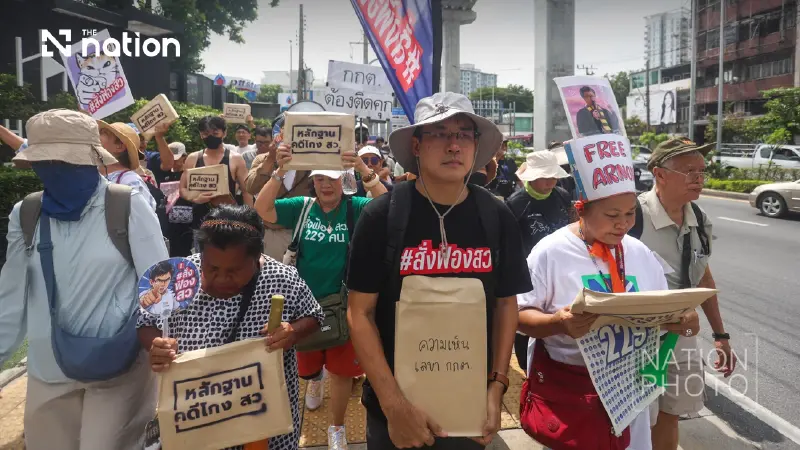


iLaw vows to release evidence if Thailand’s Election Commission declines to pursue the alleged Senate collusion case on September 14.
- iLaw organised a Bangkok march on September 13, 2026, calling for all 229 suspects in the alleged Senate election collusion case to face Supreme Court scrutiny.
- People’s Party leader Natthaphong Ruengpanyawut urged the Election Commission to act with integrity ahead of its September 14 decision, describing his participation as an exercise of constitutional rights.
- iLaw pledged to release evidence concerning anyone the commission decides not to take to court, or all its case documents if no one is referred.
- Natthaphong confirmed that opposition parties had discussed submitting a no-confidence motion against the government, but declined to disclose the details.
The Internet Dialogue for Law Reform (iLaw) marched in Bangkok on Sunday (September 13, 2026), urging the Election Commission (EC) to bring all 229 suspects in the alleged Senate election collusion case before the Supreme Court. The mobilisation came ahead of the commission’s vote on whether to pursue the case on Monday (September 14).
iLaw is a prominent Thai non-governmental human rights and legal reform organisation founded in 2009 by civil rights advocate Jon Ungpakorn. The group focuses on freedom of expression, civil and political rights, democratic reform and the rule of law in Thailand.
iLaw executive director Yingcheep Atchanont led the mobilisation alongside political figures and academics. Participants included People’s Party leader and list MP Natthaphong Ruengpanyawut, People’s Party list MP Parit Wacharasindhu and former election commissioner Somchai Srisutthiyakorn.

The 11-kilometre procession headed from iLaw’s office on Lat Phrao Soi 25 towards the Bangkok Art and Culture Centre. Participants carried documents and evidence relating to the alleged collusion case as part of a symbolic “walk, run and cycle” campaign ahead of the commission’s decision.
iLaw demands court scrutiny and questions EC independence
Yingcheep called for the complete Senate case file to reach the Supreme Court and for legal proceedings to cover all 229 suspects. He argued that an impartial body should determine the allegations, rather than leave the outcome solely to the Election Commission.

Yingcheep described Sunday as the final opportunity to demonstrate public concern before the vote. He questioned the transparency of the process and alleged connections to powerful political networks involving Bhumjaithai Party executives, MPs and several ministers.
“We are not saying who committed an offence. We have not already passed judgement. What we want is for a neutral body to receive all the documents in the case file and decide whether anyone is guilty or not,” Yingcheep said.

Yingcheep also raised concerns about the commission’s independence, arguing that four of its seven current members had been endorsed by the same Senate now under scrutiny. He described that relationship as an overlap of power that called the decision-making process into question.
“The people facing allegations chose the people who will decide whether their own case should go to court,” Yingcheep said. “The public cannot simply remain silent. If people do not speak out and the Election Commission terminates the case, there will be nothing left of this country’s system of scrutiny to ensure justice.”
Natthaphong urges EC to act with integrity

Natthaphong said he had joined the activity as a member of the public, like everyone else, and urged people to make their voices heard as loudly as possible. He argued that the case could involve the biggest fraud in Thai political history and that the public could not remain silent while no one was held accountable.
Natthaphong described his participation as an exercise of constitutionally protected rights, rather than an attempt to exert pressure. He argued that the evidence made it clear to any reasonable person that the Senate election had not been conducted honestly, and urged the Election Commission to act with integrity when reaching its decision on September 14.
Asked whether the iLaw gathering and activities by Sondhi Limthongkul could destabilise the government, Natthaphong argued that the priority was a system of checks and balances connected to the public. He also questioned whether the government had any involvement in the alleged collusion.
Natthaphong maintained that the courts, rather than the Election Commission, should make the final determination in the case. He urged people to speak out before the commission’s vote to demand that it perform its duties honestly, while offering encouragement to all commissioners in their work.
iLaw pledges disclosure if commission declines court action

Yingcheep said iLaw held a large volume of documents and evidence relating to the Senate case and would release material concerning any individual the commission decided not to take to court. If the commission declined to proceed against all 229 suspects, the group would publish all the case documents in its possession.
“This is not something we want to do. We do not want to disclose the material ourselves,” Yingcheep said. “But if the case is terminated, we will have nothing left, so we will have to make all the information public.”
Yingcheep also confirmed that he would not travel to the Election Commission’s office on Monday (September 14) and said he had no concerns about his personal safety.
iLaw’s Bangkok programme included activities at the Bangkok Art and Culture Centre at 4pm on Sunday. Parallel events were also scheduled in Chiang Mai, Phitsanulok, Phuket, Yala and Pattani as part of the final 24-hour campaign before the commission’s vote.
Natthaphong confirms opposition talks on no-confidence motion

Natthaphong also confirmed that opposition parties had already held discussions on submitting a no-confidence motion against the government. He declined to disclose the details or substance at this stage, but maintained that the information held by the opposition was substantial and robust.
