
Four scenarios as Constitutional court rules on barcode ballots on Sept 28
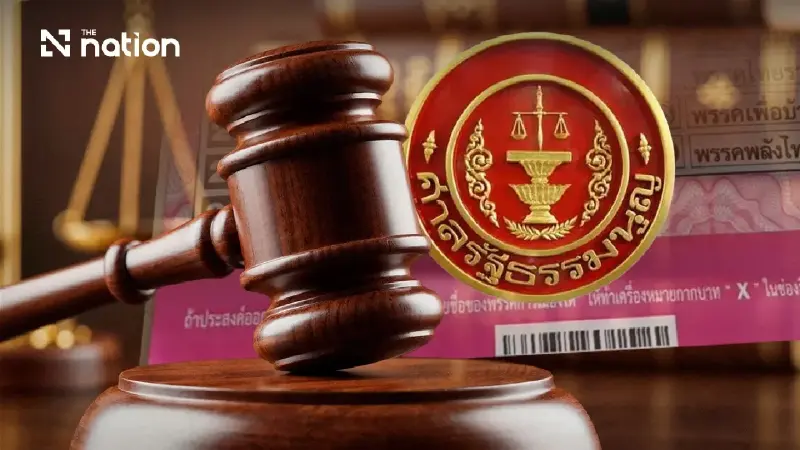


Thailand’s ballot secrecy case could affect the February 8 election, with scenarios ranging from dismissal to full or partial annulment.
- Constitutional Court will rule on September 28 whether barcodes on ballots from the February 8 election violated the constitutional requirement for secret voting.
- A media analysis outlines four potential scenarios for the ruling, which could impact the election's validity and the current government's stability.
- The possible outcomes range from a complete dismissal of the petition, which would have no political effect, to a full annulment of the election, which would require a new nationwide vote.
- Other scenarios include a partial annulment affecting only the 100 party-list MPs or a more limited ruling based on the specific type of ballot code used.
Constitutional Court is scheduled to deliver its ruling at 2pm on Monday (September 28, 2026) on whether coded ballot papers used in the February 8 general election violated the constitutional requirement for voting to remain secret.
The case could have consequences for the election’s validity and the stability of Prime Minister Anutin Charnvirakul’s government. An analysis published by Nation TV identifies four possible outcomes, from dismissal of the petition to annulment of all or part of the election.
The Constitutional Court confirmed that proceedings would go ahead despite special government holidays declared for September 28–29 because of flooding. The court’s notice sets the morning session for oral statements, deliberations and voting at 9.30am, followed by the ruling at 2pm. The court said the hearings had been scheduled well in advance.
Ballot codes at the centre of the secrecy challenge
The dispute concerns the Election Commission’s (EC) use of barcodes on party-list ballot papers and QR codes on constituency ballots in the February 8 election.
The Ombudsman referred the case to the Constitutional Court over concerns that the codes could allow ballots to be traced back to individual voters, potentially breaching the constitutional requirement for direct and secret voting.
The Constitutional Court accepted the petition by a 6–3 vote and heard key witnesses on August 26. The court has since completed its fact-finding process and closed submissions of written closing statements ahead of the September 28 ruling on ballot secrecy.
Four possible outcomes for the February 8 election
Nation TV’s analysis sets out four scenarios for the decision. These are possible outcomes identified in the report, rather than options formally announced by the court.
1. Dismissal of the petition. Under the first scenario, the court would find that ballot secrecy had been preserved. The government and parliament would consequently continue their work as normal.
2, Annulment of the entire election. Under the second scenario, the court would find the February 8 election unconstitutional and require the EC to organise a fresh nationwide vote. Nation TV’s analysis anticipates substantial legal pressure on the commission in that event.
3. Annulment of the party-list election alone. The third scenario would affect the 100 members of parliament elected through the party-list system. Nation TV’s analysis envisages their immediate loss of parliamentary status and repayment of eight months of salaries and benefits. However, the report does not establish the legal basis for those consequences or the repayment period.
Nation TV’s analysis also suggests that Anutin might be able to remain prime minister if only the party-list election were annulled. That possibility is presented as a legal scenario, rather than an established outcome.
4. Partial annulment based on ballot type. The fourth scenario envisages a more limited decision based on differences in the risk of identifying voters through each type of ballot. Nation TV’s report does not specify the precise scope of this outcome.
Opposition focuses on preparations for a no-confidence motion
Nation TV reported on September 27 that the People’s Party and other opposition leaders had refrained from commenting on the case in the immediate run-up to the decision, with little visible political mobilisation directed at the court.
Opposition parties were instead concentrating on preparations to submit a no-confidence motion against Anutin’s government, according to the report.
