
Rising Waters, Shifting Votes: How Flood Mismanagement Threatens Thailand’s Leaders
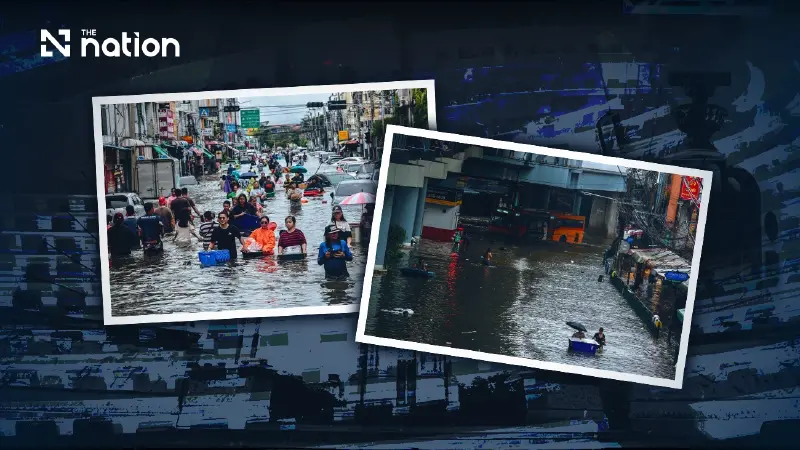


Systemic failures in managing the 2026 inundation have turned flood mitigation into a decisive political battleground for Thailand’s major parties
- Widespread public dissatisfaction with the government's mismanagement of recent severe floods has turned water mitigation into a decisive political issue threatening the ruling Bhumjaithai Party and Prime Minister Anutin Charnvirakul.
- The political fallout extends beyond the national government, damaging the reputation of local leaders like Bangkok Governor Chadchart Sittipunt and making flood prevention a critical swing issue for the upcoming election.
- To counter public anger, the incumbent government is promoting large-scale, multi-billion-baht infrastructure projects to demonstrate its competence and regain voter trust.
- Opposition parties are capitalising on the crisis by proposing their own ambitious water management solutions and providing on-the-ground relief, positioning themselves as more effective alternatives to the current leadership.
Systemic failures in managing the 2026 inundation have turned flood mitigation into a decisive political battleground for Thailand’s major parties.
The severe inundation that recently paralysed Bangkok and spread across provincial hubs has done far more than submerge infrastructure—it has laid bare the acute administrative vulnerabilities of Thailand’s governing elite.
The widespread public dissatisfaction following the government's crisis response has left a lasting political scar.
The administration led by Prime Minister and Minister of Interior Anutin Charnvirakul, along with the Bhumjaithai Party, bears the primary brunt of public frustration.
Yet, political fallout extends beyond the central government: Bangkok Governor Chadchart Sittipunt has similarly suffered damage to his reputation due to municipal drainage failures. As the waters recede, flood prevention is rapidly evolving from an administrative chore into a critical electoral swing issue.
In the forthcoming general election, voters across urban and rural constituencies alike are poised to hold political leaders strictly accountable at the ballot box.
Incumbents Bet on Infrastructure Projects
The Bhumjaithai Party faces a predicament familiar to its coalition partners: convincing an electorate weary of recurring seasonal floods that it possesses the competence to govern.
With its strategic strongholds in the Central Region—long dominated by local political dynasties—repeatedly submerged, Bhumjaithai’s electoral foundation is exposed to aggressive challenges from rival parties.
To repair its standing, Bhumjaithai is leaning heavily on promoting pre-approved, capital-intensive infrastructure megaprojects rather than introducing untested promises:
Chainat–Pa Sak–Gulf of Thailand Flood Diversion Canal: A 165-billion-baht multi-year construction project running from 2027 to 2034, approved under the second Anutin Cabinet.
Lower Eastern Chao Phraya Irrigation Overhaul: A 95-billion-baht modernisation of existing water channels. Southern Flood Mitigation: Over 700 localised projects valued collectively at 30 to 40 billion baht.
National Disaster Insurance Scheme: A state-backed safety net providing 100,000-baht disaster coverage guarantees, effective from 1 October.
Whether these multi-billion-baht commitments can restore public trust before the polls open remains an open question.
Alternative Visions Across the Political Spectrum
The broader political landscape reveals a spectrum of competing strategies as parties jockey to capture public confidence.
Pheu Thai will inevitably position water security as a flagship policy, relying on its legacy of grand visioning. Spiritual leader Thaksin Shinawatra previously advocated ambitious land reclamation projects to prevent Bangkok from sinking while repelling saltwater intrusion.
His vision includes underground drainage tunnels equipped with automated sensors to discharge stormwater rapidly.
However, Pheu Thai carries its own historical baggage: memories of the catastrophic 2011 floods under the Yingluck Shinawatra administration remain difficult to erase.
The People’s Party, led by Natthaphong Ruengpanyawut, stands as the sole major force never to have held executive office. Advocating systemic basin-wide reform, the party calls for equitable compensation for retention field communities outside flood barriers.
By deploying MPs to provide immediate ground-level relief during the peak of the floods, the party created a deliberate contrast with the government's handling.
While opponents criticise the party’s Bangkok MPs for municipal flooding, executive authority remains tied to the governorship—a key office the People’s Party may look to target next.
The Kla Tham Party, led by Captain Thamanat Prompow, relies on its established oversight of the Royal Irrigation Department under the Ministry of Agriculture and Cooperatives.
Its platform focuses on expanding water retention infrastructure across micro-, medium-, and large scales to intercept headwater runoff before it impacts urban centres.
The Democrat Party proposes a tech-driven approach, including digital water mapping, early warning systems, urban zoning adjustments, and expanded natural retention basins.
However, its historical tenure over the Bangkok governorship without permanently resolving city drainage remains a persistent vulnerability in the capital.
The New Flagship Platform
Water management in Thailand is no longer merely a technical or engineering concern; it is a primary determinant of political survival. Moving forward, every major party will be forced to present comprehensive, convincing water strategies to an increasingly demanding electorate.
In a nation where seasonal floods regularly disrupt millions of lives, the political force that offers a credible, permanent solution to the water crisis will hold a decisive advantage at the polls.
Source: Krungthep Turakij
