
Kasikornbank finds no account matching 2023 Anutin 7m-baht slip
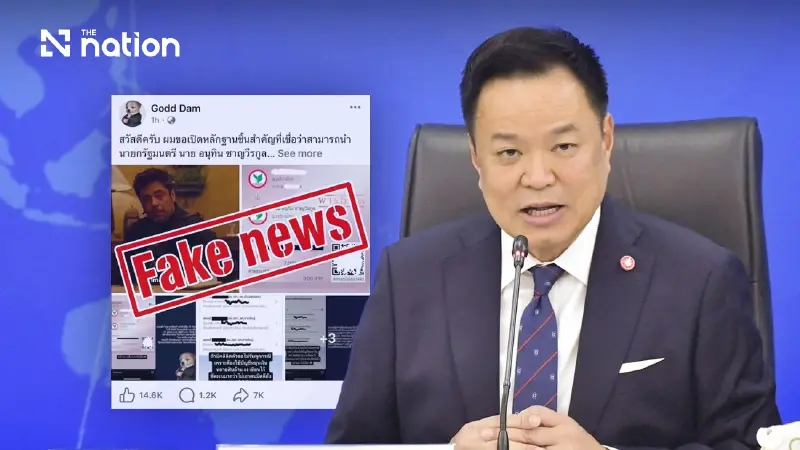


Kasikornbank found no matching recipient account number on a 7-million-baht slip naming Anutin and stated a 5-million-baht daily K PLUS limit.
- Kasikornbank stated it could not find the recipient account number shown on the purported 7-million-baht transfer slip in its system.
- The bank also clarified that its K PLUS mobile banking app has a daily transfer limit of 5 million baht, making the alleged 7-million-baht transaction questionable.
- The transfer slip in question circulated online, allegedly showing a bribe payment made to Prime Minister Anutin Charnvirakul in 2023.
- A government spokesman has labeled the allegation as "fake news," citing the bank's transfer limits as a key reason for the denial.
Kasikornbank reported on Monday (October 26) that it could not find the recipient account number shown on a purported 7-million-baht transfer slip naming Thai Prime Minister and Interior Minister Anutin Charnvirakul in its system.
In a clarification issued Monday morning, the bank also stated that transfers through its K PLUS mobile banking app were limited to 5 million baht per day.
The statement followed the circulation of an image allegedly showing a payment of “tea money”, a euphemism for a bribe, to Anutin in 2023, when he was serving as deputy prime minister and interior minister. The image prompted online criticism and questions about the alleged transaction.

Government spokesman Ekkapob Pianpises rejected the allegation as “fake news” and warned of legal action against those spreading what he described as false information.
Government spokesman sets out three grounds for denial
Ekkapob argued that no politician would accept millions of baht from an unexplained source, given the scrutiny surrounding their finances. He maintained that accepting money or benefits worth more than 3,000 baht could expose politicians to misconduct allegations.
His second argument concerned the transfer slip and banking procedures. He noted that images of slips could be altered or fabricated and claimed that Wisdom banking customers were normally limited to transfers of 5 million baht per transaction.
According to Ekkapob, larger transfers would require a request to increase the limit. He argued that anyone making an improper payment would be unlikely to follow that procedure because it would leave records with the bank.
His third argument was that Anutin was already wealthy and had no need to accept such a payment.
Online transfer test highlights own-account distinction
The controversy also prompted online testing of transfer limits. Social media personality Dr Khongkwan Fujitnirun shared images and described an attempt to transfer 7 million baht, highlighting the distinction between moving money between her own accounts and paying another person.

In a Facebook post reproduced by Thai media, Khongkwan reported that she could transfer 7 million baht between separate accounts in her own name. However, when she attempted to send money to someone else’s account, the app displayed a maximum of 5 million baht per transaction.
Khongkwan’s account described the transactions she tested. Kasikornbank’s separate clarification referred to a daily limit and did not explain how transfers between accounts belonging to the same customer were treated.
Digital ministry traces alleged disinformation network
The Ministry of Digital Economy and Society was tracing the accounts and networks responsible for circulating the allegation, according to Ekkapob.
The spokesman maintained that the investigation would pursue operators whether they were in Thailand, based overseas or using a virtual private network to appear to be outside the country.
In his personal Facebook post, Ekkapob alleged that anonymous accounts were publishing fabricated or distorted claims, with organised networks and automated bots used to increase their visibility.
He accused politicians and networks associated with an unnamed political party of helping to amplify the posts. According to his account, the original material was deleted once it had attracted sufficient engagement, leaving those who shared it exposed to possible legal action.
Ekkapob also alleged that the page had repeatedly published false information, deleted posts and closed before reopening. He questioned how it could return under the same name when other removed pages had to adopt successive versions of their names.
He further accused the unnamed party of encouraging followers to repeat its leaders’ views without critically assessing political information, then exploiting that behaviour to spread allegations.
Politicians warned of criminal and ethics proceedings
Ekkapob warned that politicians who circulated what he described as distorted information could face criminal proceedings or ethics complaints.
He suggested that politicians sharing the post had either failed to verify an attention-grabbing allegation or were participating in a coordinated effort to increase its reach.
The spokesman argued that politicians had a greater responsibility than ordinary social media users to check information before sharing it. He maintained that the investigation would pursue both the original publishers and those involved in distributing the material.
Ekkapob called for higher standards of political conduct and greater attention to the interests of the country and the public.
Although the present allegation concerned an individual’s financial affairs, he warned of potentially wider consequences if similar networks spread misleading information about national security or the country’s principal institutions and received support from politicians.
