
Satit questions Anutin’s patriotism over response to November 28 Ranong border incident
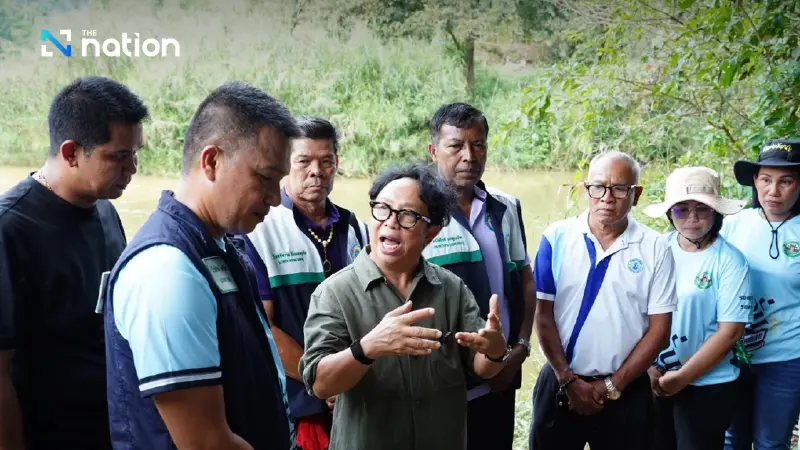


Satit says the Ranong visit followed residents’ concerns about arsenic, while Anutin says advance notice could ease tensions on the Myanmar border.
- Democrat Party deputy leader Satit Wongnongtoey questioned Prime Minister Anutin Charnvirakul's patriotism following a border incident in Ranong.
- The criticism arose after Myanmar soldiers appeared to cock their rifles at Satit's delegation, an act he described as intimidation of Thais on their own soil.
- Satit was angered that Anutin's response focused on Myanmar's potential suspicions and the unannounced nature of the visit, rather than the safety of Thai citizens.
- Anutin defended his position by stating the Myanmar soldiers were on their own territory and that diplomatic channels should have been used for the opposition MPs' visit.
Democrat Party deputy leader Satit Wongnongtoey urged Prime Minister Anutin Charnvirakul on November 29 to stand up for Thai border residents after Myanmar soldiers appeared to cock their rifles across the water from his delegation in Ranong. Satit questioned Anutin’s patriotism, saying the prime minister had spoken about possible suspicions on the Myanmar side without asking how villagers on the Thai bank were faring.
Anutin, who is also interior minister, said on November 28 that he did not know how the visit had been arranged. He said an unannounced visit could be seen in Myanmar as politically motivated and that advance notice from opposition MPs would allow the government to alert Myanmar through diplomatic channels. The soldiers, he added, were on Myanmar territory.
Satit challenges Anutin over the right to speak on Thai soil
Satit, a party-list MP and member of the House Committee on Land, Natural Resources and Environment, rejected the suggestion of a political motive. He said the committee had gone to Ban Hat Tun and the Khlong Kra Nai border waterway in Pak Chan subdistrict on November 28 because residents had complained about the increasingly murky Kraburi River. They suspected upstream mining in Myanmar and feared contamination similar to that reported in northern Thailand.

Satit was speaking to journalists on the Thai bank when armed Myanmar soldiers appeared on a bridge opposite the group. It was reported that the soldiers carried AK-47 rifles and a rocket-propelled grenade launcher. Thai soldiers asked the visitors to leave for their safety, and the group left immediately, according to a news agency, whose journalists were at the scene.
On November 28, Satit said he was unsure what signal the soldiers intended to send. Speaking the following day, he described their actions as intimidation. He said they had pulled back the bolts on their rifles while facing the Thai group. A subdistrict authority chief, provincial councillors, civic representatives and troops from a Ranong military camp were among those present. Everyone in the delegation had stayed on Thai soil and nobody had made a threatening gesture, Satit said.

“Do we Thais have no right to stand and speak on Thai soil?” Satit asked. He said Anutin’s emphasis on Myanmar’s sovereignty offered little reassurance to families living along the canal, with armed soldiers on the opposite bank. “Does that mean soldiers on the other side can intimidate people on the Thai bank whenever they like?”
Satit said he was deeply saddened that Anutin had not asked how people in Kra Buri were coping or why they wanted officials to repeat the arsenic tests. He believed residents would share his disappointment and said they had reason to wonder why negotiations with Myanmar had yet to resolve problems affecting them. “Where is your patriotism?” Satit asked the prime minister.
Ranong residents seek laboratory tests after arsenic reading
At Ban Hat Tun, residents trained by Chiang Mai University researchers used a field kit to test a Kraburi River water sample on November 28. It indicated an arsenic concentration of 0.025 milligrams per litre, 2.5 times the cited Thai standard of 0.01 mg/L. The head of the Pak Chan local authority said he would ask the Pollution Control Department to repeat the test and seek laboratory confirmation.

Satit said Chiang Mai University researchers had also obtained readings above the standard. In September, the regional pollution office reported that its earlier tests of river water, sediment and village tap water had found heavy metals within the applicable limits. Residents also voiced concern about arsenic in sediment. The source of the arsenic indicated by the November 28 field test remains unconfirmed.
Residents told Satit that the water appeared clearer than usual during the inspection and that they had seen the same pattern on previous official visits. Satit called for repeat testing of water, sediment and aquatic animals, alongside real-time monitoring. He urged Anutin to visit Ranong, his wife’s home province, and speak to the communities concerned. “Don’t just come for a cup of coffee and then leave,” he said.
Satit to take Kraburi River complaints to the House on December 3
Satit said communities along the Kraburi had raised concerns since 2019, before pollution in the Kok, Sai and Ruak rivers in Chiang Rai drew national attention. He said Deputy Prime Minister Yodchanan Wongsawat had acknowledged in the House that the Kraburi was outside the scope of the current talks with Myanmar. The two countries have agreed in principle to monitor 12 sites on the Kok and Sai rivers.
Satit called on the government to:
- Add the Kraburi River to pollution talks with Myanmar.
- Control exports of chemicals supplied from Thailand for mining.
- Tighten customs checks on mineral imports and scrutinise the Thai businesses involved.
- Fund upgrades to local water filtration systems, which Satit said needed more alum and daily cleaning.
- Secure alternative water sources for nearby communities.
Fellow Democrat deputy leader Chaichana Detdecho, party spokesperson Pongsakorn Kwanmuang and deputy spokesperson Duangrutai Buakaew also joined the visit. The delegation met residents and the heads of the Pak Chan and Mamu subdistrict administrative organisations. Chaichana said the opposition party would work with local MPs and urged residents to support the community leaders pursuing the case.
Satit said he would present the residents’ evidence through an environmental motion in the House of Representatives on Thursday, December 3, pursue the matter through the House committee and submit formal proposals to the government.
