
Malaysia EV rules prompt Chinese carmakers to adjust market plans
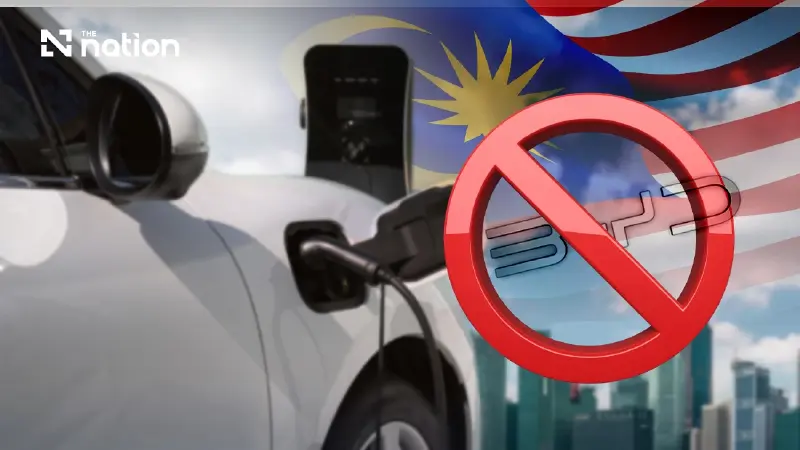


New CBU criteria are expected to limit cheaper imported EVs in Malaysia, putting pressure on BYD and other Chinese carmakers to localise assembly.
- Malaysia has introduced new rules for imported electric vehicles (EVs), requiring a minimum value of 200,000 ringgit and 180 kW motor output, making many affordable Chinese models ineligible.
- The regulations directly impact Chinese carmakers like BYD, Chery, and Zeekr, whose popular, lower-priced models no longer meet the import criteria, forcing them to alter their market strategies.
- An alternative path of setting up local assembly plants is complicated by new investment conditions, including a rule that 80% of production must be exported, which has stalled BYD's factory plans.
- In response, some brands like Leapmotor and Xpeng are adjusting by partnering with existing local manufacturers for assembly, which allows them to bypass the strict export requirements for new projects.
Malaysia has begun enforcing new measures to control imports of completely built-up (CBU) electric vehicles (EVs) since July 1, forcing Chinese EV makers such as BYD and several other Chinese brands to adjust their market strategies after many popular models became ineligible for import under the new criteria.
The Ministry of Investment, Trade and Industry (MITI) requires CBU EVs imported for sale in the country to have a CIF (cost, insurance and freight) value of at least 200,000 ringgit (around THB1.64 million) and motor output of no less than 180 kilowatts, or around 241 horsepower.
Once taxes, operating costs and distributors’ margins are included, the actual retail prices of vehicles meeting the criteria are likely to be far above 200,000 ringgit, leaving the entry-level and mid-range EV market almost entirely excluded from imports.
The measure directly affects Chinese carmakers, as many brands compete through more affordable vehicles.
Data from the Road Transport Department Malaysia (JPJ) showed that in 2025, new-energy vehicles from Chinese manufacturers, excluding Proton, in which Geely holds a stake, accounted for around 60% of Malaysia’s total new-energy vehicle market.
BYD, the best-performing foreign brand in Malaysia, currently has seven models on sale, all with starting prices below 200,000 ringgit.
Some models, including the entry-level variants of the Dolphin and Atto 3, also have motor output below the government’s minimum requirement, meaning new batches can no longer be imported.
EVs from other Chinese manufacturers, such as the Zeekr 7X and Chery Omoda E5, have been affected in the same way.
Although several manufacturers have tried to avoid the restrictions by setting up vehicle assembly plants in Malaysia, the government has also introduced new conditions for investment projects approved after Monday (September 1, 2025).
Vehicles must be priced at no less than 100,000 ringgit (around THB820,000), and at least 80% of production capacity must be exported, while domestic sales must not exceed 20%.
Body welding, painting and final assembly must also be carried out in the country.
The report said the conditions had stalled BYD’s completely knocked-down (CKD) assembly plant project in Tanjung Malim, Perak, as analysts believed exporting 80% of output would be difficult because the company already has major production bases in Thailand, Indonesia and China.
However, some manufacturers have chosen a different approach by using existing factories in Malaysia rather than investing in new projects.
Leapmotor has started assembling the C10 through Stellantis’ plant in Kedah, while Xpeng has begun producing the right-hand-drive G6 with local manufacturer EP Manufacturing Berhad (EPMB).
Because these projects use existing factory capacity, they are not subject to the requirement to export 80% of production capacity.
Analysts said the impact of the new measure would not be immediate because vehicles imported before July 1 can still be sold under the previous rules until inventories run out.
Stocks held by several brands are expected to be sufficient until around October or November this year.
However, over the next three to six months, consumers may begin to see fewer affordable imported EV options if manufacturers are unable to shift to domestic assembly in time.
The Malaysian government said the measure was intended to upgrade the country’s automotive industry, attract quality investment, encourage technology transfer and develop domestic supply chains, using the same approach that helped local carmakers such as Proton and Perodua grow over the past decades.
