
China’s new energy vehicles drive Belt and Road export surge
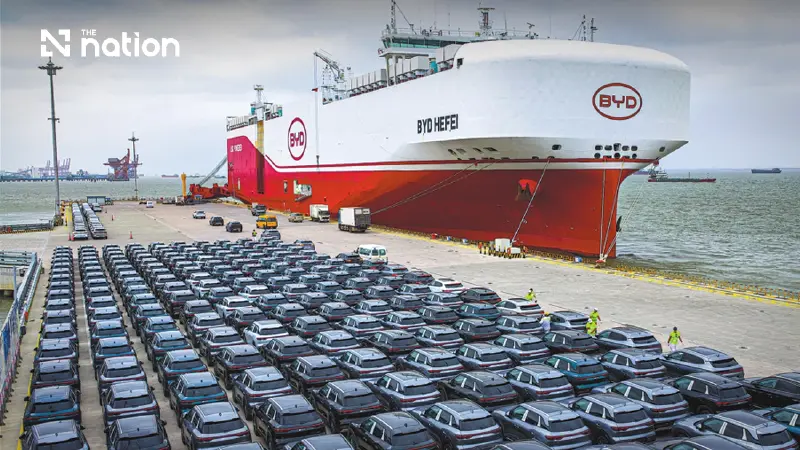


China exported 5.31 million vehicles in the first six months of 2026, while new energy models made up 50.4 per cent of June’s vehicle exports.
- China's New Energy Vehicle (NEV) exports were the primary driver of its overall vehicle export surge, more than doubling with a 120% increase to 2.355 million units in the first half of 2026.
- Countries participating in the Belt and Road Initiative (BRI) were a key market, receiving 1.135 million NEVs from China in the same period, a year-on-year increase of 59.4%.
- The value of vehicles and automotive parts shipped to BRI markets rose to $83.67 billion, accounting for 57.5% of China's total exports in those categories.
China’s vehicle exports rose 53 per cent year on year to 5.31 million units in the first six months of 2026, with new energy vehicles (NEVs) providing much of the momentum.
June shipments alone exceeded one million units, reaching 1.037 million.
NEV exports more than doubled over the six months, increasing 120 per cent to 2.355 million vehicles.
In June, China shipped 523,000 NEVs abroad, up 160 per cent from a year earlier and equal to 50.4 per cent of all vehicle exports that month, roughly one in every two.
Markets participating in the Belt and Road Initiative (BRI) played a major role in the expansion.
Data attributed to the General Administration of Customs and the China Association of Automobile Manufacturers showed that China sent 1.135 million NEVs to BRI partner countries from January to June, a 59.4 per cent increase from a year earlier.
Exports of finished vehicles to these countries rose 48.1 per cent to 3.381 million units.
The value of vehicles and automotive parts shipped to the same markets reached $83.67 billion, up 30.8 per cent, and accounted for 57.5 per cent of China’s exports in those categories.
Trade between China and BRI partners also increased.
Total imports and exports reached 12.97 trillion yuan ($1.92 trillion), 14.8 per cent more than a year earlier and equal to 50.9 per cent of the country’s foreign trade.
The half-year results followed strong growth in 2025, when China exported 7.098 million vehicles, up 21.1 per cent.
The country retained its position as the world’s largest vehicle exporter for a third consecutive year.
Tesla is among the global manufacturers drawing on China’s automotive ecosystem.
Grace Tao, vice-president of Tesla, described China as one of the company’s most important markets, with operations spanning sales, manufacturing, research and development, supply chains, charging networks and energy-related businesses.
“The Shanghai Gigafactory is a crucial base in Tesla's global manufacturing and export system, and the Shanghai Megafactory has further extended our layout from vehicles to energy products,” Tao said.
She likened vehicle manufacturing to a relay race that depended on strong teamwork.
More than 95 per cent of components used at Tesla’s Shanghai facility are now sourced locally, while the company works with more than 400 Chinese tier-one suppliers; over 60 have entered its global supply chain.
Tao said China’s strength stemmed not only from its scale but also from its fast pace of change, close collaboration and ability to put innovations into practice quickly.
She pointed to the Model Y L’s global debut in China as evidence of the increasingly important roles played by the local team and supply chain.
Tao described the Chinese market as a “must-have” for the company, citing its resilient supply chain and continuing innovative momentum, which she said made a “second China” difficult to find.
Source: China Daily
