
China warns of heavy rain as Narra approaches southern coast
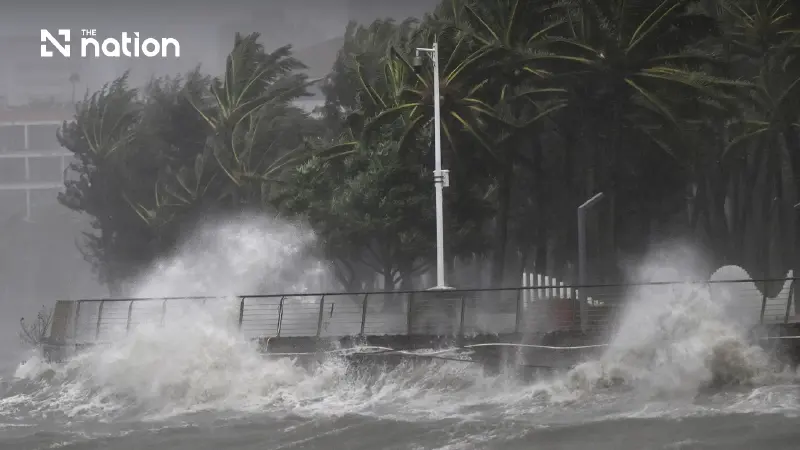


China has issued a blue alert for Tropical Storm Narra, with strong winds and severe rainfall forecast across Guangdong, Guangxi and nearby regions
- China has issued a blue typhoon alert, its lowest level, for Tropical Storm Narra as it approaches the country's southern coast.
- The storm is forecast to bring strong winds and heavy rainstorms to several southern coastal provinces, including Guangdong, Guangxi, and Hainan.
- Narra is expected to strengthen over the Beibu Gulf before moving slowly northeast towards the coast from Sunday night, with some locations warned of possible "extremely heavy downpours."
China has issued a blue typhoon alert as Tropical Storm Narra threatens strong winds and heavy rainfall across southern coastal provinces.
The system, identified by the Thai Meteorological Department as Narra, is the 19th numbered typhoon under China’s classification system in 2026.
China’s National Meteorological Centre issued the alert after a tropical depression over the Beibu Gulf strengthened on Friday afternoon (August 21, 2026), according to a Xinhua report.
Storm expected to remain almost stationary
The storm’s centre was forecast to remain almost stationary over the Beibu Gulf from Friday night until daytime on Sunday (August 23).

Forecasters expected the system to strengthen gradually and potentially reach severe tropical-storm intensity during that period.
From Sunday night, Narra was expected to begin moving slowly northeastwards at between 5 and 10 kilometres per hour.
It was forecast to weaken gradually while approaching the coastline between the western Leizhou Peninsula in Guangdong province and the southern coast of the Guangxi Zhuang Autonomous Region.
Strong winds forecast across southern waters
Strong winds were forecast across the Beibu Gulf, much of the South China Sea, the Bashi Channel and waters east of Taiwan between 8pm on Friday and 8pm on Saturday, Beijing time.
Coastal areas of Guangxi, Guangdong and Hainan Island were also expected to experience strong winds during the same period.
Chinese authorities urged coastal communities and operators to strengthen safety management for vessels, marine tourism, aquaculture and navigation in the South China Sea.
Extreme rainfall possible in some areas
Rainstorms were forecast across parts of Hainan, Guangxi, Guangdong, Fujian, Zhejiang and Taiwan, with extremely heavy downpours possible in some locations.
Meteorological specialists advised Hainan, Guangxi and Taiwan to remain alert to compounded disasters caused by heavy and accumulated rainfall.
China has already faced disruptive typhoon conditions this month, including Typhoon Dolphin, which brought torrential rain and major transport disruption to the country’s eastern coast.
Blue alert is lowest level of four-tier system
China’s weather-warning system has four colour-coded levels.
Red represents the most severe warning, followed by orange, yellow and blue. Although blue is the lowest level, authorities can still introduce preventive measures in areas exposed to strong winds, heavy rain, flooding and other storm-related hazards.
