
Asia adds gold to reserves without abandoning the dollar



Asian central banks are adding gold and diversifying reserves, but dollar use in trade remains strong, a Haver Analytics report finds.
Asian central banks are increasing their gold holdings, but the changes suggest diversification rather than a wholesale retreat from the US dollar, according to a Haver Analytics analysis reported by Krungthep Turakij.
The analysis is by economist Tian Yong Woon, who previously worked at Deutsche Bank and the International Monetary Fund (IMF). It examines securities holdings, reserve allocations and trade payments.

Thailand among countries increasing gold holdings
Over eight years, Singapore increased its gold holdings by more than 60%, while Thailand and India each added more than 50%. China’s holdings rose nearly 30%.
Japan, Indonesia and Malaysia recorded smaller increases. Among the countries examined, the Philippines was the exception, reducing its holdings by about one-third through two major rounds of sales. These figures measure changes in physical quantities rather than monetary value.
Woon said diversification could explain the accumulation, but growing overall reserves might also require proportionately larger gold holdings.

Japan and China lose share of US securities
Japan’s share of foreign holdings of long-term US securities fell from nearly 14.5% in 2012 to about 8% in July 2026. Mainland China’s declined from 13.4% in early 2012 to roughly 3%.
Meanwhile, the eurozone’s share increased from around 19% to 26%, while Britain’s reached a record 10.6%.
Japan nevertheless remained the largest foreign holder of US Treasury securities at US$1.1 trillion. China held US$618 billion, its lowest since September 2008. Japan also accounted for about 8.6% of US investors’ holdings of foreign securities.
Woon cautioned that changes in the composition of foreign creditors did not necessarily mean investors were abandoning dollar assets.
Reserve diversification has no single beneficiary
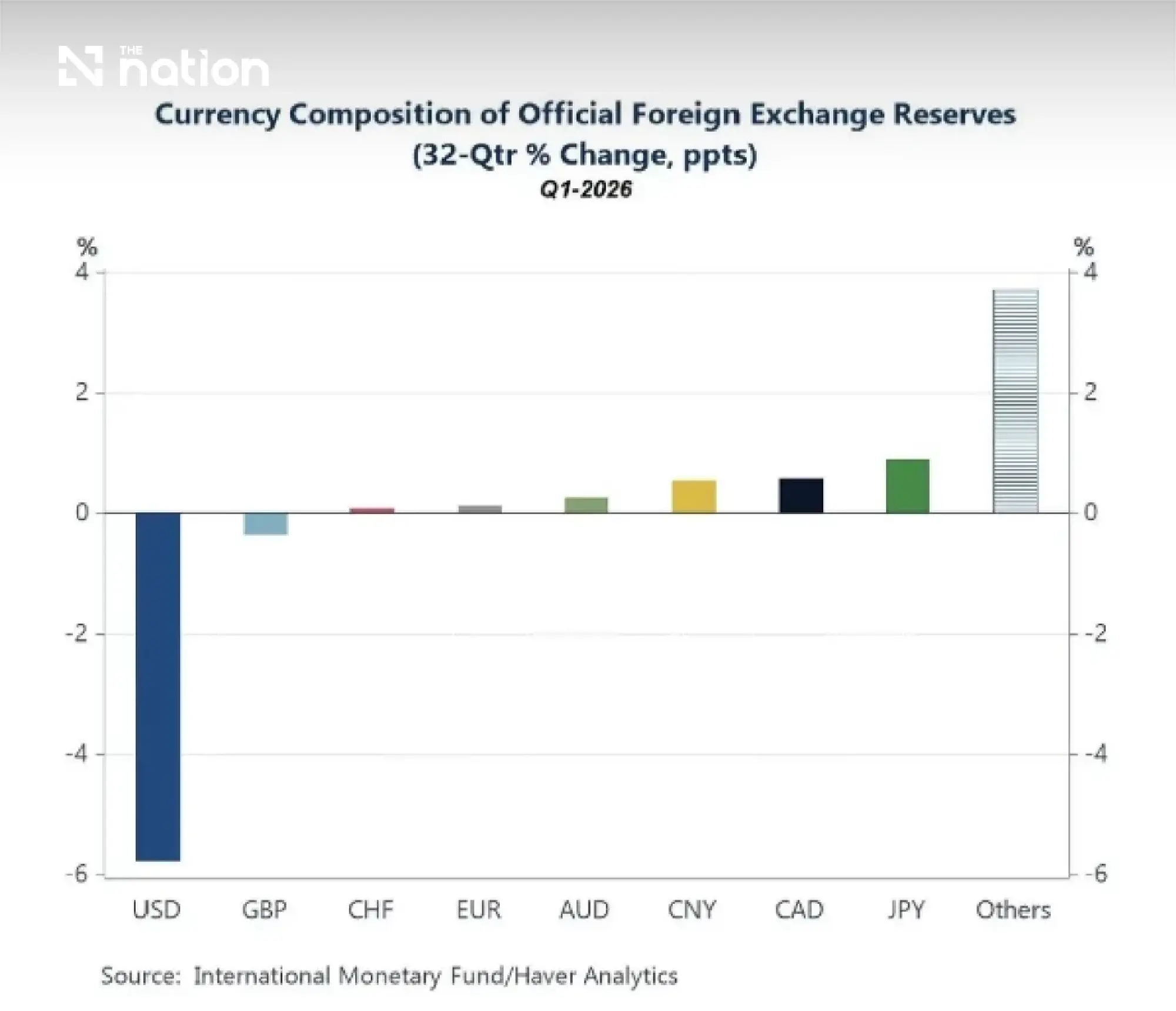
IMF data put the dollar’s share of global foreign exchange reserves at approximately 57.1% in the first quarter of 2026. These are worldwide figures, not an Asia-only measure, and exclude monetary gold.
Haver’s eight-year comparison showed a decline of nearly six percentage points. The yen gained less than one percentage point, the Canadian dollar and yuan gained roughly half a point each, and the euro changed little.
The “other currencies” category gained about 3.7 percentage points, while the yuan’s share stood at around 2%, indicating diversification across currencies rather than a single replacement for the dollar.

Dollar remains central to trade payments
South Korea still settled approximately 84% of exports and 79% of imports in dollars. The export share barely changed over a decade, while the import share eased from roughly 83% in 2022.
Woon said trade payments, dollar financing and hedging practices changed more slowly than reserve holdings. He cited broader research, including IMF studies, as supporting the view that diversification had not displaced the dollar’s central role in trade.
Source: Krungthep Turakij
