
Day and night nearly equal at the September 23 equinox



The September 23 equinox marks autumn in the Northern Hemisphere, with nearly equal day and night, while Thailand remains in its rainy season.
Day and night will be nearly equal in length on Wednesday (September 23, 2026), marking the autumnal equinox and the start of astronomical autumn in the Northern Hemisphere, the National Astronomical Research Institute of Thailand (NARIT) said.
At the equinox, the sun passes directly over the Earth’s equator, rising due east and setting due west, with daylight and darkness each lasting approximately 12 hours.
The event marks the beginning of autumn in regions including Europe, North America, northern Africa and parts of Asia. Meanwhile, the Southern Hemisphere enters spring, including Australia, New Zealand, southern Africa, parts of South America and islands in the South Pacific.
In Bangkok, sunrise is expected at approximately 6.07am and sunset at 6.13pm, according to NARIT. Thailand will remain in its rainy season, as the country’s seasons are determined primarily by weather patterns rather than astronomical events.
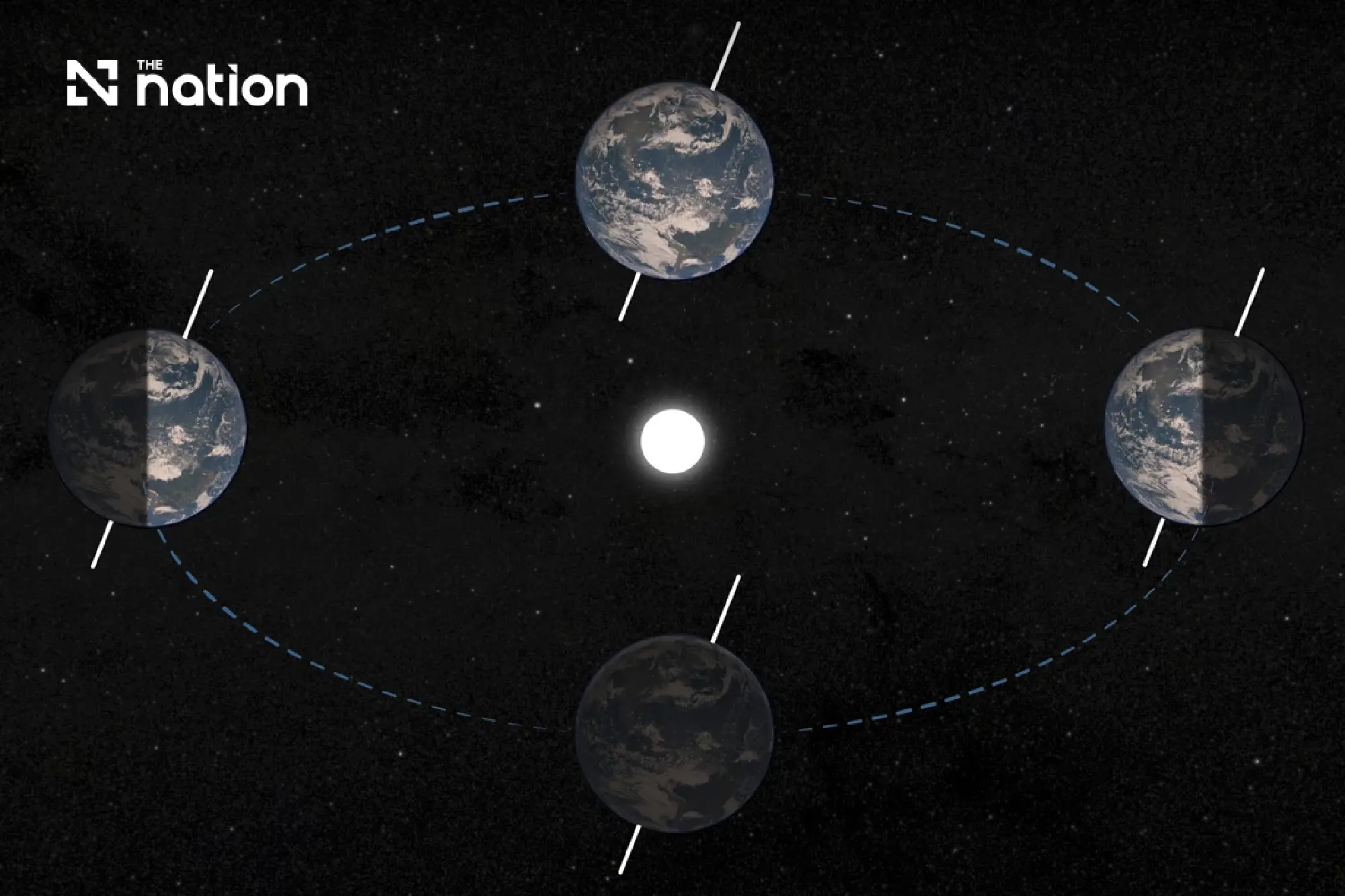

Why day and night are not exactly equal
Although the equinox is commonly associated with equal periods of daylight and darkness, the interval between sunrise and sunset can still exceed 12 hours.
NARIT explained that sunrise and sunset are measured using the sun’s upper edge rather than its centre. Sunrise occurs when the upper edge first appears above the horizon, while sunset occurs when that edge disappears below it. This means the sun remains visible for slightly longer than 12 hours in many locations, even at the equinox.
Atmospheric refraction, which bends sunlight, also affects when the sun becomes visible and disappears. If calculations instead use the sun’s centre and exclude this atmospheric effect, daylight and darkness are approximately equal at around 12 hours each.
Shorter days ahead for Thailand
After the autumnal equinox, the sun will rise and set progressively further south along the horizon. In Thailand, daylight hours will gradually shorten and nights will lengthen until the winter solstice on December 22, 2026, in Thailand time.
The December solstice marks the longest night of the year and the beginning of astronomical winter in the Northern Hemisphere. In the Southern Hemisphere, it marks the longest day and the start of astronomical summer.
