
Taiwan defends peace and freedom as Beijing condemns Lai's speech
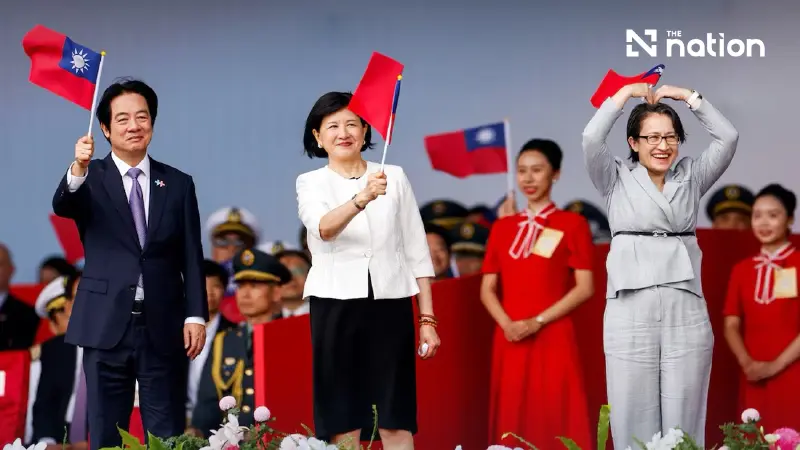


President Lai Ching-te says Taiwan wants peace but will not give up its freedom and calls for respect for its people's right to exist, as Beijing condemns his National Day speech.
- Taiwan's President, Lai Ching-te, stated in a National Day speech that the island cherishes peace but will not sacrifice its freedom or accept subordination.
- He explained that strengthening Taiwan's defences is intended to deter war and enable dialogue from a position of dignity, not to provoke China.
- Beijing swiftly condemned the speech, accusing President Lai of distorting the truth, promoting Taiwanese independence, and exaggerating the military threat from the mainland.
Taiwan cherishes peace but will not give up its freedom, President Lai Ching-te declared in his National Day speech on Saturday (October 10), calling for respect for the right of its people to exist and stressing that stronger defences are intended to deter war, not provoke China.
Beijing swiftly condemned the address, claiming that it "distorts the truth" and reveals "ulterior motives" and accusing Lai of continuing to promote Taiwanese independence.
Speaking outside the Presidential Office in Taipei, Lai argued that peace could not depend on wishes alone as Taiwan faced increasing military and political pressure from China.
"Taiwan cherishes peace, but we will not give up our freedom. We are open to exchanges, but will not accept subordination," he declared.

Lai also insisted that the right of Taiwan's people to exist must be respected.
He argued that Taiwan's resolve in the face of what he described as "authoritarian expansion" was about more than the island's survival. It also raised the question of whether international rules could withstand the use of force and whether powerful countries could deny people the right to determine their future.
China claims the democratically governed island as part of its territory, a position rejected by the government in Taipei.
Taiwan has responded to Beijing's increasing military pressure by raising defence spending and modernising its armed forces. It nevertheless faces China's much larger military, which is acquiring advanced stealth fighter jets, aircraft carriers and a vast array of missiles.
Lai insists stronger defences are not a provocation
Lai emphasised that increased defence spending was intended to deter war rather than escalate tensions with Beijing.
He explained that strengthening the island's ability to defend itself did not mean abandoning opportunities for dialogue. Instead, improved defence capabilities would allow Taiwan to pursue talks on the basis of "parity and dignity".
The president also did not repeat his customary wording that neither side of the Taiwan Strait was subordinate to the other, although he reiterated that Taiwan would not accept subordination.
Drawing on Jesus' Sermon on the Mount, Lai urged Taiwan to become a "city upon a hill", built with courage and confidence.

Beijing accuses Lai of distorting the truth
China's Taiwan Affairs Office rejected Lai's speech, accusing him of disregarding facts, misleading the public and exaggerating the military threat from mainland China.
The office also claimed that Lai remained committed to separatist thinking associated with Taiwanese independence.
Reaffirming Beijing's longstanding position, it maintained that there was only one China and that Taiwan was part of it, describing this as the "true status quo" in the Taiwan Strait.
Chinese state broadcaster China Central Television (CCTV) reported an office spokesperson as saying that Taiwan's future could and must be decided jointly by all Chinese people, including those in Taiwan.
Beijing has repeatedly labelled Lai a separatist and rejected his offers of talks. China has also never ruled out using force to bring Taiwan under its control.
The United States, meanwhile, welcomed Lai's commitment to maintaining peace and stability across the Taiwan Strait.
A senior US administration official added, in an apparent reference to Beijing, that "a routine speech is no justification for aggressive or coercive actions".
Washington remains Taiwan's most important international supporter despite the absence of formal diplomatic relations between the two sides.

US arms package awaits approval
China staged military exercises around Taiwan shortly after Lai delivered his first National Day speech as president in 2024, but did not mount a comparable round of drills around the time of his 2025 address.
Beijing's most recent military exercises near Taiwan took place in late December 2025, following news of a record US$11 billion American arms deal for Taipei.
A second proposed arms package, worth US$14 billion, has yet to be approved by US President Donald Trump.
Despite the continuing tensions, Lai welcomed efforts by Washington and Beijing to manage their strategic rivalry through dialogue and reduce the risk of military confrontation.
A Taiwanese official told reporters that these remarks directly addressed the US-China summit held in Washington the previous month.
Lai also called on democratic countries in the Indo-Pacific to work together to preserve the region's existing peace and stability.
Taiwan celebrates National Day on October 10 to commemorate the 1911 uprising that ended China's last imperial dynasty and led to the establishment of the Republic of China.
The Republican government fled to Taiwan in 1949 after losing the Chinese civil war to Mao Zedong's communist forces. The Republic of China remains Taiwan's official name.
Source: Reuters
