
Japan's Chiba faces months of recovery after Typhoon Dujuan
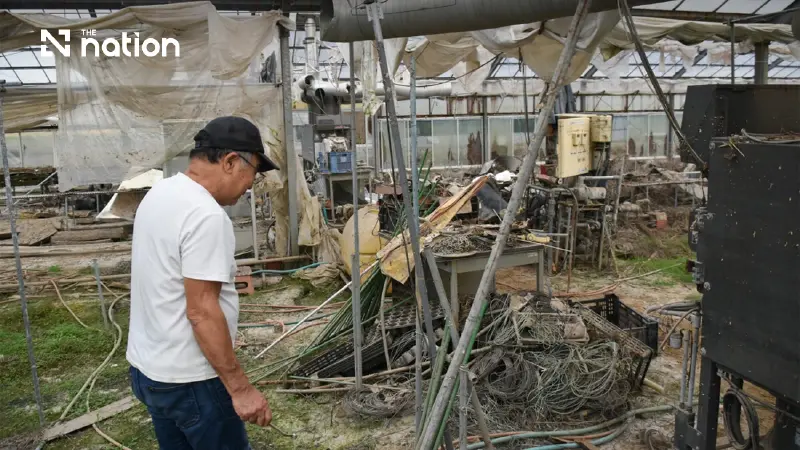


A farmer cannot replant until around next spring, rail repairs are expected to take two more months and a Shisui resident is unsure about home repairs.
- Typhoon Dujuan caused over 25 billion yen in damage to Chiba's agriculture, forestry, and fisheries, with some farmers unable to plant crops again until the following spring.
- The storm resulted in 10 deaths, 37 injuries, and over 2,300 homes being destroyed, damaged, or flooded, leaving residents facing a long cleanup process.
- Key infrastructure was damaged, including a section of the Uchibo railway line which is expected to take another two months to repair due to a landslide.
- Residents face long-term uncertainty, with some hesitant to repair their homes or deciding whether to relocate due to future safety concerns.
Typhoon Dujuan has left Japan's Chiba Prefecture with more than 25 billion yen in damage to agriculture, forestry and fisheries, a disrupted railway and residents uncertain about the future.
Residential areas in the prefecture, east of Tokyo, are now free of floodwater a month after the storm's heavy rain.
The prefecture's disaster response headquarters recorded 10 deaths and 37 injuries as of Tuesday, along with 795 houses destroyed or severely damaged and 1,534 flooded.
A 10-day inundation wiped out the entire crop on land farmed by Akihisa Suzuki, 76, in Narita.
The roughly 5,000-square-metre site includes four greenhouses, and his principal crops are radishes, aubergines and asparagus.

All his heaters and tillers are broken, while a layer of dried mud remains on the greenhouses.
"I won't be able to grow vegetables again until around next spring," he said.
Emergency restoration of embankments at Inbanuma, a major lake in northern Chiba, is complete a month after the typhoon. The embankments had failed in four places, and nearby farmland is still coated in mud.
The landslide damage between Anegasaki and Nagaura is expected to take another two months to repair.
The section forms part of the Uchibo Line operated by East Japan Railway Company (JR East).
Free loans of power-assisted bicycles have been introduced by JR East and the Chiba prefectural government.
Ayumi Hirano, 31, from Kisarazu, can make the trip in about 25 minutes by bicycle, compared with around 40 minutes on the replacement bus.
"I plan on using the bicycle when it's nice outside, and the bus when the weather is bad," she said.
"I just want it to be restored as soon as possible," she added, referring to the railway section.
An embankment collapse blocked a river in Shisui, flooding 15 houses in its Mabashi district.
The water receded there on October 13.
The tatami mats in 44-year-old Yuta Hoshina's home now need replacing after the flooding.
"We're finally at the starting line," he said.
Floodwater had reached around 55cm above the floor of Sanae Suzuki's home.
Suzuki, 56, wore protective clothing as she cleaned up.
"I'm hesitant to repair my home until I get an assurance that I'll be safe in the future," she said.
"I can't decide whether to continue living here or relocate elsewhere," she added.

[Copyright The Jiji Press, Ltd.]
