
UNEP declares breach of 1.5°C global warming limit inevitable
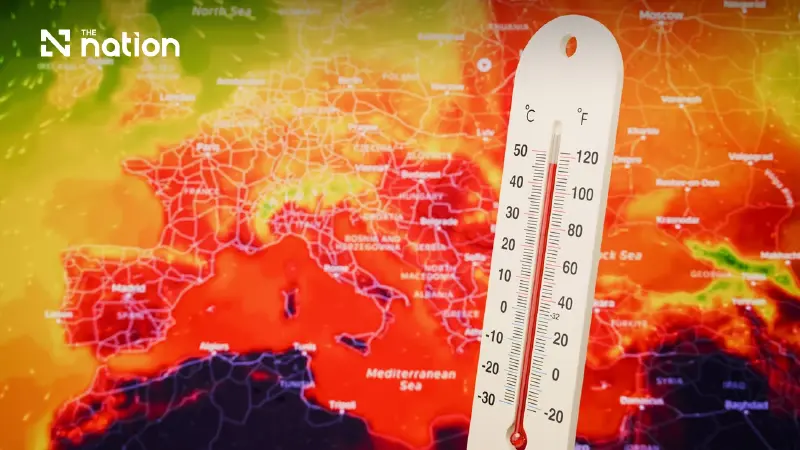


Even with the deepest emissions cuts, warming would still peak at about 1.7–1.8°C around mid-century, with about a 50% chance of a return to 1.5°C or lower by 2100.
- The United Nations Environment Programme (UNEP) has formally declared that breaching the Paris Agreement's 1.5°C global warming limit is now unavoidable.
- Even with the deepest possible cuts in greenhouse gas emissions, the report projects that global warming will still peak at 1.7–1.8°C around the middle of this century.
- Current national policies are highly insufficient, putting the world on a trajectory for a 2.8°C temperature rise by 2100.
- While the limit will be breached, there is a 50% chance of bringing temperatures back down to 1.5°C by 2100, but this requires immediate and drastic emission cuts.
The United Nations Environment Programme (UNEP) has formally announced that keeping global warming within the Paris Agreement’s 1.5°C limit above pre-industrial levels is no longer possible, saying the world is nearing an unavoidable breach of the threshold.
Its Emissions Gap Report 2026: The Point of Return, prepared to inform the COP31 talks, shows that countries’ current policies and actions fall far short of the goals set out in the Paris Agreement.
The report says that even under a scenario involving the deepest possible cuts in greenhouse gas emissions, global warming would still peak at about 1.7–1.8°C around the middle of this century.
There would be about a 50% chance of bringing warming back to 1.5°C or lower by 2100.
Bringing warming back to no more than 1.5°C would require global greenhouse gas emissions to fall by 18% by 2030, 45% by 2035 and 69% by 2040, relative to 2025 levels.
That would mean an average annual reduction as high as 5.7% over the next decade.
UN Secretary-General António Guterres remained hopeful, saying: “Breaching the temperature limit does not mean we surrender. We can still keep the rise above the limit as small and as short-lived as possible, and bring warming back below 1.5°C before the end of this century.”
Meanwhile, UNEP executive director Inger Andersen warned: “Every fraction of a degree of additional warming, and every year spent above 1.5°C, increases climate impacts and risks, such as heatwaves, wildfires and dangerous floods. But we can still keep the time spent above the limit as short as possible.”
However, the “Nationally Determined Contributions” (NDCs) currently set by individual countries would reduce greenhouse gas emissions by only 5–8% by 2030.
If countries maintain their existing policies, global warming could reach 2.8°C by the end of this century.
The situation has worsened further following President Donald Trump’s withdrawal of the United States from the Paris Agreement, resulting in the country recording the largest increase in greenhouse gas emissions in 2025.
This was driven by the easing of environmental policies to promote greater coal use, as well as surging electricity demand from data centres.
Bill Hare, chief executive of climate analysis institute Climate Analytics and a contributor to the report, put it plainly: “The key conclusion is very simple: governments worldwide must urgently enforce policies that reduce fossil fuel use as quickly as possible.”
Global warming above 1.5°C, even temporarily, poses severe risks of irreversible damage by crossing natural “tipping points”, such as the permanent loss of warm-water coral reefs, the melting of polar ice sheets and the transformation of the Amazon rainforest into grassland.
Michael Mann, a climate scientist at the University of Pennsylvania, highlighted the economic and human costs: “Every additional 0.1°C of warming will permanently reduce GDP by about 1.2%, equivalent to more than 1.2 trillion dollars a year, and expose more than 140 million additional people to life-threatening extreme heat.”
Alongside cuts in greenhouse gas emissions, about 320 gigatonnes of carbon dioxide would need to be removed from the atmosphere and stored permanently during this century.
That is equivalent to about eight years of global carbon dioxide emissions at 2024 levels.
However, economic difficulties and technological limitations make the prospects of reaching that goal highly uncertain.
Nevertheless, the UNEP report also notes that renewable electricity worldwide has expanded three times faster than projected in 2015.
It highlights the particularly rapid growth of solar power capacity, citing a sevenfold growth figure.
This has helped slow the overall growth in greenhouse gas emissions.
To keep the world on a path towards bringing warming back down, countries will need to at least triple renewable electricity generation capacity by 2035, cut coal use in electricity generation by 75% and end coal use worldwide entirely by 2040.
Source: Bangkokbiznews
