
Warming seas drive dramatic chinstrap penguin decline near Antarctica
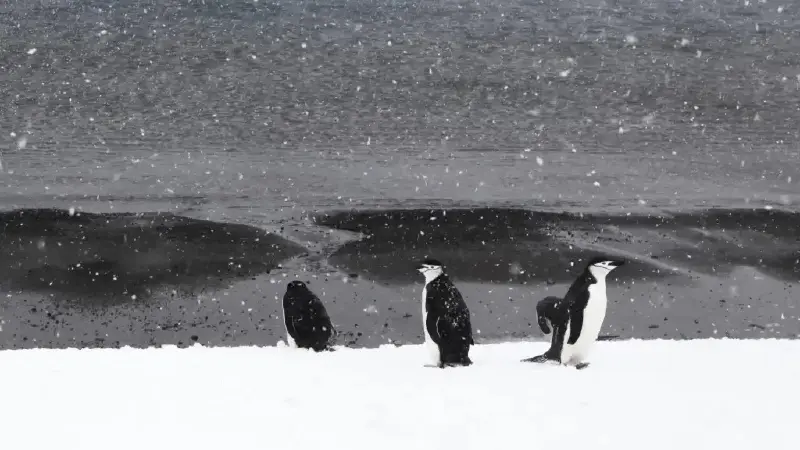


Chinstrap penguin numbers on Zavodovski Island have fallen 63% since 2011, with scientists linking the decline to warming seas and shifting Antarctic krill.
- The chinstrap penguin population on Zavodovski Island, once the world's largest colony, has declined by 63% since 2011, representing a loss of over half a million birds.
- This decline is driven by warming seas, which are forcing the penguins' primary food source, Antarctic krill, to migrate south beyond the birds' foraging range.
- Unlike the chinstraps, macaroni penguin populations on the same island have remained stable or increased, as their more flexible diet allows them to adapt to the changing conditions.
- The scale of the losses has led researchers to suggest the species' conservation status may need to be reassessed from "Least Concern" to a more threatened category.
A dramatic decline in chinstrap penguins on a remote island near Antarctica is raising concerns over the future of one of the region’s most important seabird populations and the wider marine ecosystem.
A new study published in Current Biology found that the number of occupied chinstrap penguin nests on Zavodovski Island in the South Sandwich Islands fell by 63% between 2011 and 2025.
The decline represents the loss of more than half a million chinstrap penguins and means Zavodovski has relinquished its status as home to the world’s largest penguin colony. Researchers say the island now has the highest recorded rate of chinstrap decline anywhere in the world.
Warming seas disrupt food supply
Professor Norman Ratcliffe, a penguin ecologist at the British Antarctic Survey (BAS) and lead author of the study, described the decline as particularly concerning because chinstrap penguins have a specialised diet and strong preferences for particular ocean temperatures.
Tracking data showed that the birds mainly forage in cooler waters to the northwest of Zavodovski, where Antarctic krill traditionally form the bulk of their diet.
As the Southern Ocean warms, however, krill are moving farther south towards the Weddell Sea. Chinstrap penguins cannot simply follow them because sea ice and the lack of suitable nesting islands restrict their movement southwards.
“This is a worrying decline for chinstrap penguins, which have specialist diets and specific ocean temperature preferences,” Ratcliffe explained.
Researchers used drone surveys, aerial photography, satellite records and tracking devices fitted to penguins to assess changes in the colony.
They also ruled out several alternative explanations, including competition for nesting space and the island’s 2016 volcanic eruption, because the chinstrap decline had been continuing steadily since 2011.
Macaroni penguins move in opposite direction
While chinstrap numbers have plunged, Zavodovski’s macaroni penguin population has moved in the opposite direction.
The study found that macaroni penguin numbers rose by about 28% between 2011 and 2016 and have since remained broadly stable.
Scientists believe their more flexible diet gives them an advantage. Unlike chinstraps, macaroni penguins can switch from krill to other prey, including fish and crustaceans, when environmental conditions change.
Tracking showed macaroni penguins mainly feeding in warmer waters northeast of the island, where alternative food sources are available.
Ratcliffe described the contrasting trends as “the biggest change in community composition ever observed at a single location in Antarctica”, warning that rapid warming is reshaping highly sensitive polar ecosystems.
Large changes in the balance between the two penguin species could also disrupt marine food webs in the region.
The South Sandwich Islands are particularly important because they support around 30% of the world’s chinstrap penguins. Researchers say the scale of the losses there, combined with declines elsewhere, could justify reassessing the species’ conservation status from its current Least Concern classification and potentially placing it in the Endangered category.
Antarctic warming adds to concern
The findings come amid broader evidence of unusually warm conditions around Antarctica.
In June 2026, Argentina’s Esperanza Station on the Antarctic Peninsula recorded a daily maximum temperature of 15.4°C during the austral winter, about 19°C above the 1991-2020 average for the period and a new local June record.
Although the extreme temperature event occurred far from Zavodovski and was not identified as the direct cause of the colony’s decline, it reflects the wider climatic changes affecting Antarctic and sub-Antarctic ecosystems.
BAS researchers say Zavodovski’s chinstrap collapse demonstrates that even extremely remote wildlife populations are not insulated from climate change.
Cape Adare in the Ross Sea now holds the title of the world’s largest penguin colony following Zavodovski’s decline.
