
Lagarde to resign early as ECB holds rates amid inflation concerns
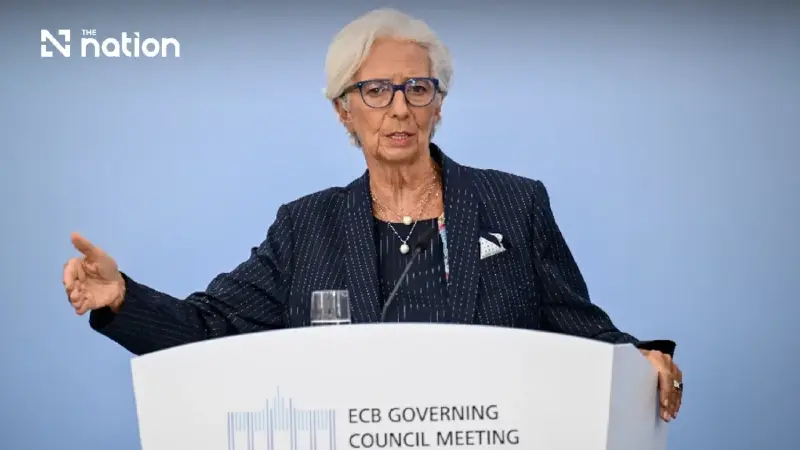


Christine Lagarde will leave the ECB on February 7, 2027, to speak on issues beyond monetary policy as the bank holds rates at 2.5% amid rising inflation.
European Central Bank (ECB) President Christine Lagarde has announced she will step down on February 7, 2027, nearly nine months before the end of her term, saying she wants greater freedom to speak about global issues beyond monetary policy.
The announcement came on Thursday (October 29), as the ECB kept its benchmark deposit rate unchanged at 2.5% amid rising inflation, higher energy prices linked to the Middle East conflict and turmoil in European government bond markets, particularly in France.
Lagarde, 70, has led the ECB since November 2019, having previously served as managing director of the International Monetary Fund. Her eight-year term was originally due to end in October 2027.
Speaking at a press conference in Frankfurt, she explained that the political neutrality required of ECB officials had increasingly prevented her from expressing views on wider international developments.
"I don't think that I can remain neutral," Lagarde said.
She explained that she wanted the freedom to express herself and participate in discussions beyond the central bank's monetary policy responsibilities.
Lagarde also expressed concern about misinformation and the distortion of facts, arguing that her experience in international economic and financial institutions could contribute to broader public debate.
She did not specify which issues she intended to address after leaving office.
ECB keeps rates unchanged amid inflation risks
Lagarde's announcement coincided with an important monetary policy decision, as the ECB left its three main interest rates unchanged following two increases earlier this year.
The deposit rate remained at 2.5%, the main refinancing rate at 2.65% and the marginal lending rate at 2.9%.
Eurozone inflation reached 3.8% in September, almost twice the ECB's medium-term target of 2%, as rising energy costs continued to affect the European economy.
The central bank warned that higher energy prices were increasing inflation risks while threatening economic growth.
The conflict involving Iran has disrupted international energy markets, adding to price pressures across Europe.
Although underlying inflation has remained relatively stable and wage pressures have not increased significantly, policymakers remain concerned that prolonged energy-price increases could eventually spread to other goods, services and wages.
The ECB has therefore left open the possibility of another interest rate increase at its December meeting, although it has not committed to a particular course of action.
French bond market adds pressure
The ECB also faces growing concerns over government borrowing costs, particularly in France, where rising bond yields have increased pressure on public finances.
Higher government bond yields can push up borrowing costs for businesses and households, potentially weakening investment, consumption and economic growth.
The central bank faces a difficult balance between controlling inflation and avoiding further pressure on an already vulnerable economy.
France's debt-market difficulties have also raised questions about whether the ECB might need to intervene if borrowing costs rise in a disorderly manner.
However, the central bank has maintained that its market-stabilisation instruments are designed to address disruptions to monetary policy transmission rather than compensate for weaknesses in individual governments' fiscal policies.
Early departure raises questions over French election
Lagarde's decision also comes ahead of France's presidential election in 2027, adding a political dimension to the appointment of her successor.
Her departure in February would allow current European Union leaders to select the next ECB president before the French election.
French President Emmanuel Macron, who will participate in the European decision-making process, thanked Lagarde for her service and called for an orderly transition coordinated with European partners.
However, representatives of Marine Le Pen's National Rally party criticised the timing of her resignation.
Jean-Philippe Tanguy, who is involved in preparing the party's economic policies, questioned the decision, while German European Parliament member Markus Ferber warned that any perception of an appointment being influenced by national electoral considerations could damage confidence in the ECB's independence.
Lagarde did not directly address questions about whether she had deliberately timed her departure to allow the appointment to take place before the French election.
Klaas Knot and Pablo Hernández de Cos among possible successors
European Council President António Costa confirmed that the process of selecting Lagarde's successor would begin immediately.
Two former central bank governors are widely regarded as leading candidates: Klaas Knot, former president of the Dutch central bank, and Pablo Hernández de Cos, former governor of the Bank of Spain and current general manager of the Bank for International Settlements.
The leadership change could form part of a broader reshuffle of senior ECB positions.
Executive Board member Isabel Schnabel is expected to leave in January, while chief economist Philip Lane's term ends in May.
Financial markets showed little immediate reaction to Lagarde's announcement, with analysts pointing to the ECB's established institutional framework and the experience of potential successors.
There has also been speculation that Lagarde could take up a role at the World Economic Forum, although the organisation has declined to comment.
Lagarde seeks to reassure markets
Despite uncertainty over the leadership transition, Lagarde insisted that her departure would not affect the ECB's ability to make monetary policy decisions.
She said the succession process was already under way and expressed confidence in the institution's strength and stability.
Her decision brings an earlier-than-expected end to a presidency that has spanned the Covid-19 pandemic, Russia's invasion of Ukraine and renewed inflationary pressures linked to the Middle East conflict.
The ECB must now prepare for a leadership transition while continuing to address inflation, rising borrowing costs and broader uncertainty across the eurozone economy.
Source: Reuters
