
Freeing political prisoners crucial for Burma's freedom
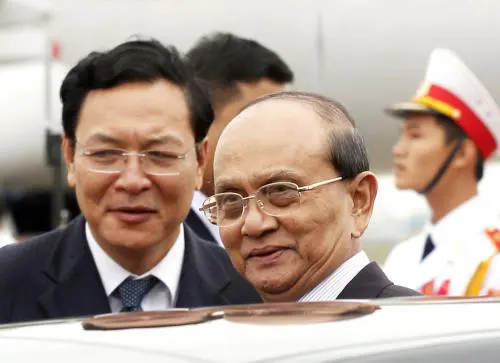


The government in Burma might not have a clear roadmap for political reform and national reconciliation but the international community, notably the US, has already set benchmarks for the country.
US Assistant Secretary of State for East Asia affairs Kurt Campbell said in Bangkok on Monday that Washington wanted to see many things before judging whether progress in Burma is real and heading towards a better future for the country.
“We would like to see [from the government] a continuing and sustainable dialogue with Aung San Suu Kyi and the NLD [National League for Democracy]. We need to see some progress on domestic diplomacy within the country toward the ethnic groups. We have concerns over both past and present interaction with North Korea. There are also a number of issues associate with political prisoners,” he said.
“Compared to our experience in the past, there are clearly changes, but we are at a very early stage of that process and we are looking to see whether they will be sustained and will continue,” Campbell said in a public lecture at Chulalongkorn University.
Burma’s new government under President Thein Sein, which replaced the junta in March, has done many things to indicate the country is now in a process of reform.
The change began with a relaxation of relations between the government and Nobel Laureate and pro-democracy leader Aung San Suu Kyi in July, when the authorities allowed her, along with some 3,000 supporters, to attend the July 19 Martyrs Day commemoration of her father Aung San, a national hero. It was the first time in nine years that she had been given the chance to attend the event.
The relaxation was followed by a series of talks between Aung San Suu Kyi and Aung Kyi, the minister in charge of relations with Aung San Suu Kyi. The talks paved the way for a high-profile meeting between President Thein Sein and Aung San Suu Kyi on August 19.
Before and after the meeting with Suu Kyi, there were positive signs of a more open society, with the authorities permitting her to take a political trip to Bago under their security arrangements, daily propaganda removed from official media, and Internet censorship eased to allow access from inside Burma to international media including Thai and dissident publications.
However, in reality such measures and actions are minor. They have made no significant headway on the road to democracy and reconciliation in a country that has been under military rule for decades.
Authorities in Naypyidaw have pledged to do more. The next step is to release the huge number of political prisoners, currently estimated to be more than 2,000.
The government announced yesterday that it would grant amnesty to another 6,300 inmates today, but it is not known how many can be regarded as political prisoners.
Among the many well-known political prisoners is Zargana, the country’s most celebrated comedian, who is serving a 35-year sentence for criticising the government’s slow response to humanitarian relief following the devastating Cyclone Nargis in May 2008. There’s also U Gambira, a 30-year-old monk who helped lead the September 2007 “Saffron Uprising”, who is serving a 63-year sentence.
A Western diplomat recently said the international community wants to see the release of political prisoners across the board. Senior politicians such as Shan State leader Khun Htun Oo, who was arrested in November 2005 and sentenced to 93 years, should be released this time, the diplomat said.
For the stake of reconciliation, former prime minister Khin Nyunt, who was purged and arrested in late 2004, was also expected to be freed, along with his associates, the diplomat said.
Authorities in Naypyidaw have sent strong signals that they are taking the matter of political prisoners seriously. The chairman of the country’s newly set up National Human Rights Commission, Win Mya, wrote an open letter to President Thein Sein asking him to release what he called “prisoners of conscience”.
“Releasing those prisoners … who do not pose a threat to the stability of the state and public tranquillity … will enable them to participate in whatever way they can in the task of nation-building,” he said in the letter, whose full text was published yesterday by the state-run New Light of Myanmar.
The release of political prisoners is a crucial step towards satisfying the benchmarks of the international community. But even more importantly, the government in Naypyidaw needs to make clear whether the prisoners’ freedom extends to their future roles in politics.
