
The US seeks stability for the Asia-Pacific region
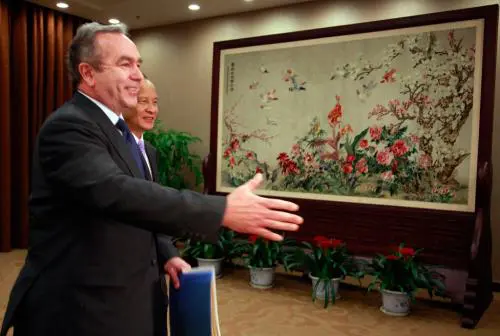


US Assistant Secretary of State Kurt Campbell speaks to The Nation's editor-in-chief Suthichai Yoon about the US's role in Asia. Part 1 of a two-part series to conclude tomorrow.
Suthichai Yoon: Mr Campbell, Is President Obama coming to Thailand?
Assistant Secretary Campbell: Not on this trip. He is very much looking forward to hosting all his friends from Asia and elsewhere for Apec in Hawaii, and he will be in Bali for the Asean Summit and he will visit Australia on this trip. A hope will be Secretary (Hillary) Clinton will come to visit. We are looking over the course of the next couple of months to step our engagement with Thailand.
SY: Why is he skipping Bangkok this time?
ASC: I don’t think he is skipping Bangkok. Obviously, it’s great for him to come to this region and we are looking for an opportunity for engagements and for the president to meet the new prime minister.
SY: But he needs to be here to show that America is really back in Asia, as Secretary Clinton told me here two years ago.
ASC: I think over the last couple of years that we’ve demonstrated that the US is determined to step up our role in the Asia -Pacific region. We’ve done so with more consequential economic, political, strategic military engagements and we are going to continue that going forward. I know the president wants very much to have a chance to spend more time in Asia. Obviously, he gets pressing commitments at home but he still wants to be coming out.
SY: What specific evidence is there that the US is making robust moves to show its presence in Asia?
ASC: President Obama last week submitted the most consequential trade deal the US has ever negotiated since the free trade agreement with Mexico and Canada. I’m talking about the trade agreement with South Korea. That’s our strong commitment. The president’s position to join the East Asia Summit, to play a leading role that we hope will be substantial and build stronger institutional links and deeper ties in the region as a whole. We will host in Bali the third US-Asean summit, during which we will announce several initiatives. One is very substantial: to increase the number of Americans teaching English throughout Southeast Asia. I think almost everywhere you turn, you’ll see evidence of the US playing a stronger and deeper role in Asia.
SY: Why is Asia suddenly becoming so important?
ASC: Well, I don’t think it’s sudden. The US has had a deep and strong relationship with Asia for decades, but there is a growing recognition globally that the lion’s share of the history of the 21st century is going to be in Asia. So we are in the processof a balancing of our foreign policy. Clearly, we are going to have critical enduring challenges in the Middle East and South Asia, Iraq, Afghanistan, and the opportunities that they present. But we are building stronger military, economic, strategic and political engagements in Asia. And we think it’s entirely appropriate and wise.
SY: What is the percentage of this balancing?
ASC: That’s an American question but I’ll give you an Asian answer. It is a mixture of incentives and opportunities. It’s a chance for deeper cultural engagement. We have launched a programme over four years that will increase the number of Americans who study in China to 100,000.It’s a diversion, the reverse of Chinese coming to the US. We are attempting to send a much larger group of Americans to study in Asia, particularly in China because we recognise how important it is. I think on the full range of issues that are important and playing out in the Asia-Pacific region, there are not always positive issues but we have challenges, transnational issues, questions of piracy, nuclear proliferation, tremendous weather events, rapidly approaching climate change.
SY: We usually look at foreign diplomacy as self-interest. What will you get by getting more active in Asia?
ASC: On the economic front, the US until recently was a self-sufficient economy. We have never been relied particularly on exports. We have a remarkable ability to absorb imports but have never needed to rely on export-led growth. But the US is making a transition in rebalancing economic activities in which we will sell more to Asia, not just in traditional areas like aerospace or construction but knowledge enterprises and other areas. I find that exiting Exporting to Asia is one of the most important things that can be done to assist global re-balancing.
SY: We used to be your security partner. Is that going to be more important? If you need us for your exports, then you also need us to be secure too.
ASC: The US believes that the last 30-40 years have been remarkably productive in Asia. One of the key components of the success in Asia has been the peace and stability provided by the US, and I think there is a welcome understanding that role continues to be important. So, as a security partner, we have been extraordinarily pleased by the level of cooperation we have with Thailand. We would like that to continue.
SY: Is America worried about Chinese influence? Are you coming back to balance Chinese influence in the South China Sea, in the overall Asean and East Asia relationship? Are you worried about the rising Chinese influence?
ASC: We believe one of important things the US can do is to build a durable comprehensive partnership between the US and China, not negative competition. Our two countries can work together and the Asia-Pacific region is big enough to support both of us. I’m confident we can find venues of cooperation and avoid negative competition. We respect China’s accomplishments and we have been able to work with them closely on a range of issues. So at the very heart of understanding is the knowledge that most countries in Asia want a better relationship with China. That is an essential feature of modern diplomacy. We recognise that we have been able to say, look, we will help you to facilitate that improving relationship. We are also grateful that most countries in Asia want to have better relationship with the US at the same time.
SY: But in one sense, China considers the US as interfering in Asian affairs, for example in the South China Sea. China would say, whatever our problems with our neighbours, they are our problems; why does the US needs to be involved? So how can you tell China what your role is?
ASC: We are very clear with our Chinese friends what our role is and I underscore that by with the measure of 50 per cent of global trade transported through the South China Sea every year. Let me assure you that is not simply a Chinese interest, but to all countries. Maintaining peace and stability and freedom of navigation through the South China Sea is of profound interest to the US. If you look carefully at every official US statement, we have never singled out any country. We talk about principles, about goals and about objectives. There is more than one country that has expansive claims, so our primary interest is in dialogue, in diplomacy and in freedom of navigation and open commerce. These are values that everyone in Asean aspires to and proposes to support, so we think what we are doing is entirely consistent with our historical engagement. We also believe that, fundamentally, our approach is welcomed by Asean states. We met last year in Vietnam and ten states spoke before us and indicated that they supported a process of diplomacy that would deal with competing claims and different perspectives and points of view in the South China Sea.
