
Mid-December restart could be optimistic for flood-hit firms


Play
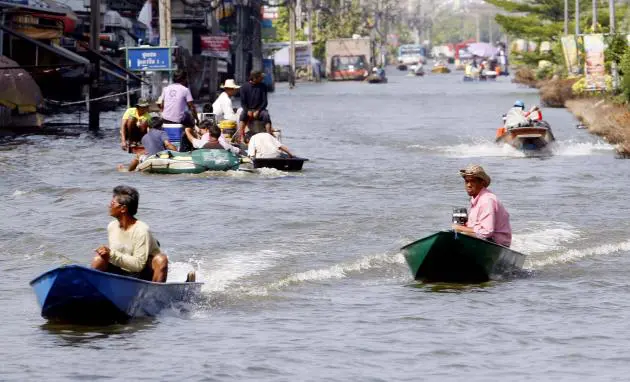
Thailand's worst floods in many decades have hit the automotive and motorcycle industries badly, with October sales and production figures down to record lows.
According to the Federation of Thai Industries (FTI), the massive flooding in Ayutthaya and Pathum Thani provinces, where many factories are situated, has resulted in a severe shortage of parts and components over the past few months.
As a result, the country’s automobile production fell 71.6 per cent in October when compared to the previous month, to only 49,439 units – which is a 10-year low.
For the first ten months of this year, Thailand’s auto production dropped 1.13 per cent compared to the same period last year, to 1.33 million units.
Auto production is, however, expected to rise sharply in November and December, bringing the year’s total to about 1.5 million units. However, this will fall significantly short of the 1.8-million-unit target set for this year.
In terms of Thailand’s total domestic auto sales, Toyota Motor Thailand reported that the October figures had dropped to 42,873 units, down 40.5 per cent when compared to the same month a year earlier.
The October sales were therefore the lowest in 13 years as several auto assembly factories, including those of Toyata, had to halt production during the floods, even though they are not situated in flooded areas. These assembly plants could not continue production because there was a severe shortage of parts and components as suppliers’ factories were inundated.
Another corporate victim of the floods is Thai Airways International, which has seen a sharp drop in business due to the disaster. The national-flag carrier has already cancelled about 500 domestic and international flights following the sharp drop in passengers. For example, flights from Bangkok to Hong Kong, Singapore, Kuala Lumpur, London, Paris, Zurich and other routes were all affected by the floods, resulting in reduced frequencies of services.
Domestic services to Phuket, Had Yai and Surat Thani have also seen fewer passengers. As a result, the airline has switched to smaller aircraft as it reduces flight frequencies with a view to minimise the impacts on regular passengers.
Demand is expected to return to normal in December, but the floods have already hit the airline’s 2011 revenues significantly, because this crisis has happened at the start of the high season for tourism.
During the first nine months of this year, THAI reported a loss of Bt4.8 billion due to foreign exchange losses and high fuel prices.
The Airports Authority of Thailand also reported that Suvarnabhumi international airport, the country’s main gateway, had seen the number of users down from an average of 130,000 per day to about 100,000, while the number of flights has also declined from about 900 to 800 per day due to the floods in parts of Bangkok and other provinces.
These examples typify the economic damage caused by the massive floods, which the Bank of Thailand has forecast will reduce the country’s 2011 GDP growth to 2.8 per cent from about 4 per cent.
About 1,000 factories inside seven flooded industrial estates in Ayutthaya and Pathum Thani provinces are among those that have faced the worst damage, as they prepare to file insurance claims amounting to over Bt200 billion in combined compensation.
When insurance contracts expire at the end of this year, it remains uncertain if the insurance firms will continue to provide 2012 coverage for factories in flood-prone areas.
