
New factories to be situated on higher ground post flood crisis


Play
A government body has proposed a new royal decree to consolidate the administrative powers on water resource management during future crises.
Pitipong Pungboon Na Ayudhaya, head of a subcommittee in charge of planning on the national committee on water resource management, said the proposed law will allow the government to tackle natural disasters such as massive floods more effectively.
In addition, a unified national database on water resources will be set up so that there will be a reliable system of early warnings to the public, to allow evacuation up to one week in advance.
The proposed new law will also integrate water resource data covering the industrial sector, factory locations, public utilities and residential areas.
The government will also focus on longer-term measures to improve water drainage by dredging existing canals to speed up water flow, and increasing the efficiency of water pumps and water-gates and related equipment, including telemeters, at a total of 392 water-level monitoring stations nationwide.
These proposed measures should help restore some investor confidence as certain factories in Ayutthaya province prepare to resume production following the massive inundation over the past two months.
About 10 of 140 factories are now ready to reopen at the High Tech Industrial Estate, for example. Earlier, some plants at Factory Land and Bang Pa-in industrial estates in Ayutthaya also resumed production.
Rojana and Saha Ratana Nakorn industrial estates will be the last two to reopen.
Rojana Industrial Park, home to Honda Automobiles and other major Japanese firms, has said it will invest in the construction of a permanent concrete wall, with a height of 5-6 metres above sea level, around its vast compound perimeter.
High Tech Industrial Park will also spend about Bt300 million to build 11 kilometres of new dykes at a height of 5.4 metres, up from the current 4.2 meters.
According to High Tech, the recent flood water reached a peak of 4.9 metres above sea level at its estate.
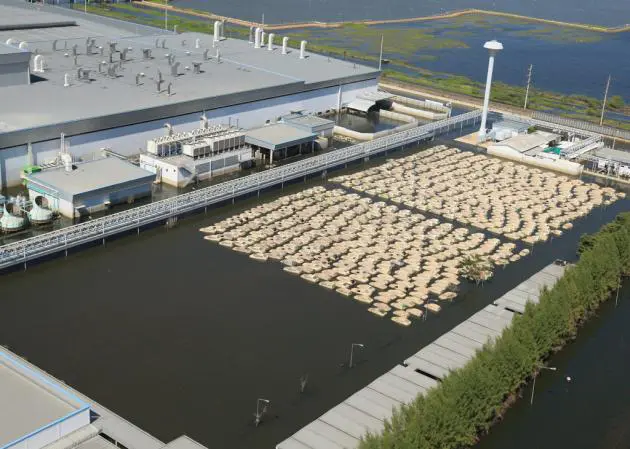
The country’s worst floods in 50 years have significantly damaged a total of seven industrial estates in Ayutthaya and Pathum Thani, where nearly 1,000 factories have been submerged.
Many existing production facilities for the electronics, automotive and other industries are unlikely to relocate in the short and medium terms, largely due to the high cost and time factors involved in relocating.
However, their new investments will be shifted to higher and drier places such as Amata, Hemaraj and other industrial parks on the Eastern Seaboard and in other regions.
Amata plans to launch a new sale of industrial land totalling 2,000 rai, while Hemaraj’s new project has a total of 1,700 rai for sale.
At this stage, Japan’s foreign direct investment in Thailand is expected to remain strong due to a number of factors.
First, the strong yen has resulted in reduced competitiveness for manufacturing in Japan. Second, the March tsunami in Japan has made it necessary to further diversify the risks of Japan’s domestic production facilities.
According to the Amata Industrial Park, Toyota has confirmed that it will continue production activity in Thailand, while Honda Motors says it is considering moving its facilities for motorcycle production to Thailand,
This will lead to big-lot sales for an assembly plant and new contracts for supply of parts and components.
