
Perspectives on future economics from WEF, Davos


Play
From January 25-29 I had the opportunity to join the high-level Thai delegation at the World Economic Forum in Davos-Klosters, Switzerland.
There were many important discussions among global leaders, world-renowned thinkers, academics and leading social activists. I would like to share the main gist of these discussions that I think will have major implications for the global economy and developing countries like Thailand in the coming years.
On growth and employment, there has been a proposal to create human capital index aims to monitor and benchmark how a country is performing in areas important for growth and employment, including primary education and infant mortality, secondary and tertiary education, training and retraining, the flow of talent within and across national borders and industries, and enablers such as the ease of starting a business and incentives for entrepreneurship.
One objective of the index is to track the skills and knowledge industry requires today and in the future, and the ones that are currently available or may become available. Government, industry, educational institutions and labour will thus be able to take proactive measures to act on mismatches. In many sessions, it became clear that there is a paradox of high unemployment in countries where businesses complain that they cannot find enough people to fill particular jobs.
Education is the key in growth and employment. While the model will vary from country to country, the basic principles should include close collaboration between educational institutions and industry. Curricula should be designed and refined with the changing human capital requirements of employers in mind. The emphasis should be on science and maths, although the importance of a liberal arts education should not be forgotten.
Training and retraining are also essential. The Nordic countries are strong in these areas and should be able to provide models for others to adopt. In Singapore, government and business collaborate on programmes to retrain people. As a financial centre, the country has been hit hard by the financial crisis, which has put many bankers out of work. Many have been retrained to become, for example, financial advisers in micro-finance and small and medium-sized enterprises. Governments tend to leave training and retraining to businesses, but they should realise that the cost of large-scale unemployment is far higher than investment in training.
Business and life skills should begin to be taught in primary schools. Maths lessons should incorporate business concepts. Entrepreneurship should be encouraged at a young age; in Mexico, children learn how to build and run a business in Entrepreneurship Camp. Self-employment is seen as an important piece in employment growth because new technology, for example, initially destroys jobs before creating new opportunities from an acceleration of growth – a process that may take years.
Talent mobility is another important piece in growth and employment. The skills and knowledge that businesses require may be more abundant in another city in the same country, or in a different nation. In a world where global supply chains are becoming more extensive and deeper, governments should rethink migration policies and re-examine formal and informal barriers to the free movement of talent.
Businesses should think about making their training programmes applicable to their own industry (even other sectors) in their own country and across borders. It is also useful for pension schemes, medical coverage and other benefits to be made portable, so people who move to other countries, particularly older workers, are not penalised or prevented from taking on new opportunities.
Social protections should be established. The countries that perform best in terms of economic growth are those with high levels of social protection, such as unemployment benefits and retraining. The unemployment levels in the Nordic countries are far lower than in Spain, for example.
On sustainability and resource utilisation, the world is at the dawn of a new era. Technology is redesigning various bacteria that have the potential to create biofuels and transform human waste into electricity and fertiliser, which could put the world on the path to sustainable development. Bacteria that are usually absorbed in CO2 can produce sugar, which can then create myriad polymers. Modern technology can turn sunlight into oil. Today, the energy equation is simple: when GDP goes up, energy use goes up and environmental impacts intensify.
One of the links in this chain must be broken. Getting the energy mix right is critical. It is rare for a country to have an energy policy that “joins up”. China is an exception and can be seen as a role model. Its Five-Year Plan takes into consideration the “macro-energy balance equation” and focuses on energy conservation by engaging local authorities in provinces that now have the power to choose between conservation and supply. In addition, China recognizes that, in determining energy needs, low carbon must be part of the energy security solution. The government is aiming for a 17 per cent carbon reduction leading up to 2015. Key to the energy solution is determining how much growth is desired and the quality and quantity of energy to power that growth. This systematic approach is a sustainable model for developing countries seeking economic and social development as well as energy security.
One of the biggest challenges now is to provide sustainable energy for all. Today, 1.2 billion people have no access to electricity. Energy is dominated by large companies focused on supply; energy companies of the future need to be user-focused and more socially and environmentally responsible.
Food security is interlinked with other sectors: land, energy and water. Managing this nexus is critical. Subsidies, which must be abolished, distort this nexus. However, the poor must be protected and must be at the centre of any strategy that addresses proper market prices, which should also reflect social costs. Agriculture used to be at the centre of food security, but today and in the future it needs to be improved to achieve broader development outcomes such as better nutrition and health; more effective water, energy and land management practices; and control of carbon emissions.
The world’s food systems are broken after 30 years of mismanagement and bad subsidies that distort production and distribution patterns – and still do. An important consideration is that inside the resource shortages are sharp inequities across and among different social groups. Gender is a cross-cutting issue that cannot be ignored.
The oceans – our largest ecosystem – provide the natural capital that drives all economic activity. They are under threat. With the world’s population set to hit 9 billion by 2050, 70-100 per cent more protein will be needed. If sustainable aquaculture is developed, protein production can be trebled.
From my experience at the meeting, I can sense the important issues being discussed need to be taken seriously and followed up by governments and concerned agencies. The world is at a fundamental tipping point, with many challenges ahead. New technology has offered us unprecedented connection. The Arab Spring may not have taken place without the aid of social networking. Leaders can congregate, discuss and coordinate economic and social policies in a way that was unthinkable a few decades ago. With great human interconnections, I can only hope we can shape the world for a better tomorrow.
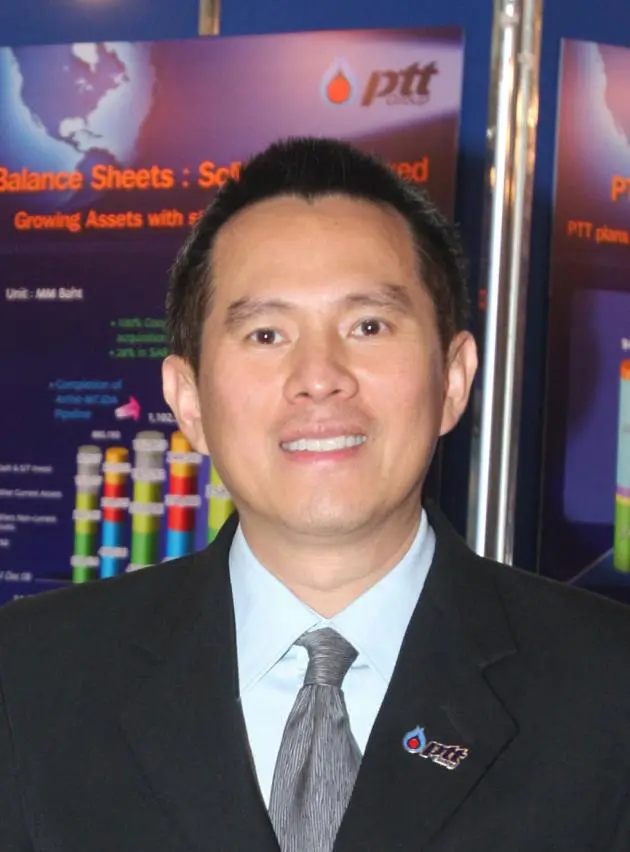
Dr Chodechai Suwanaporn is executive vice president, economics & energy policy, PTT Public Company Limited. [email protected]
