
What would they say to each other at a 'peace summit'?


Play
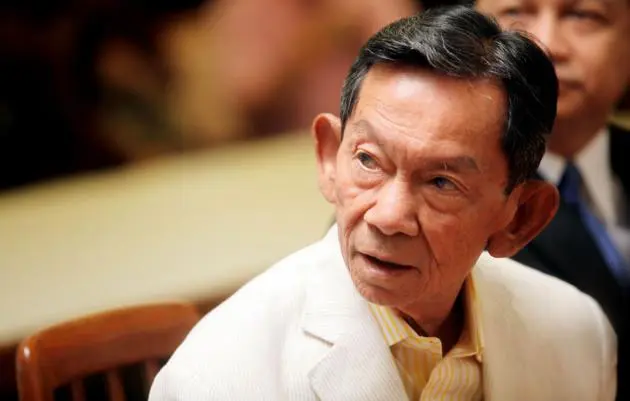
Can you imagine General Prem Tinsulanonda and Thaksin Shinawatra meeting for a proposed "peace summit"? I can, but only in my wildest dreams.
Even in “amazing Thailand”, the scenario – as proposed by a “third party” with a genuine desire for a breakthrough in the country’s political stalemate – appears incredibly naive and far-fetched.
Some politicians are really contemptuous of the public’s level of intelligence. They can always, without fail, come up with simplistic ideas masquerading as “solutions” to most of the complicated issues that in fact were of their own creation.
No, come to think of it, they might not be that innocent after all. Neither are they ignorant of the facts involved. They are simply desperate enough to make suggestions that the average Thai would consider too far-fetched even to contemplate in the first place.
Chart Thai Pattana chief adviser Sanan Kachornprasart, having admitted failure in playing the role of “peace-maker”, suggested that ousted former premier Thaksin Shinawatra, and president of the Privy Council, General Prem Tinsulanonda, should hold a summit and the current political crisis would be resolved in no time.
Thaksin and his supporters have claimed all along that someone with “extra-constitutional power” might have engineered his ouster.
But Prem has let it be known (without uttering a word to that effect in public!) that he is not a party to the ongoing conflict.
Therefore, even agreeing to the summit concept would be tantamount to admitting that he is in fact taking sides in this national face-off.
In fact, if Thailand’s lingering conflict was simply a Prem-Thaksin issue, it wouldn’t have been such a prolonged and messy affair. The red-shirt leaders have insisted all along that the prevailing crisis is the result of the gap between the rich and poor, the prai and the ammart – in other words, it’s the huge gap between the elite and the downtrodden.
The yellow shirts offer a different theory. They claim that the real problem in the country is that some rich politicians have resorted to populist policies employing “evil capital” to exploit the poor through corruption and abuse of power.
They may both be right. Or even if only one side is correct in its analysis, it still has nothing directly to do with whether Prem was behind Thaksin’s ouster or not. If Prem is considered “leader of the privileged”, Thaksin – being the country’s richest and undeniably most influential politician – can’t possibly be said to represent the poor and powerless, especially now that his Pheu Thai Party is in power and most of the “prai” leaders have now assumed highly privileged positions in the government.
Back to the tantalising question: What would Prem and Thaksin discuss in the proposed summit?
If he was really courageous, Thaksin could pose a direct question to the Privy Council president on whether he was behind the 2006 coup. And if Prem wasn’t his own restrained and reserved self, he could probably ask Thaksin why the latter had devoted so much time and energy to putting all the blame for his political trouble on him.
That’s the most unlikely scenario, of course. Another possible scenario, although still improbable for all intents and purposes, is for the two to be nice to each other and to promise to forgive and forget – and issue a joint communique declaring an end to the country’s conflict amidst cheers from the red and yellow shirts before disbanding their political groups.
Even under that highly unlikely scenario, the rest of the country (those who are neither red nor yellow) would still find the imagined summit irrelevant. This country, after all, doesn’t belong to only these two gentlemen. The national interests aren’t defined by just these two persons – and whatever solutions they might thrash out (if that’s at all possible) don’t necessarily answer the basic issues this country is facing.
But if we take this absurd idea to its illogical conclusion, the first “peace summit” would have to be between Thaksin and the 2006 coup-maker, General Sonthi Boonyaratglin.
Or have I missed the big news? Perhaps, judging from Sonthi’s bizarre behaviour recently, they might have already held their virtual summit without the public’s general knowledge.
In that case, they can claim that peace is at hand – but it has nothing to do with you and me and the rest of the country.
