
Asean must develop new ways of tackling old and new problems


Play
If leaders cannot change when circumstances demand them to, they will be out of touch and less effective.
These words well apply to the “Asean Way” in the light of Asean leaders’ community building, especially in these times of climate crisis.
Looking back, the Association of Southeast Asian Nations was built upon opposition to imperialism. A non-aligned movement was initiated by Indonesia so that its neighbouring governments refrained from taking any side during the Cold War. It was a tremendously difficult task at that time, considering that even before the Second World War the peoples of the region were divided by a history of colonialism, ethnic and religious diversity, territorial fights and other antagonisms.
That Asean has survived the conflicting interests and constant mutual suspicion of its member-states is attributable to the efforts of its political leaders to deal only with non-contentious matters such that no member would feel its national interests threatened by a group decision. This is the essence of the Asean Way, or consensus decision-making, that does not diminish sovereignty or interfere in domestic affairs.
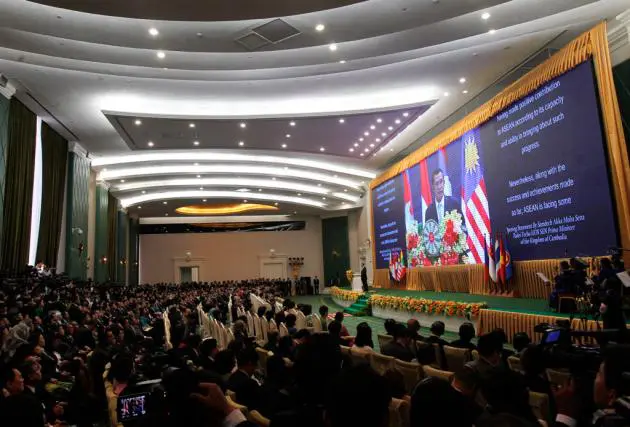
In today’s very different environment, there seem to be efforts to move Asean to a higher plane of cooperation, with emphasis on the economic and social side of the association. Examples are Asean’s economic community-building and climate-change initiative. In fact, how to keep efforts on track to realise economic integration by 2015 and how to implement climate action commitments in the Bali Concorde III were on the agenda of the Asean Summit in Cambodia this week.
One thing, however, that has intentionally not changed over the decades is the Asean Way. Hence, there are reasonable doubts about the capability of Asean to make the single community a reality, given the same old Asean Way still enshrined in the new Asean Charter and valued by incumbent political managers in the region.
A community has some institutionalised structure that defines it independently from state membership. But because of the Asean Way, functional structures and compliance mechanisms cannot be set up; and in the absence of such, the Asean community will not have substance and strength to operate. There are also legitimate concerns that Asean’s community building is just another effort to reinvent from the top a process that does not have at the bottom a truly integrative thrust considering that the Asean Way does not include processes where people engage in decision-making.
Sadly, the Asean Way is also the excuse of the 10 governments for their failure to get their act together in the UN climate-change negotiations. While there were intentions and efforts from some governments to make Asean a relevant and strong actor in the negotiations, these are blocked by other Asean nations in the name of national interests. Leaders in the region failed to give mandate to their negotiators to speak and act as a group in the climate-change talks. Without the mandate, Asean joint leaders’ statements, and resolutions to advance regional interests on the climate-change initiative platform, are empty words.
Reminiscent of the ideological divide during the Cold War, present civil society advocacies that demand more renewable energy, energy efficiency, protection of forests, and people’s engagement in the formulation of national mitigation and adaptation actions to battle climate change are dismissed by some Asean governments as imperialist schemes to sabotage national economic development. Others label civil society advocacies “too idealistic” whenever political will is lacking to make the necessary changes possible.
Climate change does not have national domains nor an ideological brand. Climate change-induced extreme weather events will have similar effects across Southeast Asian countries due to their similar ecological features. In fact, a recent mapping by Hadley Research Centre of the UK shows Southeast Asia to be worst affected by global temperature rise, with decreased water flows from Himalayan glaciers. The latter will trigger a cascade of economic, social and political consequences. Accordingly, the effects will destabilise the region by 2030, just 15 years after the planned economic integration, as it faces wild monsoon variations, with effects on coastal infrastructure, agriculture, marine currents and fish stocks. Coastal cities will be hit by subsidence and rising sea levels.
Obviously, a transnational problem like climate change requires transnational solutions without compromising the principle of historic responsibility. But the latter can never be an excuse for inaction. At present, it is clear that both tasks of building a single economic community and battling climate change cannot be done in the same old Asean Way.
The times demand Asean leaders change the old way of doing things. If they cannot change, then maybe it would be best for them to keep Asean as a security consensus body where the Asean Way works comfortably for everybody. Asean is not, and should not be, the only expression of international relations in Southeast Asia. New associations with appropriate ways of working are needed to address transnational issues like climate change, build strong communities, and operate other non-security arrangements.
In the end, it is the worthy leaders of Southeast Asia who will embrace change, make history and initiate new movements.
Zelda DT Soriano is policy advisor, Greenpeace Southeast Asia ([email protected]).
