
Looking forward


Play
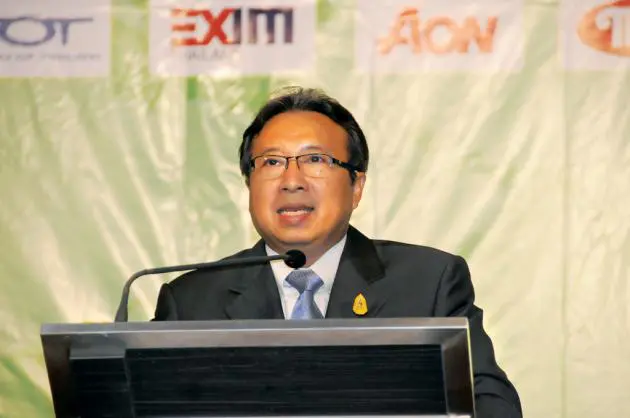
Industry Minister MR Pongsawat Sawasdiwat says Thailand has many strengths but will have to change certain attitudes as the Asean Economic Community becomes a reality.
MR Pongsawat Sawasdiwat, the industry minister, talks about the opportunities and threats for Thailand as it prepares to become part of the Asean Economic Community (AEC) in 2015. In his opinion, the AEC will have implications in five areas, namely: freer flow of investment, trade, labour, services and capital across the national borders of all 10 Asean member countries.
Besides Thailand, the other Asean members are Malaysia, Indonesia, Singapore, the Philippines, Brunei, Myanmar, Vietnam, Laos and Cambodia.
“Our national strategy is based on the implications in these areas. First is the investment sector, and our strengths are in the automotive, electronics and agro-industries, so we have to capitalise on our extensive supply chains and clusters in these sectors, which are among the strongest in Asean.
“Thailand can be used as a base for the auto industry, as we have the biggest production capacity, which will be about 2 million vehicles this year. If investors want to set up an assembly plant in Myanmar, for instance, they can use parts and components from Thailand.
“On labour, we will have to provide more training to our skilled human resources to move up the value chain from labour-intensive to higher-value industries. In addition, we will consider setting up industrial estates along the borders with Myanmar or Cambodia for apparel and other industries that need a lot of unskilled or semi-skilled workers.
“Mae Sot district in Tak province is a good example, as it is next to Myanmar’s border. Once we have a special economic zone in that area, there could be a free flow of labour. People can come into Thailand and work and return to Myanmar the same day.
“Thai universities also have to prepare for a freer flow of professionals from Singapore and Malaysia, for example, who can come to work more easily. Therefore, Thai graduates need to improve their skills to stay competitive.
“English proficiency is one area for improvement. Another is in IT skills, as we’re lagging behind both Singapore and Malaysia, while Vietnam is neck and neck with us.
“To facilitate cross-border trade, the so-called ‘Single Window Asean Customs System’ will help reduce paperwork and boost regional trade flow requirements.
“On services, we’re quite strong in the tourism, hotel and medical services sector, but we still need to improve competitiveness in financial services.”
“In terms of capital and stock markets, there will be more offshore funds invested in Thailand, and more funds from Thailand will be invested in other Asean countries. In fact, the Thai stock exchange is an emerging-market leader.
“On potential threats, I think English-language skills is one, since Singapore, Malaysia, the Philippines and even Myanmar have [a history of English speaking] and better systems of teaching English, so we have to change our teaching methods.
“We also have to get a better understanding of the cultures in other Asean countries in order to avoid conflicts due to religious and other differences. For example, we have to adjust our mindset on Myanmar, since it is no longer an enemy from the Ayutthaya period. That was 200 years ago.
“And we shouldn’t think of Cambodia as another enemy because of the recent border conflict. They are all friends, and we should think of Asean as a whole and how to increase this friendship. Once we have more friends, we will have more business and investment opportunities.
“This is a big challenge for all Thais in terms of how to be a good member of the Asean grouping,” he says.
