
Now that parks chief is gone, who will save Kuan Kreng Wetland?


Play
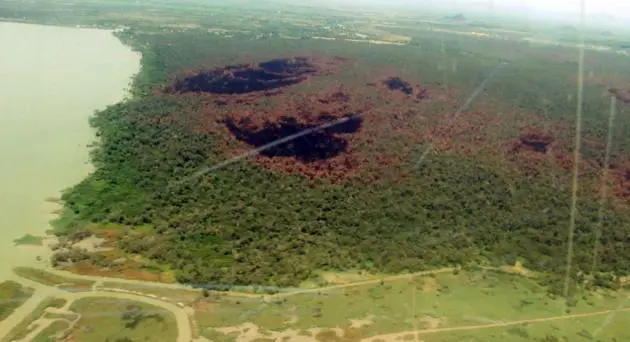
The past few months have brought devastation to one of Thailand's most important ecological sites. Fires in the Kuan Kreng Wetland, which stretches across the three southern provinces of Songkhla, Phattalung and Nakhon Si Thammarat, have seen hundreds if
Footage of Damrong Pidet, director-general of the Department of National Parks, Wildlife and Plant Conservation, flying over the scene in a helicopter appeared in the media almost every day over the past few weeks. Damrong has declared war on the illegal encroachment of the reserve, and his courageous stance to protect the wetland forest deserves to be commended. He ordered that all illegal documents relating to land ownership be revealed for further scrutiny by September 20. Sadly, he retired from his powerful position at the end of September.
The oldest records available for Kuan Kreng date back to the 1960s and reveal that it was then still a pristine wetland forest. According to the Royal Thai Survey Department, in 1967, the Wetland covered more than 354,000 rai (566sqkm). In 1994, a Prince of Songkla University study revealed that the wetland forest had shrunk to 195,545 rai (313sqkm). More recently, the Thailand Institute of Scientific and Technological Research revealed in 2005 that only about 86,942 rai (139sqkm) was left. Based on these figures, news reports a more recent survey by Prince of Songkla University, I would estimate that less than 15 per cent of the original area is still wetland.
Despite being Melaleuca-tree wetland forest, the Kuan Kreng Wetland is a major and crucial component of Songkhla Lake, the largest natural lake in Thailand. The wetland forms the habitat and breeding ground diversity of flora and fauna, feeding fresh nutrient-rich water into Songkhla Lake, on which the livelihoods of many local people depend. If the Kuan Kreng reserve is destroyed, which is highly likely based on what we have been witnessing, it is not impossible that the whole Songkhla Lake ecosystem will come to an end. The inextricable link between Kuan Kreng and Songkhla Lake is both complex and delicate. Though these natural ecosystems have been resilient in the past several decades, there exists a tipping point beyond which the destruction will reach a point of no return. Then it will be too late. The whole Songkhla Lake system would collapse.
Research has shown that human impact – unsustainable agricultural practices, land misuse, urbanisation, waste-water discharge, and coastal erosion – has led to rapid sedimentation that has already reduced the life expectancy of the lake almost twenty-fold, to about 200 years. Should encroachment in the Kuan Kreng Wetland be allowed to continue as it has, Songkhla Lake may even disappear within a generation.
Encroachment here is not a recent phenomenon. Prince of Songkla University’s recent ground survey showed that a very large portion of the so-called wetlands has been converted into a mammoth oil-palm plantation. Large swaths of oil palms have been cultivated here for at least 10 to 15 years. The plantations look very well established and, to most people’s eyes, very legal.
The problem is clear. But the solution is not. Enormous public wetland forests have been illegally handed to individual private owners, by issuing illegal property rights on public land. The matter has become even more difficult because such chronic wrongdoing has been practised for years, if not decades. It involves a large number of people – some whom are aware of the problems and some whom are not. Thus, it is not a matter of simple land confiscation. Given the government’s prolonged negligence of this issue, which has led to unimaginable consequences, a negotiation process between all involved is necessary.
Let’s not debate, for the time being, why the law was not properly implemented in the first place. That would take forever. Let’s instead focus on the sustainability of the country’s only large natural lake. It is acclaimed by all sides – both the private and public sectors, including related government ministries – as being highly ecologically significant. A small portion of the lake – Kuan Kee Sian Wetland – was designated the first Ramsar (wetland of international importance) site in Thailand. Such international recognition confirms its ecological significance. The Kuan Kee Sian Wetland is by no means a standalone ecosystem, but surrounded by Thale Noi Lake and Kuan Kreng Wetland, both vital components of the Songkhla Lake system. Not only does destruction of the Kuan Kreng Wetland ruin national integrity, its consequence – destruction of the whole Songkhla Lake – will lead to unimaginable adverse impacts – ecologically, socially and economically. Such long-term loss, which will be borne by our future generations, enormously exceeds the current short-term gains enjoyed by illegal landowners. We have to bear in mind that, although we can sell, buy and utilise pieces of land, natural resources and the environment do not “belong” to us. We borrow them from future generations.
“We do not inherit the earth from our ancestors; we borrow it from our children,” said Chief Seattle in the early 1900s.
I therefore plead with those whose actions are – intentionally or unintentionally – contributing to the destruction of the Kuan Kreng Wetland to stop immediately. Together we must prevent the rest of the wetland from further destruction, and then restore it. The government must step in. I mean the government, and not just the director-general of the National Park, Wildlife and Plant Conservation Department, who does not have the wide-ranging powers to handle this task alone. The mission is too big, too wide-ranging, involving too many stakeholders including many government departments.
It is a fact of life that getting different government departments to fall in line under one command is extremely difficult. Damrong was successful because he used the media. That was an excellent start. The change has been initiated. The issue has received public support all over the country. I am glad to know that, though a recent poll suggested that a large section of the public do not mind corruption as long as they get a share of the proceeds, the “silent majority” of Thais do hate corruption. They are waiting for a leader. They are waiting for the right issue and the right time. Isn’t this a great opportunity for the government to step in, stop future misconduct (I am not yet talking about retroactive action – that would be too burdensome for any government), and bring sustainability back to our environment, our community and our grandchildren. It’s a win-win-win situation.
Professor Chatchai Ratanachai, Faculty of Environmental Management, Prince of Songkla University ([email protected]).
