
Charter reform: The question is in the question(s) asked
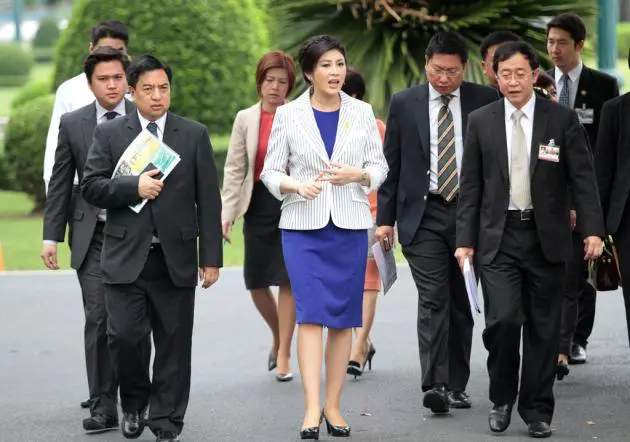


If you really listened to Premier Yingluck's story about the proposed constitutional amendment, you might have been led to believe that it's about the separation of power between the executive and legislative branches.
If, however, you read between the lines, there isn’t much of a separation after all.
At first, she said the whole issue about rewriting the charter to make it more democratic doesn’t really have anything to do with her government. “It’s a parliamentary thing,” the premier has repeated several times recently – until last Saturday, when she spoke on her weekly radio and television show.
In that programme, Yingluck, perhaps for the first time, elaborated on how her Cabinet will pave the way for a national referendum on the proposal to amend the charter before Parliament votes on the third and final reading of the bill to rewrite the Constitution.
In other words, she was admitting that the issue would no longer be an exclusive function of the legislative body, in which her Pheu Thai Party holds the majority of votes anyway. By detailing the next steps in the political move, the premier was confirming what everybody else had concluded all along – that both the Cabinet and the ruling party in the House are very much in sync on the political direction.
Yingluck didn’t hide the fact that she had consulted her brother, former premier Thaksin Shinawatra, on the charter move. It’s no secret either that Pheu Thai leaders have been getting more direct instructions from the same person on what to do and how to proceed on the issue. Only some very naive political observers would be ignorant of the fact the government and party are joined at the hip.
It was probably no coincidence that just one day before the premier laid out detailed steps on the constitutional issue, leaders of the coalition government met and issued a joint statement that echoed a similar strategy. They announced that a national referendum would be held before pro-government MPs vote on the final reading of the Constitution amendments.
It was clearly a subtle shift in strategy to pacify opponents of the move and critics in various circles who have vowed to protest against the “rush to ram through changes” to satisfy the powers-that-be.
A move to bulldoze the bill through the House would have produced a new round of political confrontation and possible violence on the streets. Yingluck indicated that the tactical shift to move the referendum up front (instead of organising it after the new charter is drawn up) was clearly aimed at preventing a fresh showdown between Pheu Thai and all the anti-Thaksin elements.
“We would like to involve the people in the process from the start so there won’t be any tension,” she said.
But holding a referendum based on the certainty that the ruling party can garner a clear majority (based on the 14 million votes Pheu Thai got in the last general election) doesn’t guarantee smooth sailing all the way.
Pheu Thai MP for Yasothon Peerapan Palusuk said voters must be presented with only one question – whether they agree with a proposal to create a drafting assembly to write a new charter.
That will create a new set of issues, since there is no basic disagreement on whether or not the charter can be amended – for the right reason, for the right purpose, at the right time. And that means any changes should empower the people in general, and not benefit any particular group of politicians – which is the question being raised in the ongoing controversy.
The first question to address, therefore, is what question (or questions) should be asked in the referendum. The forming of an assembly is only the mechanism toward eventual changes. The crux of the conflict – which the government claims to be trying to resolve – is the substance, not the form or wherewithal.
Unless the real issue of the conflict between advocates and opponents of the proposed amendments is resolved before the next step is taken, the country could slide toward another showdown.
And, as all parties concerned realise, the next confrontation will be much worse than all the preceding ones.
