
Reckless drivers endanger lives as a matter of course


Play
Shocking results have been revealed in a joint research study conducted last year by the Thailand Accident Research Centre (Tarc) at the Asian Institute of Technology (AIT) and the Thai Roads Foundation. The study, which was partly funded by the Thai Heal
Speed surveys of buses and vans were carried out quarterly in 2012 on four major national roads (highways 1, 34, 35 and 338) and on one motorway (Motorway Highway 7). It was found that 55 per cent of vans on fixed routes exceed the speed limit with regularity, as do 53 per cent of vans on non-fixed routes,67 per cent of buss on fixed routes, and 81 per cent of buses on non-fixed routes.
Driving over the speed limit results in a higher risk of a crash or severe accident. As the speed of the vehicle increases, the driver tends to have less control over the vehicle, and the chances of taking evasive action decreases as well. The effect of a collision that a vehicle travelling at higher speed incurs is much higher than the effect of collision at a lower speed. The severity of injury greatly increases as the impact of the collision increases.
The speeding habit of bus and van drivers is a serious threat to public safety on the roads, and this threat is exacerbated with the Songkran holiday upon us. Public transport is the common mode of transport for inter-city travel in Thailand, and 87 per cent of people who use public transport to travel back to their home provinces duting the holida normally use either buses or vans running on fixed and non-fixed routes.
Road accidents are a leading cause of death in Thailand, and speeding has been identified as a key contributing factor for road accidents in the country. What is more worrying is that road accidents in Thailand are most evident during the traditional Songkran holiday season and the New Year holiday. The Emergency Medical Institute of Thailand (EMIT) states that the total number of people who died or were injured due to road traffic accidents over the Songkran holiday last year, in a span of just seven days between April 11 and 17, was 27,881.
Travelling by bus or van cannot be considered safe at any time of the year in Thailand, especially during the Songkran holiday. Since road transport is the only major way of getting to most places in Thailand, people have no other choice but to use unsafe buses and vans. Travelling upcountry can mean risking one’s life because of reckless drivers.
It is important to mention that besides speeding, there are other reasons why travelling by some of these vans and buses may be unsafe.
Vans: To avoid frequent stops at gas stations, many passenger vans have added extra gas cylinders. When fully loaded with passengers and gas, these vans can weigh about 3,500 kilograms, which is 1.75 times more than the allowed weight limit of 2,000 kilograms. The extra weight makes the vans highly unstable and unsafe, which increases the chance of an accident.
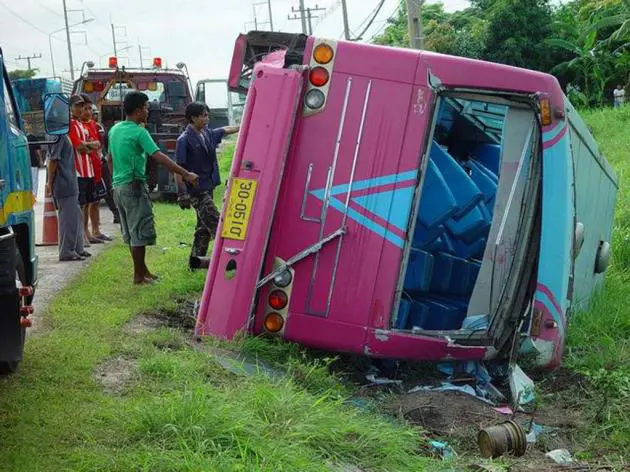
Double-decker buses: These are used as charter tour buses and also on fixed routes. Investigators in many accidents caused by or involving double-decker buses have found that these buses, which should have a maximum height of 3.5 metre, are at times up to 5 metres in height. The extra height weakens the superstructure of the bus, making the bus unstable and prone to roll over, which is why such accidents involving double-decker buses in Thailand are quite common. To prevent such accidents, Thailand has been planning to implement the UNECE Regulation No. R66, which will make it mandatory for buses to go through a test for the strength of the superstructure.
Concerned stakeholders must take action now to reduce the number of road accidents in Thailand. Since this year’s holiday has already begun, nothing drastic can be done such as weighing vans or testing the strength of double-decker buses. However, some preventative measures can still be taken to at least minimise the number of road traffic accidents during this holiday season. The police must strictly enforce the speed limit and other traffic laws, and clamp down hard on drunk driving, to ensure that Thais as well as foreigners are able to reach their destinations safely and enjoy the water festival with joy and happiness. Passengers can also take part by politely encouraging drivers to slow down and follow the rules – although this may be asking too much.
Ridwan Quaium is a research associate at the Transportation Engineering and Thailand Accident Research Centre, the Asian Institute of Technology.
Dr KunnaweeKanitpong is an associate professor at the School of Engineering and Technology and manager of the Thailand Accident Research Centre, the Asian Institute of Technology.
