
Ego and infighting prevent peace in the deep South


Play
No one, it seems, will cooperate to formulate a common goal and strategy to end the insurgency in the violence-plagued region
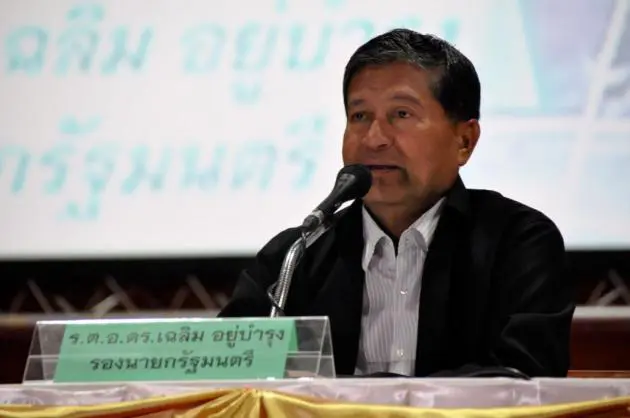
The manner in which veteran politician Chalerm Yoobamrung departed from his post as the country’s security chief said a great deal about the government’s sincerity in its handling of the ongoing conflict in the three southernmost provinces.
As head of the Centre for Implementation of Policies and Strategies for Solving Problems in the Far South – the so-called “Pentagon II” – Chalerm was supposed to be the lead policy-maker for the Malay-Muslim region that has been wracked by insurgent violence since 2004.
But Pentagon II was hastily put together in a knee-jerk reaction just days after a group of insurgents gunned down soldiers patrolling on motorbikes in Pattani’s Mayo district. That July 2012 incident was caught on camera and the public outcry prompted the government to act hastily.
When it was first established, Pentagon II was a little more than a public-relations exercise to give the impression of a civilian body with oversight in the restive region. The civilian leadership of then-Defence minister Yuthasak Sasripapa was supposed to be symbolic, while the day-to-day operations came under the control of the Army. A few months later Chalerm was brought in.
But Chalerm was not satisfied with being just a symbolic head. He wanted to make something out of it – something that could enhance his political leverage. Like other policy-makers before him, Chalerm thought the effort to bring peace to the South need not be a collective effort.
Chalerm has accused the secretary-general of the Southern Border Provinces Administration Centre (SBPAC), Thawee Sodsong, of orchestrating his removal from his post. He blasted Thawee for keeping him and the Army in the dark about the current “peace process” that the SBPAC brass has been working on. This initiative began when fugitive former premier Thaksin Shinawatra, the de facto leader of the ruling Pheu Thai Party, met with 16 separatist leaders in Malaysia in March 2012.
Chalerm has accused Thawee of going over his head and has vented to the media about the deals and details going on in the negotiating room.
Rather than blasting Thawee, perhaps Chalerm should ask Thaksin why he was not brought into the picture from the beginning. He should have known that, as far as Thaksin is concerned, people are only useful as long as they can act and fulfil a certain purpose. In this respect, Chalerm thought too highly of himself and was brutally jolted when his eviction notice arrived.
Political reality aside, one has to wonder, amid the never-ending jockeying for positions in the government, if the interests of the people, the security of the nation, and the wellbeing of all citizens in the South play any part in the policy formulation. From the look of it, the country’s key players in the deep South are more concerned about protecting their little bits of political turf.
Issues – like the current peace talks – have been made public seemingly for the sake of public consumption, as if they were part of some kind of contest. Along the way, they end up competing among themselves for the spotlight. The main players, meanwhile, seem incapable of talking to one another about a common policy and strategy.
But people’s lives are at stake here. Insurgent attacks continue unabated and victims are killed almost on a daily basis. The people of the deep South deserve better.
Unfortunately, inter-agency rivalries continue shamelessly, even though more than 5,500 lives have been lost since January 2004 in this ongoing insurgency that has no end in sight and is being reported on nowhere else in the world.
