
Former British premier says THAILAND MUST NOT GIVE UP on reconciliation


Play
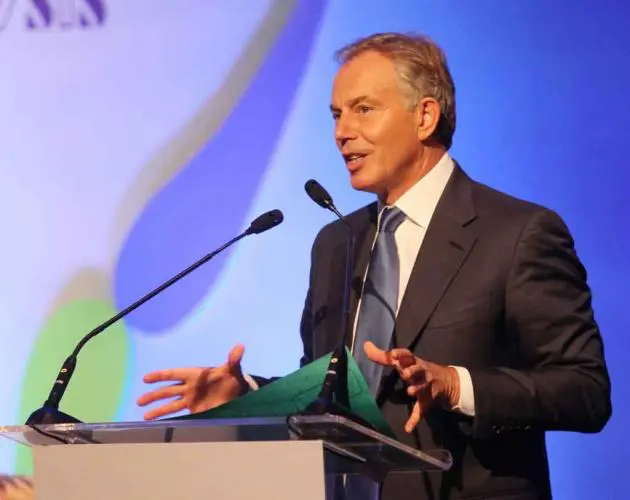
Tony Blair advises that understanding and compromise are essential requirements for any reconciliation process to succeed
Former British prime minister Tony Blair was in Thailand this week to take part in the government's political reconciliation forum. The follwing are excerpts from an interview with The Nation's Veenarat Laohapakakul, during which said it is Thais who have to start the reconciliation process, and not lose hope in it succeeding eventually.
Q: Mr Blair, why did you decide to accept this invitation to come to Thailand?A: The issue of reconciliation is one I obviously know about, since I was heavily engaged in the Northern Ireland peace process and now the Middle East. And also, I am working in about 20 countries on these types of issues. There’s a certain expertise and I am pleased to come and share it.
Q: In your opinion, what is Thailand’s political conflict all about?
A: You have to be careful from the outside giving opinions, but I think the problem is that you have a very polarised politics and it’s not just the normal battle between two political parties. You have to find a way to overcome these differences and that depends frankly on the shared political will by the leadership of the main groups or factions. A shared political will to overcome any past grievances and look to the future, and if the political will is there, it can be done. This is not an impossible situation. It is a perfectly resolvable situation, but you have to work hard to resolve it.
Q: We now have a very divided society. Where should we even start?
A: I think there are certain constitutional and institutional questions that you have to resolve. But there are also real issues to deal with – poverty, equality, education, infrastructure – where there should be a certain amount of common ground whatever political party you come from. Sometimes the best way to start building some trust is to get people to look at those policy areas where there should be a shared common set of objectives and purposes. But where constitutional and institutional changes are proposed, people have to see it as fair and impartially done.
Q: What steps should be taken in this process?
A: I don’t think it is for me to start lecturing. The people of Thailand have to solve their own problem. For the process in Northern Ireland, we have to reform the judiciary, the power sharing system, the police and so on. We went to a lot of effort to make sure that people saw that the process was objective. In other words, we were not trying to fight for one party against another party, but we had some objectivity in it. We usually use people from the outside, in order that people will say, okay, we can see that it comes from someone who has no side in this conflict. We can see that it’s objective.
Q: The Thai government is initiating this process called the political reform council, but how can we make it credible and make it really work?
A: That depends in part on the quality of the dialogue. It also depends on the ability to listen to the other point of view and see if you can find some common ground. Around the world, there are similar problems in many places. People always think their situation is completely unique, but it never really is. The only dialogue that works is the dialogue that’s genuine, and where the atmosphere around the dialogue is such that people are willing to be frank and also give and take, and not just turn up to the dialogue to shout at the other people, which is sometimes what happens.
Q: What should the role of the government be in this whole peace-building process and reconciliation?
A: The government is the government of the country, for the whole of the country, but on the other hand it’s also the government of a particular political party, so that’s always the problem. It’s important, especially, to be in a situation where the government is genuinely reaching out and finding common ground. It is not for me to say what this government does. I found this myself when I was trying to lead the Northern Ireland peace process because I was player in that process as well as trying to be an arbitrator of it. This can be difficult for governments, but there are ways to do it.
Q: How best should the government handle opposition groups?
A: To try to establish as much common ground as possible. Democracy is not only about the majority taking power; it’s about the majority creating some common ground with the minority. If that doesn’t happen, then democracy sometimes can break down, especially if you’ve got one group that is very dominant.
Q: In this whole reconciliation process, what should be the role of the oppositions parties, as well as opposition groups, and the public as well?
A: The role of the opposition is obviously to – if the government reaches out – to reach back. Just try and meet halfway. The opposition must realise that ultimately the only way to win is to build support among the people. I am not saying anything controversial here, but what is happening in your politics is the areas of the country from which government and opposition draw their support have become very defined. When I ran the Labour Party, we’d lost four elections, one after another. I had to reconstitute my own party and say I have to start winning support in places that I never won support before. The opposition has an obligation to reach out, and this happens best when you have a situation where the people as well are urging politicians to make the compromises necessary in the interests of the country.
Q: What are the lessons in mediating the Northern Ireland peace process that Thailand can learn from?
A: Well, they are very different, obviously. But there are three lessons, I would say. One is, if you are changing institutions or constitutions, you have to do it on the basis that, ultimately, people perceive it as fair. The second lesson is that you have to have a framework for the future development of the country, which can unite the country, so the things that you are doing in economic and social terms are improving the prosperity of the people and bringing the country together. Thirdly, frankly, is never give up. Just carry on trying, because it is important. And for a country like Thailand, which could certainly become a major regional power, and possibly a global power actually, this is important for the country today. You want, in the end, to have a sense from the people that we have to sort this out because we’ve got a bigger prize that we can put within our grasp.
Q: What drove you to take a leadership role in solving the Northern Ireland conflict?
A: I felt that a dispute of this nature in the 21st century was just crazy. It was holding our country back, it was costing our country an enormous amount. And for the people in Northern Ireland, it was just blighting their lives. So the reason I tried so hard is because I felt we can do better than this. Whether you are Catholic or Protestant, who cares; we have common interests in providing job opportunities, decent education, healthcare and building the country together.
Q: For an amnesty and truth-finding commission, how should these two factors play into the whole process of conciliation?
A: For amnesty, you have to find a way forward, but it has to be a way that people think is fair. I cannot tell you what is the right thing to do on amnesty, but whatever is done has got a greater chance of being accepted if it’s seen to be fair. Secondly, the truth and reconciliation commission is a great idea, and I’ve read the report and it is obviously very measured.
The thing is, you will never persuade people that their grievances are wrong. This is what I have learned from the work I do. But you can honestly look at what happened in the past, and honest examination is important. What you do in terms of amnesty and so on is another matter, but you should do it knowing you will never take away the grievances. The victims of violence in Northern Ireland will never forget and they will never stop feeling a sense of injustice, but we have produced a framework for the future that allows us not to forget the past, but to concentrate on the future.
Q: The United Kingdom is often cited as a model for democracy, and I am sure there are competing political ideas in the UK, but how do you keep that from spilling over and creating a climate of hatred in the country?
A: Well, sometimes we get very controversial things in the UK and there are big demonstrations – against me, or Margaret Thatcher, who used to see big demonstrations against her. But we have never disturbed our essential democracy, and that is for two reasons. One, the rule of law is accepted as impartial. That’s very important. So in the end, people know if they go to court, you may agree or disagree with the verdict, but it is impartially administered. Second, the political parties try to respond to the needs of the people and they compete for power not for the sake of politicians just holding onto political power, but competing as to who does the best job for the people. That’s important for democracy.
Democracy is not just a way of voting but a way of thinking. This is really important. A lot of the new democracies in the Middle East don’t really quite understand this yet. They think, if the majority wins, that’s it. But it’s not. How the majority treats the minority is a vital part of democracy. So you need to have a sense that the political parties are competing not as factions to grab power, but competing as to who offers the best deal for the people.
Q: In the UK, how does the majority honour or listen to the minority?
A: It becomes part of your culture, which is not to say there are no fierce battles on issues. There are fierce battles on lots of issues. But in the end, people accept that there is a certain system of fairness that prevails. After the Labour Party lost four elections, I remember people in the party saying to me, you know, we can never win. We lost for 20 years, we’ve been losing and we will never win. And I say that’s rubbish. We can win, we have to find better policy platforms. We have to find a better way of appealing to the people. And people accepted that.
Some things can be done by the rules, and some things have to be done by feeling, or culture if you like. And the culture that works in democracy has got to be a little of give and take. When that breaks down – you can see in America right now, where Congress has become very polarised – it becomes a problem. You cannot get legislation through; you can’t get issues like the budget resolved. So Thailand is not unique in this. You can get this in any democracy. But you do have to try to overcome it in the end.
Q: Coming to Thailand, aren’t you afraid that you will be drawn into the Thai political conflict itself?
A: Wherever I go, because I am a reasonably well-known figure. All this stuff about me being paid, which, by the way, I am not. That’s absolute rubbish. You get these stories made up all over the place. Nowadays in politics, especially with the media and social media, you step outside the front door, it’s controversial. You have to put all that to one side and do what you think is right.
This is a subject I feel very passionate about, and actually, partly because I spent my honeymoon here in Thailand. I have a great affection for the country. So I am absolutely delighted to come here.
