
So far - winners and losers in Thai unrest


Play
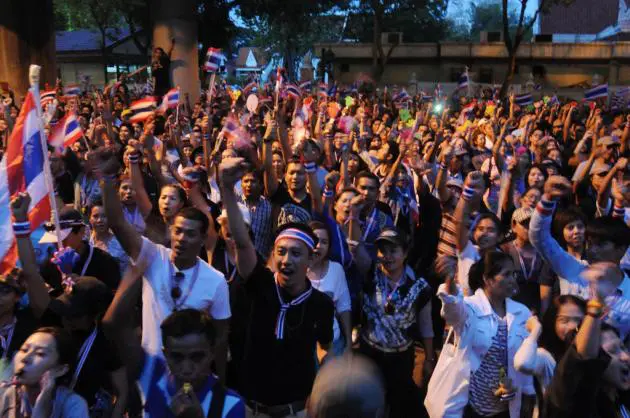
The biggest winner of the month-long civil disobedience movement is the awakening of young Thais, who are twentyish equipped with smart phones and dozens of apps. They are no longer shy away from the so-called irritant social elements they used to churn o
Over the past weeks, they have done all these amazing things: demonstrating and peace marching on streets amid blazing sun, blowing whistles for hours including occupying government buildings. Of course, they tweeted and retweeted and Instagram their photos on Facebook. When they were asked to help to prevent the security forces from apprehending a group of their leaders at Ministry of Finance, immediately they tweeted and called their family, relatives or friends to drive cars in several hundreds at the wee hours to block toll-ways and their entries including streets and sois leading to the ministry. It was an incredible political achievement.
After the student movement reached its peak during 1973-76, which overthrew the Thanom-Praphat dictatorship and paved the way for more democratic Thailand, a long standing yarning could be heard for more active political engagements from students. Now we have it. Nobody expected in the beginning that various student organizations and informal networks would show up so forcefully, not to mention, several hundreds of high school students.
Although these youngsters still lack the sophistication of their predecessors – namely Theerayuth Boonme, Seksan Prasetkul, in terms of political discourse and orientation, they however share a common perception that unless they take part, they would become puppets themselves and eventually could suffer from the ongoing political impasse. For instance, thousands of students from vocational institutions, who are notoriously known as troublemakers, have suddenly morphed into respectable crusaders for justice and democracy.
The second winner is the civil society organizations, which have played active role in sharpening and sustaining the movement. There are well over 80,000 civil groups of various shades and colors with proper registrations or without. Previously, they seldom got together due to their different objectives and ulterior motives so are their organizational structure and funding. But the issues related to the amnesty bill, corruption charges and planned mega-spending schemes have united them in a nick of them. It is interesting to see how these informal and loosely-formed networks of civil groups would able to strengthen and become weighty political entity.
The third winner is the individuals who disconnect electricity and water, unlock doors at ministries and blow the whistles. In other culture the whistle blowers have different meaning – they are people telling secrets nobody knows. In the Thai case, they all know about Thaksin’s secret. That is why they show up and blow the whistles to purge him away. The unlikely hero is, Suthep Thaugsuban, former Democrat Party hotshot, who has reinvented himself into a popular mass leader, something he could not accomplish in his party. His rise as a leader with a staying-on power tells a lot about his background from a village chief.
On the contrary, the biggest loser is undeniably Prime Minister Yingluck Shinawatra. Her charm and non-committal comments which used to be her strength and weapons of mass destruction have suddenly turned against her. For the past two years, albeit her political novice, she managed to survive and played high political poker games. She made a catastrophic mistake as she underestimated the opposition of amnesty bill. She was so confident the bill would go through with the majority in the House. Moreover, her nearly one billion baht frozen bank account linked his brother, as revealed by the Democrat Party during the no-confidence vote, also shattered her innocent image. Now, she is in ruins – her photogenic looks rear its ugly heads.
The second loser is the Red-shirt movement and its affiliated organizations. The confrontation they had over Saturday’s night with the anti-government supporters at Ramkhamhaeng University, killing five persons and injuring scores have discredited further the groups as thuggish. It is interesting to note that the Red-shirt supporters including businessmen and intellectuals have conspicuously absent from the political dialogue and debates these days. There must have been some realization among their peers the Red-shirt movements and political manifesto needed to be changed.
However, another biggest loser is Thailand’s 180-year-old friend, the United States. After all these years, Washington is still do now know how to deal with Thailand. As the world’s foremost supporter of democracy, the US could only say: the United States firmly believes all parties should work together to resolve differences through peaceful dialogue in ways that strengthen democracy and rule of law. That helped explain why both former prime minister Abhisit Vejjajiva and former finance minister Korn Chatikavanij joined the protesters to the US Embassy last week trying to explain the US about the nature of Thai politics.
Finally, there is one person, Thaksin, who is neither a winner nor a loser – not yet for the time being. He is a grand spectator housed in a VIP room far away from the blood, sweat and tear’s struggle he helped to chronograph. As of now, he is thinking of his next bet.
