
Society needs to bridge the respect gap between lecturers and students


Play
A few weeks ago, my friends and I paid a visit to our old university lecturer. The gathering was enjoyable, bringing back the good old times. Many warm memories came back, including good lessons given by the lecturer which could be exercised during our ca
A thought occurs to me: how many university students today would remember their lecturers in the next 25 years?
The question arose in light of a dramatic episode concerning a lecturer and students.
How would you define student/teacher or student/lecturer relationships today? Are these ties full of respect, love, and good wishes? Or are they simply individuals who were paid for services and service users? The answer is crucial in explaining the many good ties and the many sour ties that exist in educational grounds across the country.
The relationships vary, depending on how those involved are willing to define the ties they have had through classrooms.
A social-media storm whipped up around a Thammasat University (TU) lecturer early this month. At first, she became a subject of harsh attacks as some of her students accused her of looking down on temple-school students.
To back their accusation, the students posted an audio clip of the lecturer saying, “Why do you sit on the floor? I am not teaching at a temple school. Students there sit on the floor because they don’t have chairs.”
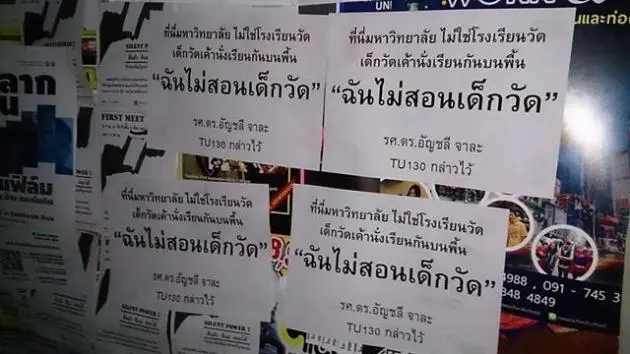
After the clip emerged, TU students started putting up signboards against the particular lecturer. “What’s wrong with students of a temple school? Why do you look down on them?”
Some students demanded an apology from the lecturer, who they say had dehumanised others. Then, someone has posted another audio clip of the same classroom incident to make listeners understand the overall situation better. This clip lasts longer and shows that the lecturer was in the process of nudging her students into taking seats rather than sitting on the floor.
“Take seats please. We have chairs. Don’t sit on the floor. You’re not temple school students. I don’t allow that… If you want to sit together, you must come early and reserve seats in the same row…”
By then, attacks against the woman had subsided but there is a big question about the relationships between lecturers/teachers and students these days. What has gone wrong? Why do some students seem to dislike their lecturers so much that they have gone as far as slandering her online?
A lecturer at the Kasetsart University believes such problems have arisen because youths feel there is no need to show respect to the people being paid to teach them. “These youths also think they are in the free world and can do what they like. Many also believe they can use social media as their weapons,” this lecturer said. This lecturer said that her students once attacked her online for telling them not to use lecturers’ elevators and restrooms.
A schoolteacher laments that the parents of a student even brought local reporters to her class to complain that she used corporal punishment – which is already banned by the Education Ministry. “But they have failed to recognise my good intention. The student had engaged in a fistfight at the school and I wanted to send a clear message that he should never do this again,” the teacher said. She is facing a disciplinary probe, as a result.
A lecturer at Chiang Mai University said that in her younger years, she always looked up to lecturers as inspiring role models and was thus well aware how much ties between students and lecturers have changed. And with this, it was no surprise that youths also changed and therefore might not look up to teachers like the previous generation. She didn’t know what her students think of her or whether they count her as a role model, like how she used to view her teachers. But she had no complaints.
In her eyes, circumstances have changed significantly and so have the ties between students and lecturers. “And what can I expect now that a general-subject class is packed with some 200 and 300 students? How can students feel close to me?” she says.
In small cities or villages, respect still rules. The ties between teachers and students there remain so warm and deep. Students have continued to surround their teachers and alumni have continued to come back to show former teachers their respect.
They have learnt a lot from their relationships of course, not just the academic stuff that all paid teachers are supposed to provide. But first thing is these students bring with them full respect for their teachers, from the first day they enter the school doors. This respect almost demands that teachers fulfil their duties. In turn, they will benefit from all parties. This does not happen with new university students.
We need to understand them too. We need to admit some big universities have focused largely on making money via courses. Direct admission also stirs a belief that they have to invest a lot to earn a place at the university. Respect for lecturers is low and this could turn into low respect for other people in society. This is beyond the issue of lecturers and students. It’s a social concern that worries all in society.
Chularat Saengpassa
