
Female fighters battle for freedom and equality in Syria


Play
Every night before 27-year-old Arin goes to bed, she hangs her Makarov on the rack by the door to her one-bedroom apartment in a small, dusty town on the Syrian border with Iraq.
She was given the Russian semi-automatic pistol as reward for her success on the front line of the battle to protect Kurdish areas of northeast Syria. A year ago she was working as a nurse in Cologne in Germany. Her life has changed dramatically in 12 months.
“This is a bloody war,” says Arin, using her combat name, sitting in the almost deserted apartment block in Til Kocher in northeastern Syria.
“But we need to fight it, we need to protect our women and children or nobody else will defend us.”
Arin is one of thousands of young Kurdish women who have taken up arms in the past two years, with the Kurds, Syria’s largest minority group, largely left to their own devices by President Bashar al-Assad’s forces battling Islamic State militants who have seized large areas of Iraq and Syria.
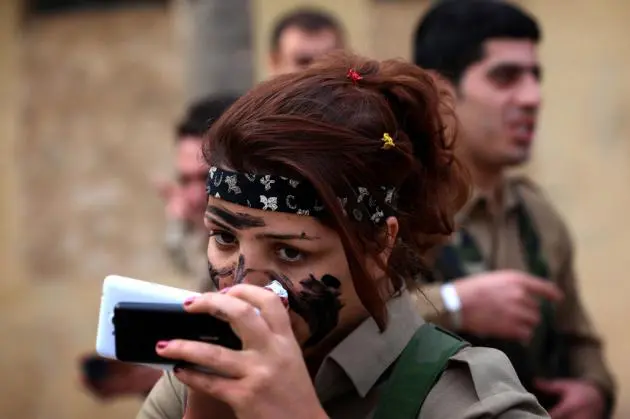
About 7,500 women are estimated to have joined the Women’s Protection Unit, or YPJ, which was set up in 2012 as part of the People’s Defence Unit (YPG), the Kurds’ dominant fighting unit in the northern Syria region of Rojava.
Their aim is to fight any group that threatens Kurdish inhabited areas of Rojava and the YPG has taken defacto control over a sizeable chunk of Syria’s predominantly Kurdish north.
While female fighters are common within the ranks of Kurdish forces, a women-only combat unit is unusual in the mostly conservative Muslim world.
Like the followers of Islamic State, many Kurds are Sunni Muslims but this band of young female fighters hope their frontline role will help put women on an equal footing with men.
“We want to set an example for [both] the Middle East and the West. We want gender equality for all,” says one of the six other women in Arin’s unit who all live in the same, small apartment.
David L Phillips, director of the Peace-building and Rights programme at Columbia University in New York, says these women are making a mark:
“They are some of the fiercest and most effective fighters. Many of them are widowed, and strongly motivated on the battlefield by their personal loss.”
Arin, who was born and raised in Germany, says she was awarded her pistol after she killed 20 Islamic State militants, earning her the reputation among her colleagues as one of the most dangerous snipers in the group.
Born in Cologne of Kurdish parents, Arin graduated from nursing school and was working there when the Syrian conflict started. Some 200,000 people have died during the four-year conflict, says the United Nations.
“I had a good life, I liked living there,” Arin says, dressed in a green camouflage uniform with baggy trousers, but she felt she had to do something as the news became worse. “I remember watching television when I saw women and children slaughtered by Daesh [Islamic State], and I couldn’t stand it anymore.”
Last year she travelled to Syria to join the YPJ and now heads her unit. It originally had 20 members, mainly from Syria and Turkey. Today, seven survive.
She is reluctant to give too many details about the group’s combat operations or to comment on any links between the YPJ and the Kurdistan Workers’ Party, or PKK, an organisation fighting for Kurds in Turkey that is designated a terrorist group by the US and EU.
Syrian Kurds have an ambiguous relationship Assad, who has mostly left the Kurds alone while focusing firepower on insurgents fighting to unseat him. The Syrian Kurds have denied cooperating with Assad.
When they’re not fighting, the unit of seven women avoid talking about war, preferring to cook and laugh as if they were living an ordinary life.
Arin hasn’t talked to her parents since she left Germany.
“I don’t call them, it’s better this way,” she says. “My life is here with these brave women. They are my family.”
The daily schedule of Arin’s unit is always tight, starting with breakfast at 8am and strategy meetings.
Nisan, a 24-year-old combatant, spreads a grey plastic tablecloth on the floor. She lost her right finger while fighting in Rabia, the Iraqi town adjacent to Til Kocher, in August.
Rangin, another sniper, enters with breakfast: tomatoes, olives, goat cheese, and homemade bread.
After breakfast, the unit’s phone rings. Orders are given and three women grab their combat gear, as a car outside waits to take them to Jezza, a town close to Kobani on the Turkish border and one of the war’s most violent flashpoints.
“We are going to fight the Daesh, take care,” Arin says as she closes the door behind her.
