
A slowing China triggers a growing crackdown


Play
And the climate of fear caused by enforced disappearances threatens to spread to Southeast Asia
With each new report of an aggrieved Chinese citizen or journalist gone missing, concerns grow over Beijing’s escalating crackdown on dissent in mainland China and abroad as the nation’s growth rate continues to slow. It is no longer just pollution from China that Hong Kong citizens have to worry about.
And indeed, all of China’s Southeast Asian neighbours and trading partners, including Thailand, should take note of the growing impact of a slowing China on both economies and dissent.
The Asian Development Bank (ADB)’s outlook for Asia in 2016, released on Wednesday, forecast China’s economic growth would continue to be moderate. In it is flagship annual economic report, the ADB saw China’s growth slowing to 6.5 per cent this year and 6.3 per cent in 2017.
In contrast, Beijing has predicted growth of 6.5 to 7 per cent this year and an average of 6.5 per cent over the five years ahead. The slowing growth rate has already reduced by up to 0.3 percentage points the economic outlook for developing Asian nations overall, notes the ADB, given China’s trade and supply linkages.
Yet, if it was simply a slowing, but still growing China that trade partners had to contend with, that would be challenge enough. Instead, in a potentially ominous new development for businesses in Hong Kong, new worries and protests have arisen over whether China’s version of “rule of law” and treatment of dissent has now extended beyond its borders.
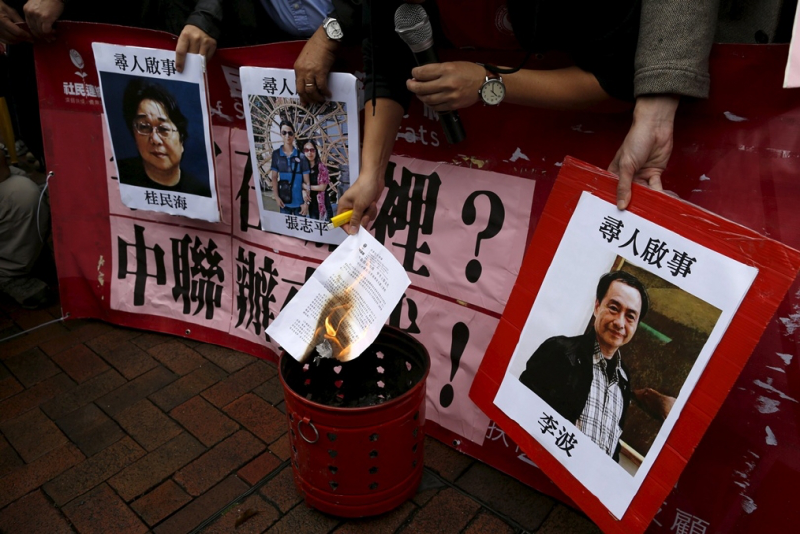
No longer does Beijing’s legal and security net trawl for only mainland Chinese citizens. Hong Kong citizens as well as passport holders from Sweden and the United Kingdom have also vanished in mysterious circumstances over the past few months before reappearing in the hands of Chinese security forces.
The capitalist, freewheeling Hong Kong has been pretty much left on its own to run as an autonomous special administrative region of China since the British left in 1997.
That could now be changing. As China’s GDP growth decelerates to its slowest in a quarter-century, Beijing appears to be paying more attention to stamping out anything that could trigger questions about its leadership and ability to run the nation.
In a tale that reads like a Cold War spy thriller, Gui Minhai, a Swedish national born in China, went missing last autumn from his condominium in Pattaya on the Gulf of Siam. Four of his colleagues also disappeared.
One, Lee Bo, vanished at year’s end from Hong Kong, the home base of their publishing company Mighty Current Media and its now closed retail arm Causeway Book Store. Mighty Current specialises in controversial and outright gossipy books often highly critical of China’s communist leadership. Gui and Lee’s three colleagues reportedly disappeared while in mainland China.
Gui subsequently re-emerged on China’s government-run state broadcaster CCTV. In a tearful confession to camera, Gui said he had returned to China to face justice for his involvement in a 2003 fatal hit-and-run accident in the city of Ningbo. Family and friends are sceptical and suspect the filmed statement was coerced.
Meanwhile Lee reappeared in Hong Kong a few days ago after more than two months in mainland China. He was quoted by a Chinese website as saying he would never again sell “fabricated” books or run a bookstore.
Why the disappearances? One popular theory focuses on Mighty Current Media’s planned publication of a tell-all book on the love affairs of twice-married Chinese president Xi Jinping. The speculation is that those plans spurred Xi to send Chinese security forces across the border into both Hong Kong and Thailand to spirit the Swedish and British passport holders to China against their will.
“An upsurge in cases of possible enforced disappearances in China in the context of an ongoing crackdown in dissent is deeply worrying,” the global writers’ organisation PEN International said in a statement released in London in January.
More intrigue will follow. Western media are reporting that Chinese dissidents in the United States and Europe are saying that close relatives back in China may have been detained by police as part of an investigation into the authors of a mysterious letter that appeared online in China, calling for Xi to resign.
Steve Herman, Southeast Asia bureau chief of Voice of America and a long-time Asia reporter now resident in Bangkok, noted earlier this year on the disappearance of Gui from Pattaya, “A critical unanswered question is whether there was collusion between the Chinese government and Thai authorities. The lack of concern expressed by the ruling military junta is notable.”
Ominously, he added, “China has demonstrated that it has the long reach to apparently abduct people beyond Hong Kong, including here in Southeast Asia.”
A climate of fear could descend quickly if it is confirmed that mainland Chinese security forces have abducted people from the streets of Hong Kong and Thailand. But until then, business goes on.
The tale of the missing booksellers and a growing crackdown on criticism of Beijing by individuals at home and abroad, however, should give Southeast Asia reason to pause.
Whether in Hong Kong, Thailand or one of China’s other major Asia trading partners, leaders should recognise that it is clear and transparently enforced rule of law – not looking the other way on “enforced disappearances” – that is essential for business confidence and economic growth in the long run.
China must recognise too that its strength lies ultimately in the free enterprise and free speech of its citizens.
Curtis S Chin, a former US ambassador to the Asian Development Bank, is managing director of advisory firm RiverPeak Group, LLC. Follow him on Twitter at @CurtisSChin.
