
'Typha Pilot House': A Green Innovation to Fight Global Warming


The Thai-German 'CHARMSbio' Project Typha Insulation Cuts Air-Con Costs by 80%, Turning Traditional Thai Houses into Carbon Sinks
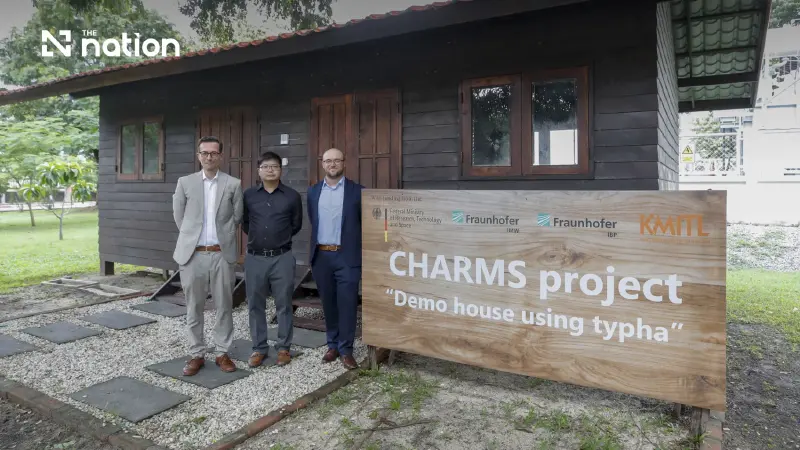
Who would have guessed that the Typha (aka cattails) — a humble weed that chokes waterways across the country — could be transformed into a shield for the planet and a genuine energy-saving innovation? Amid the global push toward a low-carbon society, the Thai-German joint research project “CHARMSbio” has sent a significant ripple through the world of green architecture and construction materials with the unveiling of the “Typha Pilot House,” a mock house echoing the spirit of a traditional rural Thai home. Presented at KMITL Expo 2026, hosted by King Mongkut's Institute of Technology Ladkrabang (KMITL), the structure is fitted with bio-based natural insulation panels that have been proven to break the heat cycle and cut air-conditioning energy use by as much as 80%. It's a striking case of turning traditional wisdom into a tangible weapon against the climate crisis.


The collaboration traces its roots to a heritage-management perspective brought by Henrik Beermann, Deputy Head of the Innovation Acceptance Unit at the Fraunhofer Institute for Systems and Innovation Research (Fraunhofer ISI), a German expert in technology transfer. Beermann argued that conserving old wooden buildings shouldn't mean simply preserving them as historical relics — they need to be revived for genuine everyday use. The research team went further, discovering that the aged timber itself functions as a massive natural carbon sink. Beermann likens the realization to putting on a new pair of glasses: it reframed the entire problem, opening the door to blending in new bio-based materials and elevating the idea of cultural heritage into a concrete tool for carbon management and climate action — which ultimately led to the invention of an entirely new construction material.

Meanwhile, Asst. Prof. Dr. Natdanai Sinsamutphadung, faculty member in the Department of Civil Engineering and Principle Investigator of the CHARMSbio project on the Thai side at KMITL, helped decode the traditional Thai wisdom behind stilt houses — raised high to cope with rising and falling water, a legacy of the country's old canal-based cities. To keep the engineering test precise and free of confounding variables, the research team removed the stilted base and instead built a pair of identical twin test houses, matched down to the last detail in structure and surface finish. High-precision sensors were installed to keep environmental conditions perfectly controlled between the two. One house was fitted with bio-based natural insulation panels made from cattail; the other was left without, so the team could compare the results empirically.

After nearly two years of monitoring conditions and livability inside the twin test houses — through the hot season, the monsoon, and heavy storms — the research team gathered some compelling empirical data. Jakob Richtmann, a researcher at the Fraunhofer Institute for Building Physics (Fraunhofer IBP) and a member of the German team, reported that the room fitted with natural Typha insulation ran noticeably cooler and felt markedly more thermally comfortable. With the air conditioners in both rooms set to the same 22°C, the insulated room saved as much as 75–80% on electricity, thanks to its ability to hold a stable temperature long enough to switch the AC off for extended periods, while the uninsulated room's unit had to work constantly to fight off the outside heat. On moisture resistance, the Typha panels — true to the plant's wetland origins — proved highly resistant to damp and mold. Although the exterior surface weathered somewhat under monsoon conditions, its waterproofing and thermal insulation properties inside remained fully intact. A separate issue with rainwater leakage turned out to stem from poorly sealed joints in the roof structure, not a failure of the insulation itself, and the team is preparing repairs. The project has also gone a step further by installing PM2.5 dust sensors — an idea that emerged while scaling the project to Chiang Mai — to address indoor air quality for modern buildings as well.

Developing natural insulation from Typha is also helping to dismantle a long-standing Thai perception that wooden houses or natural materials are somehow outdated. A consumer-behavior survey using the SenseMaker research methodology in Chiang Mai found that people hold a strong emotional attachment and genuinely positive attitude toward traditional wooden houses — tied to family, nostalgia, and environmental awareness. The real obstacle, the survey found, is a lack of knowledge, technology, and access to high-performance natural materials for restoration and repair. By stepping in to develop proper standards and guidelines, the research institutions are helping reposition bio-based materials as a modern, safe, low-carbon technology. On the regulatory front, Thailand currently has no requirement governing the proportion of thermal insulation used in buildings — unlike Germany, where the Energy Efficiency Law mandates insulation in all new construction to cut electricity use and reduce coal burning, complete with simulation tools that let contractors systematically calculate thickness and installation methods. Early on, the research team considered adapting the standards set by WTA (International Association for Science and Technology of Building Maintenance and Monuments Preservation), which Germany uses for the upkeep of historic buildings. But after weighing Thailand's structural and regulatory constraints, the project pivoted instead to prioritize developing and promoting low-carbon construction materials and bio-based natural materials more broadly.

To keep the research from ending up as another report gathering dust on a shelf, CHARMSbio has built its operations around four concrete pillars: engineering testing through the real twin test houses; technology transfer and intellectual-property management with Fraunhofer ISI; pushing for policy and building standards alongside the Department of Public Works and Town & Country Planning, the National Housing Authority, and the Association of Siamese Architects; and hands-on education and training through a partnership between Germany's BBI construction trade school and Rajamangala University of Technology Thanyaburi (RMUTT), aimed at producing trainers and field installation teams. The work runs on an equal-partnership basis: KMITL draws on its local engineering network to manage construction of the test houses quickly, while the German team develops the formula and presses the prototype insulation panels in Fraunhofer IBP's lab — leveraging its more advanced machinery — before shipping them overseas. In the current phase, the project has taken a further step forward, beginning trials of pressing and producing panels from locally sourced Thai cattail and rice straw to test their real-world performance.
As for funding, the CHARMSbio project's grant to establish a Center of Excellence for bio-based urban planning is not enough to sustain long-term operations, so the project is preparing to become financially self-reliant through three main channels: launching commercial training courses in craftsmanship and installation of the German insulation technology; jointly writing project proposals to pursue additional international research funding; and holding shared intellectual property rights between KMITL and the German side to license the insulation panels and processed natural materials, with the profit share feeding back into the research center going forward. The plan also calls for expanding the testing blueprint to different regions of the country according to local climate conditions — tackling PM2.5 dust in the North, resisting monsoon storms in the South, and testing material warping under the intense sun of the Northeast. RMUTT is currently building another test house to serve as a hands-on training school for constructing buildings fitted with insulation layers to German standards.
In the end, CHARMSbio demonstrates more than the fact that cutting-edge European technology and a local weed can be combined to solve an environmental problem. This piece of evidence proves to the world that true green innovation isn't measured by how advanced the machinery is — it's measured by turning a worthless weed into a shield for the planet, and by weaving international trust to hand communities genuinely sustainable, energy-efficient homes and clean, pure air for good.
