
When Communities Become Their Own Architects: Collective Housing Builds Sustainable Ways of Life
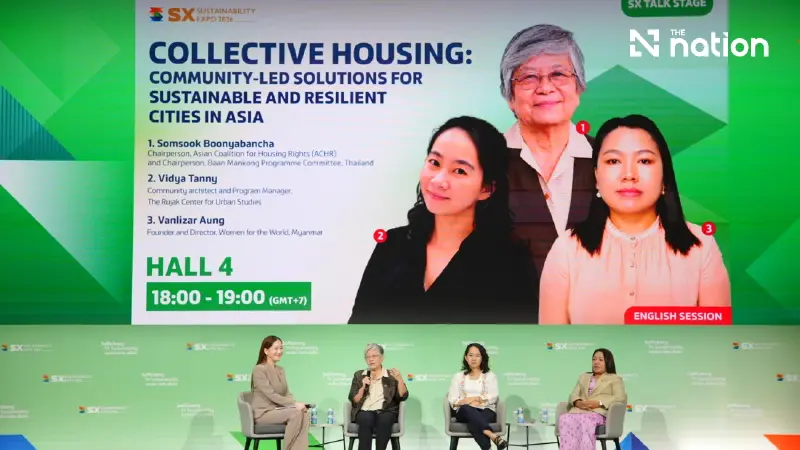


Today, more than 500,000 disadvantaged, low-income and formerly homeless people across Asia live in homes they are comfortable in because they designed them themselves.
They have neighbors, close-knit and caring communities, and ways of life they have shaped on their own terms. This was unheard of in the past, yet it is happening today and continues to expand, thanks to Collective Housing – an approach in which community members jointly conceive, plan, design, build and manage their own communities and ways of life.
Housing remains a major global challenge, particularly for low-income groups and for people affected by disasters, which are striking with increasing suddenness and severity. An estimated 1.1 billion people across Asia live in slums, in substandard housing or in areas from which they could be evicted at any time. As urban development accelerates and inequality widens, the problems facing cities and their residents grow more complex, leaving people less resilient.

“We want cities that can adapt quickly, but how can we have such societies or cities if we do not have communities that are adaptive and sustainable?” observed Somsook Boonyabancha, who has helped spread the Collective Housing approach across Asia.
Somsook is Chair of the Board of the Asian Coalition for Housing Rights (ACHR), Advisor to the Board of the Community Organizations Development Institute (Public Organization) (CODI), and Chair of the Subcommittee on Baan Mankong (Secure Housing) and Land Management. She is also a recipient of the Shaper Award at Sustainability Expo 2026 (SX2026), ASEAN’s largest sustainability event. The award honors individuals whose roles and achievements have made an outstanding contribution to sustainable development across various fields.

Speaking at the panel discussion “Collective Housing: Community-led Solutions for Sustainable and Resilient Cities in Asia” at SX2026, Somsook explained that in today’s market system, architects design homes for developers to build and sell, and buyers must pay high prices to live in homes they had no part in designing. Collective Housing reverses this thinking by making homeowners the architects in a broader sense. Beyond designing their own homes, they also design their own communities – deciding what they want their community to be like, where their children can play and how they want to live – and then design and build accordingly.

Vidya Tanny, an Indonesian architect and project manager at the Rujak Center for Urban Studies, added that building cities with strong adaptive capacity means letting communities build them, because communities know best what they need.
She cited a community redevelopment project in Indonesia after a tsunami destroyed an entire city and left hundreds of thousands of people homeless. With assistance slow to arrive, local communities came together. Experts from various fields went into the area to talk with residents and help identify safe sites suitable for new settlements. The communities then pooled their resources to buy materials to rebuild their homes and neighborhoods, and planned their own infrastructure.
Similarly, in Myanmar, after Cyclone Nargis devastated many areas in 2008, the Collective Housing approach helped restore hope to the lives of those affected.
Vanlizar Aung, founder and director of Women for the World in Myanmar, said the power of women should never be underestimated. Starting from women’s groups, Collective Housing became a reality, ultimately building as many as 1,000 homes within two months – a remarkable solution to post-disaster homelessness, achieved without relying solely on government assistance.
According to Vanlizar, the women’s groups joined forces to launch the community rebuilding initiative, bringing in friends and acquaintances to work systematically. They drew up plans for new homes, pooled their savings – with those who had money lending to others – and managed the funds together so that everyone had enough capital to start a new life. They brainstormed, shared whatever experience each person had, and organized information into a system that was easy to use. In the end, they were able to design homes that truly met the community’s needs, and to plan the drinking water and other infrastructure the community required, including how it should be laid out and managed.

In Thailand, there are more than 50 such projects nationwide. One familiar example is the redevelopment of railway-side communities in Taling Chan, which tackled slum conditions, community safety and the landscape along the railway. It was achieved without the need for loans, giving low-income residents the opportunity to live in clean and safe homes. Another is the Khlong Prem Prachakon canal-side development. When the Bangkok Metropolitan Administration (BMA) needed to improve the drainage canal, rather than relocating the residents who had long lived along its banks, the area was redeveloped so that communities could design their own homes and neighborhoods on their original land, with residents jointly keeping the canal clean and safe. The result is a livable community and a well-maintained canal that helps drain water from the city more efficiently in the long term.
“Urban development today leaves each family and household living separately, with no interaction. Neighbors do not know one another. It creates isolated families in crowded cities, which is not natural to Asian culture at all. Collective Housing, by contrast, is natural and in keeping with the Asian way of life. It encourages living together, recognizes our ‘humanity’, and helps build strong societies with bargaining power, creating a collective strength that people have never had before,” said Somsook.
Those leading Collective Housing initiatives in Thailand, Myanmar and Indonesia agreed that they would like Collective Housing to become the mainstream approach to building homes and communities for people of all groups and levels in every society. Beyond meeting everyone’s needs precisely, it delivers real positive impact and helps communities manage resources efficiently. Most importantly, it makes everyone realize that society belongs to us all and is the responsibility of every one of us.
