
Beyond the Ranking: How True Corporation's Investor Relations Built Market Trust
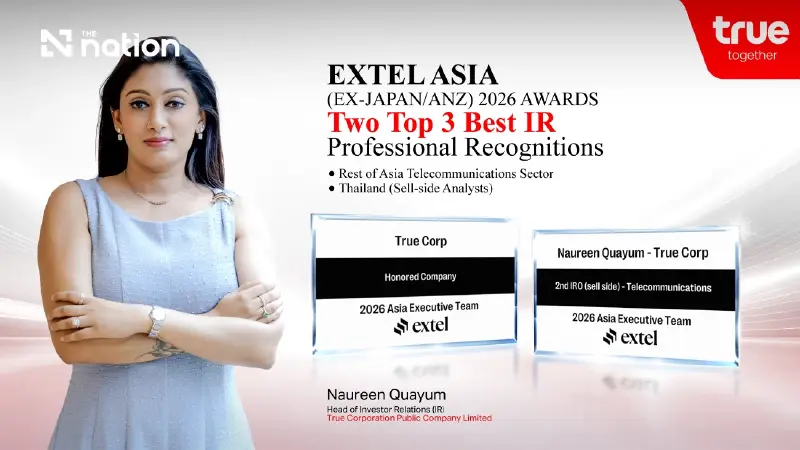


August 5, 2026 - The recognition announced this year in the Extel 2026 Asia Executive Team survey and the 2025 IAA Awards reflects three years of work that rarely made headlines on its own: explaining one of Southeast Asia’s most complex telecom transformations, one difficult conversation at a time.
In an age when investors and analysts have more data than ever, the challenge for investor relations is no longer simply access to information. It is helping the market understand what matters, why it matters, and whether management can be trusted to deliver against what it says.
That is the work behind True Corporation’s recent recognition in the Extel 2026 Asia Executive Team (ex - Japan/ANZ) survey and the 2025 Investment Analysts Association (IAA) Awards. For Naureen Quayum, Head of Investor Relations at True Corporation, the recognition reflects a sustained effort to explain one of Southeast Asia’s most complex telecom transformations with clarity, consistency and candor.
An Amalgamation, Explained in Real Time
True Corporation's 2023 amalgamation could never be reduced to a quarterly script. Investors were not only watching revenue or profitability. They were trying to assess whether two companies could integrate networks, systems and cultures while still delivering the synergies promised — and whether management had enough visibility, in real time, to know if the plan was working.
That task became more demanding as access to financial information expanded around her. Investors no longer depend on an IR team simply to deliver numbers already available through disclosures, databases and analytical platforms. What they increasingly want, Naureen said, is context: not just the figure, but the reasoning behind it, and confidence in the person explaining it.
"Our role is to separate what is important from what is interesting," she said. Rather than cataloguing every integration workstream, her team focused on handful of core themes, explained how they connected, and identified milestones the market could track over time. The goal was what she calls "evidence, not narratives" - showing that strategic decisions were translating into operational improvements and, ultimately, financial results.
The evidence arrived in stages. In 2026, under Group Chief Executive Sigve Brekke and Chief Financial Officer Nakul Sehgal, True reported its sixth consecutive quarter of profitability in the latest quarter, Q2 2026, reporting Net Profit After Tax of THB 6.6 billion, while EBITDA reached THB 28.3 billion, an increase of 13.5% year-on-year. The Board of Directors has approved an interim dividend of THB 0.15 per share. These figures did not eliminate every question around the transformation, but they gave investors measurable proof points against which to test management’s strategy.
Communicating Through Setbacks
Credibility isn't built only when the numbers are improving. Some parts of the integration moved slower than planned, Naureen said, and market expectations had to be reset more than once. Each time, her response was the same: address it directly, while the details were still fresh, rather than waiting for conditions to improve.
That consistency became a stated principle. "Transparency becomes most important when the news is negative," she said. Her approach was to stay accessible, explain the cause plainly and give the market enough context to assess the setback for themselves. Transformation is rarely linear; what investors and analysts find harder to accept is inconsistency or silence.
It also runs in both directions. When the same question comes back from multiple investors, Naureen reads it as a signal — not that the market misunderstood something, but that True's own disclosure, or an assumption it was resting on, might need a second look. Engaging with the capital market community, she said, is not only about explaining the company to the market; it is also about bringing the market’s questions back into the company.
That feedback loop is what elevates IR from a communications function to a strategic one. It is one of the few roles responsible for explaining the company to the market while also bringing the market's scrutiny back into the company.
A Team Effort, Recognized by the Market
None of this rests on one person. Naureen calls investor relations "a team sport," crediting True's Group CEO and CFO for their willingness to engage openly with investors, and the finance, commercial, strategy, legal and communications teams that supply information accurate enough to survive an analyst's or an investor’s cross-examination. Without that support, an IR officer can deliver a polished message but cannot sustain it once the market starts testing it.
That market testing is what made this recognition meaningful. Naureen was ranked No. 2 among IR professionals in Asia's telecommunications sector outside Japan, and No. 3 in Thailand, in the sell-side results of the Extel 2026 Asia Executive Team survey — a ranking built from the votes of the same analysts who question her regularly. True also received recognition across the Chief Executive Officer, Chief Financial Officer and Investor Relations categories at the 2025 IAA Awards for Listed Companies.
Naureen described the recognition as a vote of confidence in the team rather than an individual achievement — the market's collective assessment of whether True communicates clearly, responds thoughtfully, stays accessible and holds credibility over time. She treats it as a checkpoint, not a destination. "Maintaining trust," she said, "will always be more important than receiving it."
Trust Can't Be Automated
Investor relations was originally built around information scarcity: not enough information reached the market fast enough or fairly enough. Generative AI has changed the problem. The market can now summarize disclosures, compare metrics and flag anomalies faster than ever. The harder task is no longer finding information; it is knowing which information matters.
Naureen doesn't see that as a threat to her function so much as a redefinition of it. AI can already summarize a results call faster than any analyst, flag anomalies across a balance sheet, and put institutional-grade analysis within reach of investors who never had it before. What it cannot do is stand behind the numbers. As she put it, AI can analyze data quickly, "but context, judgment and trust remain human."
The distinction is at the heart of what investor relations has become. A model can tell an investor what changed in a balance sheet. It cannot explain why management made a particular trade-off, or who is accountable if the assumptions behind it prove wrong. Someone still needs to be reachable when the automated summary runs out of explanation, and answerable when it turns out to be incomplete.
Extel and the IAA did not create True’s credibility. They made visible what the market had already been testing - one disclosure, one difficult question and one conversation at a time.
