
Thailand plans rooftop solar grants of 50,000 baht per household
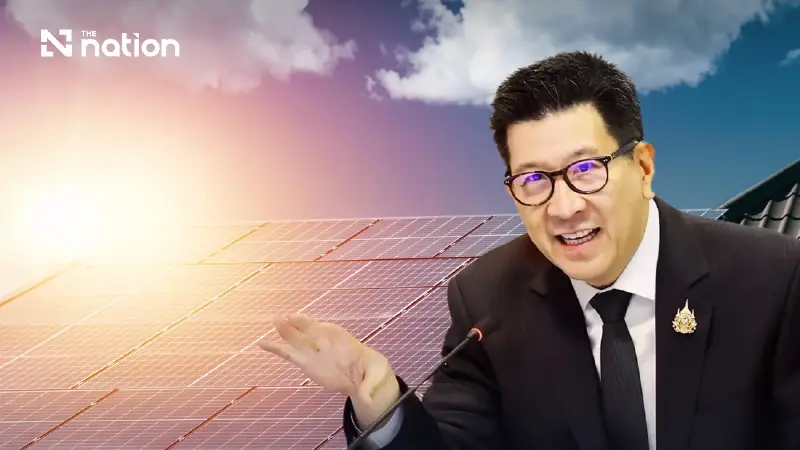


Thailand plans 50,000-baht grants and low-interest state-bank loans to help up to one million households install rooftop solar systems.
- The Thai government plans to provide a non-repayable grant of 50,000 baht per household to encourage the installation of rooftop solar systems.
- In addition to the grant, state-owned banks will offer low-interest soft loans to cover the remaining installation costs, removing the need for large upfront payments.
- The program will include a Net Billing system, allowing households to sell surplus electricity back to the grid to further reduce their energy bills.
- The initiative aims to support up to one million households, reduce electricity costs, promote clean energy, and strengthen Thailand's long-term energy security.
Deputy Prime Minister and Finance Minister Ekniti Nitithanprapas has outlined plans to provide grants of 50,000 baht per household for rooftop solar installations, alongside low-interest loans from state banks.
Ekniti said the Finance Ministry was working with the Interior Ministry, the Metropolitan Electricity Authority (MEA) and the Provincial Electricity Authority (PEA) to accelerate the rooftop solar programme.
The initiative is intended to promote clean energy use and reduce household electricity costs.
Under the proposed scheme, participating households would receive a non-repayable government grant of 50,000 baht. The funding has been allocated under the second workstream of the Finance Ministry’s emergency borrowing decree, which covers the energy transition.
The programme would also introduce a Net Billing system, under which the purchase and sale prices of electricity are calculated separately. Income from surplus electricity sold back to the grid would then be deducted from a household’s electricity bill.
This would allow households with rooftop solar systems to sell electricity they do not use to the MEA or PEA.

State banks to provide low-interest loans
The Finance Ministry is also working with the Government Savings Bank and Government Housing Bank to offer low-interest loans to households participating in the programme.
The financing arrangement is intended to remove the need for households to provide a large upfront payment when switching to clean energy.
After the government’s 50,000-baht grant is deducted from the installation cost, participants would be able to apply for a state-bank loan to cover the remaining amount and repay it in monthly instalments.
The financial institutions would apply a new credit-assessment method based partly on each household’s electricity-use history, making loans more accessible to the general public.
The repayment mechanism would also be designed to reflect the savings generated by the rooftop solar system.
For example, a household that reduces its monthly electricity bill by 2,000 baht could use 1,000 baht of that saving to repay the bank while retaining the other 1,000 baht as an immediate reduction in its energy costs.
“Preliminary calculations show that the investment would pay for itself within three to four years, without people having to provide their own upfront funds,” Ekniti said.
“From the fourth or fifth year onwards, households would receive the full benefit of lower electricity costs.”

Scheme targets up to one million households
The programme is intended to support between 500,000 and one million households in making the transition to clean energy.
It would be particularly suitable for homes with average monthly electricity bills of between 3,000 and 4,000 baht.
The recommended minimum installation capacity is five kilowatts, with systems of that size currently estimated to cost slightly more than 100,000 baht on the market.
Ekniti said encouraging households to generate their own electricity would also strengthen Thailand’s long-term energy security.
“Thailand currently relies heavily on imported gas for electricity generation, at around 60%,” he said. “Promoting household electricity generation is therefore an important mechanism for building long-term energy security.”
One-stop service to oversee safety standards
The programme would be provided through a one-stop service, with the MEA and PEA responsible for inspecting and certifying installation standards.
The two electricity authorities would also select and assess installers to ensure they met the required qualifications and to reduce the risk of accidents, including electrical short circuits.
The Board of Investment would help develop measures encouraging the use of domestically manufactured equipment, including solar panels and related components.
The policy is intended to ensure that Thai suppliers and businesses benefit from the programme, while strengthening the domestic supply chain and creating jobs.
The government aims to submit the proposal to a screening committee and accelerate its implementation within one month, with the grants subsequently transferred directly to eligible households.
