
Climateflation drives up food prices and living costs


Extreme heat is damaging crops, raising insurance and energy bills and complicating inflation control as climate risks spread through the global economy.
Climate change is becoming a direct inflationary force in the global economy, with extreme heat damaging crops, lifting food prices and feeding through to insurance, energy and healthcare costs.
Known as “climateflation”, the phenomenon occurs when climate change and extreme weather push up prices and living costs by reducing agricultural output, disrupting supply chains and increasing production expenses.
Food is the most immediate transmission channel, but the pressure is spreading across household budgets and into central-bank decisions. What was once treated largely as a long-term sustainability risk is increasingly affecting current inflation, consumer spending and economic growth.
Crop losses feed directly into food inflation
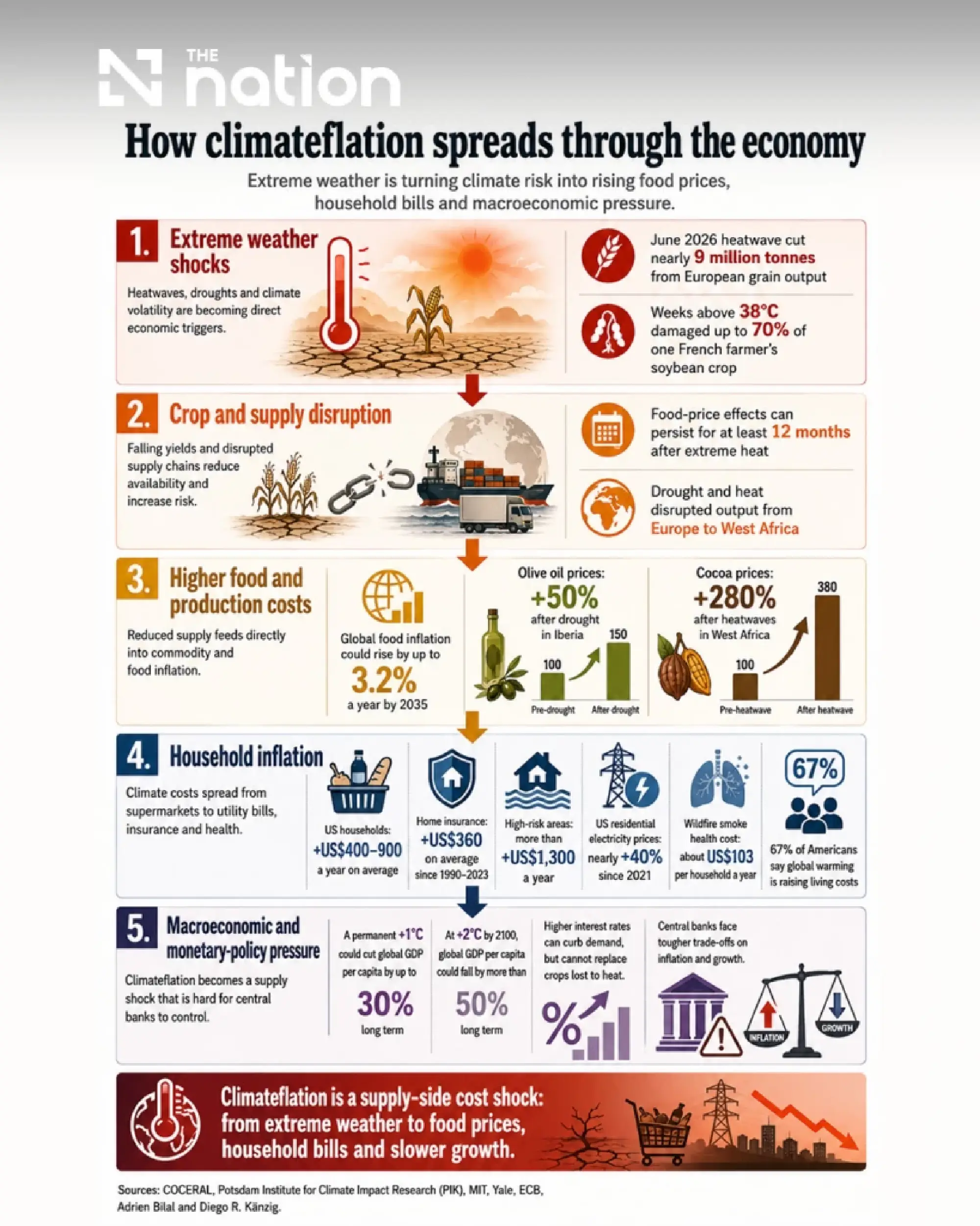
Figures from the European grain traders’ association COCERAL showed that a heatwave in June 2026 alone destroyed nearly 9 million tonnes of European grain output, causing substantial economic losses.
The resulting pressure on food inflation was described as more severe than the effects of the war in the Middle East and the closure of the Strait of Hormuz.
The scale of the damage is visible at farm level. Benoît Merlot, a farmer in France’s Auvergne-Rhône-Alpes region, had spent more than a decade preparing for drought by selecting crop varieties better able to withstand dry conditions.
Those preparations proved insufficient when temperatures remained above 38 degrees Celsius for several weeks. Merlot said as much as 70% of his soybean crop was damaged.
Research by Maximilian Kotz of the Potsdam Institute for Climate Impact Research found that higher temperatures alone could increase annual global food inflation by as much as 3.2% by 2035.
The effects are not limited to the immediate period of extreme weather. Higher temperatures can continue to influence consumer price indices for at least 12 months after an extreme heat event.
Several commodities already illustrate how climate shocks can move rapidly through global markets. Olive oil prices rose by 50% following drought on the Iberian Peninsula, while cocoa prices surged by as much as 280% after heatwaves in West Africa.
Prolonged drought in Morocco left hundreds of thousands of people unemployed, while sharp increases in maize prices contributed to protests in Kenya.
The examples show how unstable weather can affect food prices throughout the supply chain, from agricultural production and wholesale markets to products on supermarket shelves.

Climate costs spread across household budgets
Climateflation extends well beyond food. A survey by the Yale Program on Climate Change Communication and the George Mason University Center for Climate Change Communication found that 67% of Americans believed global warming was increasing their cost of living.
Respondents identified household utility bills, food and home insurance among the expenses being affected.
Research by the Massachusetts Institute of Technology found that extreme weather linked to climate change was pushing up prices across the US economy, adding an estimated US$400–US$900 a year to the average household’s expenses.
Lower-income households face greater exposure because they have less financial capacity to adapt and may be unable to gain access to energy-efficient technologies that could reduce their bills.
The unequal impact makes climateflation both an economic and a sustainability challenge. Households with the fewest resources are often the least able to absorb higher food, energy, insurance and healthcare costs.
Insurance, energy and health bills climb
Catherine Wolfram, a professor at MIT, identified home insurance premiums as one of the clearest climate-related financial burdens.
Insurers facing greater risks from wildfires, storms and other extreme events are raising premiums while reducing the number of plans available to homeowners.
Researchers estimated that climate change contributed to an average US$360 increase in home insurance premiums between 1990 and 2023.
The impact is substantially greater in high-risk areas. Households in California or Florida may pay more than US$1,300 extra each year for insurance against increasingly severe wildfires and storms.
Energy expenses are also rising. Electricity and cooking-gas costs have increased across much of the world, while US residential electricity prices have climbed by nearly 40% since 2021.
Part of the increase has been attributed to the need to upgrade electricity grids so that they can better withstand storms. Households are also using more air conditioning as temperatures reach 40 degrees Celsius across the country.
Less visible climate costs are emerging through public health. Wildfire smoke can contribute to premature deaths, producing estimated economic damage of about US$103 per household each year.
Anthony Leiserowitz of Yale University said public awareness remained limited regarding the health effects of extreme heat and the spread of new infectious diseases, both of which could continue to increase medical expenses.
Yale research found that only 35% of Americans recognised the connection between climate change and rising healthcare costs.
Central banks face a supply-side inflation problem
Climateflation also creates a monetary-policy challenge. Central banks, including the European Central Bank, increasingly recognise that climate volatility can make inflation more difficult to control.
Higher interest rates can reduce consumer and business demand, but they cannot restore crops destroyed by heat, repair disrupted supply chains or immediately increase the availability of essential commodities.
Climate-related inflation therefore behaves as a supply shock. Central banks may be forced to choose between keeping interest rates high to contain prices and avoiding excessive damage to investment, employment and economic growth.
Recurring food and energy shocks could also make inflation more volatile, complicating forecasts and weakening the effectiveness of conventional monetary-policy tools.
Bob Ward of the London School of Economics and Political Science said the global food system had been built on the assumption of relatively stable weather.
That system must now adapt to greater uncertainty by diversifying supply chains and reducing dependence on individual regions or producers. Such a transition would require substantial investment and more complex management.
Rising temperatures threaten long-term growth
The economic consequences may extend far beyond short-term changes in consumer prices.
Research by Adrien Bilal and Diego R. Känzig found that every permanent 1-degree-Celsius increase in global temperatures could reduce global GDP per capita by as much as 30% over the long term.
That estimate is about 10 times greater than the economic damage projected by previous models.
The losses would accumulate over time and could not easily be reversed. Under current policies, a 2-degree-Celsius rise in global temperatures by 2100 could reduce global GDP per capita by more than 50%.
These findings position climate conditions as a fundamental influence on economic growth, investment and human productivity rather than a separate environmental concern.
Climateflation also changes the economic case for reducing greenhouse-gas emissions. Cutting emissions could ease long-term pressure on food prices, while stronger and more diverse supply chains could reduce exposure to future climate shocks.
Delaying climate action or weakening carbon policies would leave households, businesses and governments facing higher recurring costs. From this perspective, the transition to clean energy is not only an environmental objective but also a long-term strategy for limiting the “global warming tax” increasingly embedded in food, insurance, energy and healthcare bills.
Source: Bangkokbiznews
