
A river runs through it


Play
Straddling the Danube, the city of Budapest is home to magnificent architecture and some of the best cafes in the world
The chilly wind cuts right through us as the driver opens the coach door. Wrapping our coats tightly around ourselves, we step out of the heated vehicle into an usually cold Budapest to gaze at the bronze statue of King Stephen I of Hungary mounted on a horse.
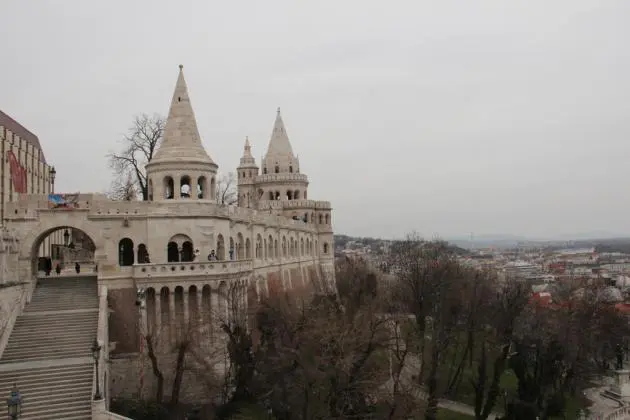
The statue stands between the Fisherman’s Bastion and the Matthias Church. At its base, tourists are excitedly snapping photos of two huge hawks and two men dressed in the uniforms of the ancient Hungarian military.
The white tower and colourful diamond pattern of the roof tiles on Matthias Church are spectacular even against today’s grey sky. Originally built in Romanesque style in 1015, the earliest remains of date back to the 13th century when King Bela IV ordered the church built after the Mongol invaders left Hungary. Matthias Church, Buda’s first parish, became a mosque when the Turks captured Buda and its treasures were shipped off to Bratislava while the ornate frescoes on the wall were whitewashed. When the Turks left, it was rebuilt in Baroque style, then late in the 19th century, architect Frigyes Schulek, who also designed the Fisherman's Bastion, went back to the original 13th century plans and restored the edifice in Neo Gothic style.
The Halaszbastya or Fisherman's Bastion, a terrace in neo-Gothic and neo-Romanesque style, gets its name from the guild of fishermen responsible for defending the stretch of the city walls in the middle ages. It was designed and built as a decoration with seven towers along the terrace representing the seven Magyar tribes that settled in the Carpathian Basin in 896. It was severely damaged during World War II and Janos Schulek, the son of Frigyes, led the 1947 restoration.
From the Fisherman's Bastion, we take in the panoramic views of Budapest. The Danube River is like a small blue ribbon slithering between Buda and Pest and the gigantic Hungarian Parliament building, where Saint Stephen’s Crown is housed, looks like a tiny model.
The city of Budapest grew out of three separate towns: Buda, Pest and Obuda. The three were formally and administratively united as Budapest in 1873.
Budapest holds the title “City of Spas” with 118 springs, providing more than 70 million litres of mineral-rich water daily, ranging in temperature from 21 degrees Celsius to 78C.
The bathing culture started with the Romans who conquered the area as early as the 2nd century and founded a colony named Pannonia, centuries before the Magyars, the ancestors of current Hungarians, arrived. The Romans exploited the thermal springs on the northeastern borders of the Pannonia and named the city, Aquincum, which means abundant water. It was later named Buda by the Magyars and became Obuda when the Royal Palace was built on Castle Hill.
The thermal spa culture flourished during Turkish occupation, which lasted for more than a century. Ottoman bathing customs were introduced and developed and by the end of the 19th century, spas were an essential part of every Grand Tour.
The Szechenyi Bath is one of the largest bathing complexes in all Europe, and the only old medicinal baths to be found in Pest. The indoor neo-Baroque medicinal baths date from 1913 and the outdoor pools date from 1927.
Still shivering despite layers of clothing, we’re amazed to see people of all ages clad in bathing suits dash through chilly wind to soak in the thermal pool. Surrounded by yellowish neo-Baroque style buildings, it is like going back in time of the golden age of Budapest.
A few hundred meters from the complex is the Hero’s Square, Budapest’s best known landmark. Two semicircular colonnades with statues of the leaders of the seven tribes that founded Hungary and other outstanding figures in Hungarian history stand aside the Millennium Memorial, a high column topped with a statue of the archangel Gabriel.
Hero's Square and the adjoining city park, Varosliget, were created to commemorate the 1000th anniversary of the Magyar conquest of Hungary.
A highlight in the park is Vajdahunyad Castle, which was originally built from cardboard and wood in honour of the millennium. A variety of architectural styles ranging from Romanesque to Gothic were intended to represent each century since the Magyars arrival. The site proved so popular that Vajdahunyad was rebuilt in brick.
Snow blankets the park but many visitors seem blissfully unaware of the cold weather. They line up in front of a statue of Anonymus, the writer of the first book of the Hungarian history, the “Gesta Hungarorum”, eager to touch the monk’s stylus as it is believed to bring good luck in one’s studies.
We make our way to one of Budapest’s famed cafes for a hot drink. Many of the Hungarian capital’s cafes are famous all over Europe, among them Cafe Gerbeaud, operating since the middle of the 19th century, and reputed for its delicious cakes. Also popular is the elegant New York Café, the preferred hang out of writers, actors, poets and journalists some 100 years ago.
Refreshed after coffee and pastries, we head to St. Stephen's Basilica, a Roman Catholic basilica named in honour of King Stephen I of Hungary, whose incorruptible right hand is housed in the reliquary. The church is 96 metres tall and on par with the Hungarian Parliament Building. This equation symbolises that worldly and spiritual thoughts have equal importance.
Budapest may be dubbed as Paris of the East but after walking along the Danube, crossing the Chain Bridge, munching paprika with breakfast and sipping Palinka after dinner, I realise that Budapest is far more than that: it’s a city that glows with its own unique charm.
If you go
You need a Schengen visa for travelling around Hungary. Budapest is connected to more than 20 European cities through various airlines.
