
A journey through time


Play
Riding the Trans-Siberian Railway takes travellers back to the good old days
It’s a memory of a past era: the rhythmic rattling of a train’s wheels on the rails is something scarcely known in today’s age of high-speed trains. When you’re on the Trans-Siberian Railway travelling through the huge expanse of Russia beyond the Urals, it’s a sound that lulls you to sleep at night and the first thing you hear when you wake in the morning.
A trip on the world’s longest single rail route reveals a steady coming and going of passengers along the way and the transport of cargo. At the rail stations there are trains kilometres long and loaded with timber from Siberia’s endless forests or coal and ore for the power plants and industrial complexes along the route. Since the start of construction in 1891, the route of the Trans-Siberian Railroad has been the main artery of the Russian empire.
The journey starts in Moscow, but the Siberian feeling only truly starts in Krasnoyarsk, city on the Yenisei River and the gateway to Siberia. It was from here that the Cossacks conquered and settled the eastern regions.
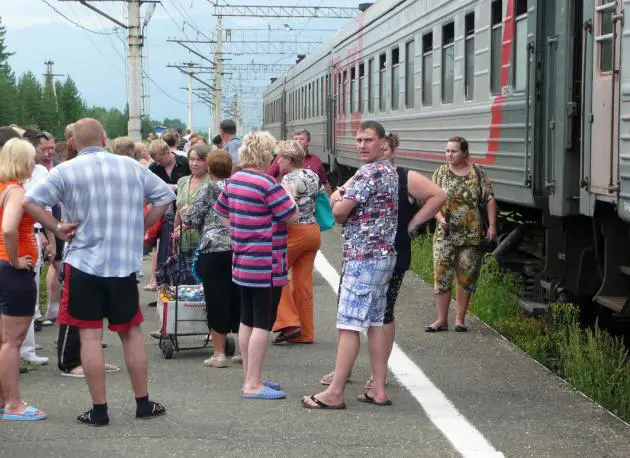
On the platforms of the gigantic railway station there are kiosks and market women pushing carts with food items for the journey – pickles and tomatoes, pancakes and bread, fish and meats.
Tourists boarding the train are met by the attendant who carefully checks their tickets and visas. A brief nod and a wave tells them they can proceed. Inside the coach the lighting is dim as the window shades are still down and some guests are sleeping. Some doors of the compartments are only partially shut and the sound of snoring can be heard. The air is stuffy.
There are five compartments per rail coach. In each there are two red leather-covered couch seats, right and left, a folding table next to the window and a luggage rack over the door. Many of the coaches were built as late as the 1980s in the former East Germany.
The Trans-Siberian Railway is more than simply a train. It is an entire network between Moscow and Vladivostok with a number of individual train routes. One is the Baikal-Amur Magistrale that circles north of Lake Baikal from Taishet to Tynda.
There are side routes that head off into Manchuria, Mongolia, Beijing and even North Korea. And almost every major city operates its own train that operates shuttle service links to Moscow and on to St Petersburg, Warsaw, and Cologne.
Outside the window the outlying districts of some industrial city are gliding past: Pre-fabricated buildings and a forest of construction cranes. Even in cities in Siberia housing cannot increase fast enough. All along the route there are cities, mines, power plants, and steel and aluminium factories.
But then the concrete buildings give way to the dachas, the small wood-frame summerhouses surrounded by their large vegetable gardens. Now and then there are some cattle, and always a banya, the Russian sauna, next to the dachas.
Many of the passengers are families going on vacation. Burdened with their packs and suitcases they emerge from the cities and gather on the rail route to ride to their destinations, be it the sea, or Moscow or camping on Baikal Lake. The compartment door opens. The coach attendant is standing there. She wants to check the tickets once again, registers the compartment number and without a word hands a plastic bag with a packet in it containing sheets and towels.
These women are the uncontested bosses of the passenger coaches. They supply the passengers, vacuum the carpets in the corridor daily and clean the compartments with wash rags. They also rein in the youths who may be drinking a bit much and they always know the current prices for food items being sold at the train station platforms.
Outside, the temperatures are rising. In the summer, these go well beyond 30 degrees Celsius and it is no cooler inside the train. The coach is coming to life, children are running up and down the corridor, the adults are standing at the windows.
The route stretches across broad plains, and further to the east, through mountains which are snow-capped even in summer. Every few hundred kilometres there is yet another imposing train station.
The train races over huge steel bridges stretched across the Yenisei, Angara and Lena rivers, and one starts to fathom the sheer size of Siberia. At 13 million square kilometres it is larger than Canada or the United States. With about three persons per square kilometre it is also one of the most sparsely populated places on earth.
For the moment, the trip ends in Ust’-Nyukzha. There, two weeks of camping, fishing and hunting on the Olyokma River with a local hunter and his German wife are planned. Later, the return journey will go via Sverobaikalsk on Lake Baikal and on to Irkutsk.
