
On the trail of the elusive Russian soul


Play
A whirlwind tour of St Petersburg ends over vodka and pickles in a tour guide's apartment
“St Petersburg smells like coffee, cats and urine,” says our tour guide Irina Netshayeva as she leans against the window of the bus, then quickly adds: “At least, this was how the writer Fyodor Dostoyevski described the smell of the Czarist metropolis”.
At the moment, the city smells only of frost, an odour that has permeated into the bus. It’s October and winter is approaching.
“The weather here is like its women: moody,” she says as an ice-cold rain pelts the windows of the bus.
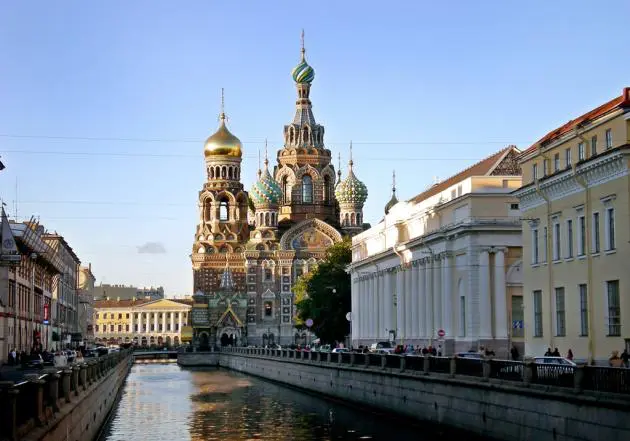
The bus is rolling along Nevsky Prospect, the four- and-a-half kilometre-long main boulevard of St Petersburg, and Netshayeva rattles off the attractions, left and right, as the bus passes by. Here is one of the most beautiful buildings in the city, the Yelisseyev delicatessen with its huge green-framed windows; over there, on a side street, the brightly-coloured Church of the Redeemer with its famous onion-shaped spires.
“Now look fast over to the left,” Netshayeva commands, calling attention to the mighty Kazan Cathedral with its gigantic colonnade entrance. Now over to the right – the store of the famous sewing machine company Singer, now with a cosy cafe.
The tourists in the bus start to murmur among themselves. All this is going much too quickly, too much to see in such little time. And how can one discover the soul of the city – much less the famed Russian soul – when moving at turbo speed? There’s no time to debate a possible answer, but later on, in visiting a private apartment, they might broach the subject again.
But for now, the bus is crossing the Neva River, and after making a curve, its passengers can espy a young bride pulling a black overcoat closer around her frilly white wedding dress.
“This square is beloved by newlyweds,” Netshayeva says. “They even come here from Moscow.”
Now the windscreen wipers of the bus are sweeping left-right-left, but instead of rain, they are clearing the first snowflakes of the coming winter.
The bus stops here, and the passengers disembark, to the sound of ice crackling beneath their feet. Birzhevaya Square forms the top point of Vasilyevski Island, which divides the Neva into two channels. A shivering couple is posing for a picture, with the Peter and Paul Fortress in the background and the steeple of the fortress church looking like a golden needle piercing the sky.
The greatest of all the Czars, Peter the Great (1672-1725) lies buried in the church. It was he who at the start of the 18th century designed the city that would bear his name. Inside the church is his sarcophagus, raised waist-high as visitors pass by. There is also a cat creeping around. Netshayeva says it is the church cat.
Is this the famed soul of Russia? Irina thinks she has an answer waiting about five kilometres further west, in the Erarta Museum of Contemporary Art located on Vasilyevski Island. The museum is located in a pompous villa with thick columns, built in the style typical during the rein of the first Soviet leader, Vladimir Lenin.
But many of the paintings now hanging on the walls could never have been shown during the Soviet Union, notes Aleksandr Kosenkov, an artist now exhibiting his works in the Erarta. Among the works is an abstract painting in which the viewer can just make out two women on skis and lifting hand weights. The women are naked.
Or maybe the Russian soul is hanging over here, Netshayeva winks slyly as she leads the group to another wall. There’s a painting by Nikolai Kopeikin from 2008 called “Motherland.” In it, a sad-looking elephant is sitting beside a lake, looking off in the distance. The trees on the distant lake shore are a lush green. The elephant’s back is leaning against a thin birch tree. On the grass next to it is an empty bottle of vodka. “Ladies and gentlemen, introducing the Russian soul,” our tour guide announces.
Well, maybe. Or maybe one can get closer to it during a visit in the apartment of Elena Hartshenkova, and her tattooed 17-year-old son Kyrill, who hastily brings out three bowls of sour pickles. These are always good after drinking vodka, explains Hartshenkova,, who is a colleague of the tour bus guide and who every few months invites tourists into her flat.
She serves up a snack of tea poured from the traditional samovar, as well as biscuits, apple cake and vodka.
“Many vacationers want to have such an authentic experience, want to know how it looks inside the homes of the people here,” she says.
So, a number of travel agencies now try to fulfil this wish and organise visits with families for small groups. Elena shows her guests everything – from the Rammstein poster in Kyrill’s room to the water boiler in the bathroom, to the utility bills for the apartment.
Everywhere there are flowers – real ones, but also plastic, or knitted, painted, printed or woven. And on the bookshelf there is Leo Tolstoy’s “War and Peace.”
On the Net
_ Kazan Cathedrale, in Russian http://kazansky-spb.ru/
_ Erarta Museum, in English http://www.erarta.com/en/
_ Singer-House, in Russian http://www.spbdk.ru/
