
Cuteness in black and white


Play
Visitors to Chengdu come for the pan
I was hurrying down the corridors of the Panda Story Cinema when I caught a glimpse of a video starring a pair of newborn panda cubs.
It was the first time I had set eyes on newborn cubs, and I was amazed at the way they looked – tiny, pink and virtually hairless – no remote resemblance to the cuddly giant pandas that we are all familiar with. It also reminded me of why so many people spend time at the Chengdu Research Base of Giant Panda Breeding.
Just 10km from downtown Chengdu, this sprawling 100-hectare sanctuary houses the world’s largest population of captive-bred giant pandas and red pandas, which actually look more like racoons.
Wild bamboo forests, brooks, a lake and man-made caves simulate the panda’s natural habitat.
Clusters of towering bamboo provide much welcome shade along the walkways that meander through the open enclosures.
Pandas are most active in the morning, so that’s a good time to visit the base.
These bears are known to be quiet and solitary by nature but they are also extremely playful.
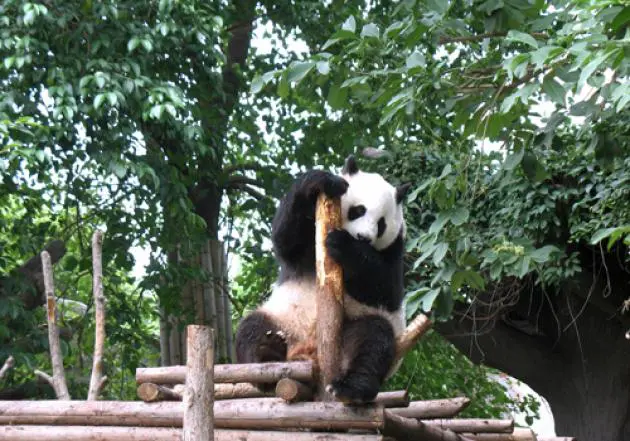
Giant pandas are a delight to watch, whether they are playing or crunching heaps of bamboo.
They eat while sitting upright, clutching the bamboo stem with their five fingers and an extended wrist bone that works like a thumb.
I could hang around for hours watching these cute bears, but we had a packed schedule and soon it was time to leave.
My next stop is the Jinsha Site Museum that sits on an archaeological dig site.
Jinsha was the capital of the Shu kingdom, which was one of the Three Kingdoms in ancient China.
Large palace foundations, and ceremonial and burial pits dating back some 3,000 years have been discovered over a stretch of five square kilometres.
Excavation is ongoing and, to date, more than 6,000 artefacts including gold, jade, bronze, stone and ceramic ware have been unearthed, together with tonnes of ivory and thousands of boar tusks and deer horns.
The museum, which is seven km from the city centre, is located in a lovely park.
The relics hall features one of the most important excavation areas – the ritual site. Most of the artefacts were excavated here and the site is well-labelled with nuggets of information that will appeal to anyone interested in the highly developed ancient civilisation that once prospered here.
The exhibition hall nearby displays the main artefacts found at the site. The exhibits are well organised, with just the right dose of information to fuel visitor interest.
Next on our list was the Leshan Giant Buddha and Mount Emei, both Unesco World Heritage Sites.
Leshan is about 150km from Chengdu. Its biggest attraction is the 71m towering Buddha, carved out of a cliff at the confluence of the Dadu, Min and Qingyi rivers.
The immensity of the Buddha is best viewed from a boat, so we boarded one at the wharf, and headed downstream. After a short ride, the boat turned around and stopped in front of the cliff.
Built during the Tang Dynasty 1,200 years ago, this largest stone Buddha in the world withstood the ravages of time, thanks to an innovative drainage system inside the body that mitigates weathering.
It took thousands of men and 90 years to complete work on this cultural icon which has been drawing crowds ever since. The Giant Buddha faces Mount Emei, home to the first Buddhist temple in China and built on the summit of Mount Emei more than 2,000 years ago. Today, dozens of temples dot the slopes of this 3,099m mountain.
On the last day of our tour, we hit the road to Taoping Qiang Village. Located 160km west of Chengdu, this 2,000-year-old Qiang minority settlement is an architectural wonder.
It has survived major earthquakes through the centuries. The 7.9-magnitude Sichuan earthquake of 2008 reduced entire villages to rubble, but Taoping village, 20km from the epicentre, remained unscathed.
The village is characterised by blocks of five-storey stonehouses, a labyrinth of alleys and three imposing watchtowers.
Spring water from the mountains is channelled to every household via a network of hidden trenches.
This elaborate water system cools down the houses, quells any fires, and serves as an escape route from enemies in the days of old.
Besides tourist attractions, Chengdu is a haven for shoppers and foodies. Our four-day tour of Chengdu was packed with one gastronomic adventure after another. We had our fill of some of Sichuan’s finest cuisine, and I miss their succulent tea-smoked duck, delectable Ma Po tofu, spicy Dan Dan noodles, and aromatic green tea.
Little wonder, then, that my first visit to Chengdu has left me hungry for more.
IF YOU GO
Thai Airways International and AirAsia operate flights between Bangkok and Chengdu. The best time to visit Chengdu is from March to June and September to November. The winter is very chilly so make sure you pack plenty of warm clothes.
