
Swiss and Singapore presidents to visit Thailand during IMF-World Bank meetings


Swiss President Guy Parmelin and Singapore President Tharman Shanmugaratnam will make official visits to Thailand during the 2026 IMF-World Bank meetings.
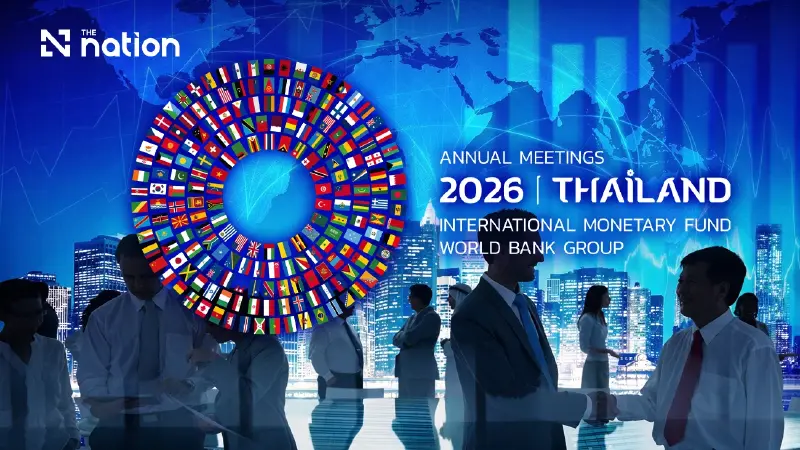
The presidents of Switzerland and Singapore will make official visits to Thailand during the 2026 Annual Meetings of the International Monetary Fund (IMF) and the World Bank Group in Bangkok from October 12-18, the Foreign Ministry has announced.
Jaithai Upakarnitikaset, Director-General of the Department of Information and spokesperson for the Ministry of Foreign Affairs, said President of the Swiss Confederation Guy Parmelin and Singapore President Tharman Shanmugaratnam would visit as guests of the Royal Thai Government.
Thailand is hosting the IMF-World Bank annual meetings for the second time, making it one of only three countries to have hosted the gathering twice, Jaithai said.
More than 15,000 participants from over 190 countries are expected to attend, along with more than 1,000 members of the media.
Swiss president to lead business delegation
Parmelin and his wife will make an official visit accompanied by a Swiss business delegation.
The visit will be the first official visit to Thailand by a Swiss president in 22 years and comes as the two countries mark the 95th anniversary of diplomatic relations.
The ministry said Switzerland is an important economic partner for Thailand, ranking as its second-largest trading partner in Europe and its largest trading partner within the European Free Trade Association.
More than 150 Swiss companies currently operate or invest in Thailand, while the Thai community in Switzerland numbers about 36,000.
Singapore president due to meet Anutin
Tharman will also visit Thailand as a guest of the Royal Thai Government.
Prime Minister Anutin Charnvirakul is scheduled to welcome him at Government House, while the Singapore president is also due to have an audience with Their Majesties the King and Queen at Amphorn Sathan Residential Hall.
The ministry described Singapore as one of Thailand’s key strategic partners, with cooperation spanning the green economy, food security, digital economic connectivity, technology and innovation.
Singapore is also one of Thailand’s most important economic partners and is currently its largest foreign investor.
The Foreign Ministry said further details and the outcomes of both official visits would be announced later.
Four events held alongside annual meetings
The ministry also outlined four activities being held around the IMF-World Bank meetings.
A round-table meeting titled “Strengthening ASEAN Resilience and the Role of Emerging Development Partners for a More Secure and Sustainable Future” will bring together development cooperation agencies from Thailand, Laos, Indonesia, Malaysia and Japan on October 9.
Discussions will focus on strengthening ASEAN’s ability to respond to challenges through trilateral cooperation supporting the Sustainable Development Goals, with an emphasis on people-centred development and leaving no one behind.
A dinner talk titled “Rethinking Growth: Thailand’s Pathways to a More Rebalanced and Sustainable Future” will be held on October 13 at the Sheraton Grande Sukhumvit.
The event will present Thailand’s approaches to balanced and sustainable economic growth, focusing on the Sufficiency Economy Philosophy and the Bio-Circular-Green Economy model, with examples of their application in businesses and communities.
A high-level forum on “Food System Transformation and Economic Growth: Powering Economic and Social Development Through the Energy Transition” will follow on October 14 at the InterContinental Bangkok.
Organised by the Foreign Ministry with the United Nations Economic and Social Commission for Asia and the Pacific and the Food and Agriculture Organization of the United Nations, the forum will examine how the energy transition can strengthen food security and the resilience of agricultural and food systems, reduce dependence on fossil-fuel imports and support sustainable growth in the Asia-Pacific region.
The fourth event, “Promoting Quality Infrastructure in Asia-Pacific”, will take place on October 15 at Conrad Bangkok.
Organised in cooperation with the Organisation for Economic Co-operation and Development and the Blue Dot Network, the forum will examine challenges facing quality infrastructure development in the Asia-Pacific and ways to attract sustainable investment for infrastructure projects.
