
Nobel laureate urges governments to focus on climate change, not economic growth
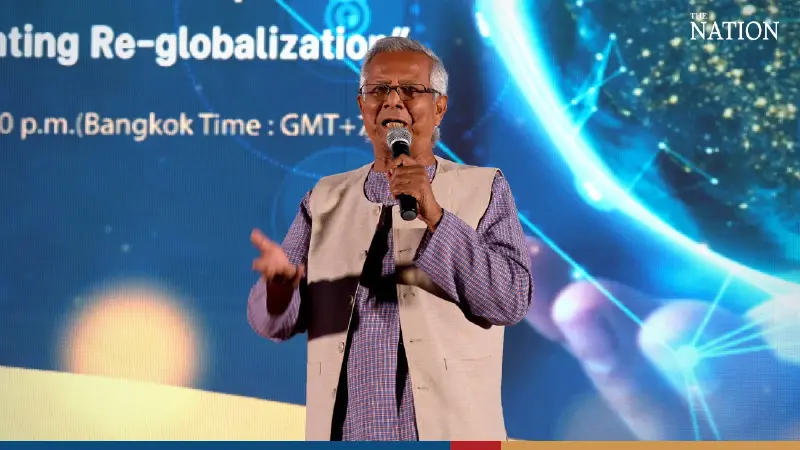


Human beings should not be satisfied with economic growth alone as there are many other issues to deal with, Nobel laureate Professor Muhammad Yunus said on Friday in Bangkok.
The Bangladeshi social entrepreneur and civil society leader said the Asean region had the potential to grow further. However, he warned that the global economy was developing rapidly, triggering many issues, such as inequality, unemployment and the dangerous influence of artificial intelligence (AI).
“We have many issues to discuss for new generations, which could otherwise turn us into dinosaurs,” he said.

He said the global economy is moving gradually towards inequality, claiming that the majority of global assets belong to a small group of wealthy people.
Yunus, who was awarded the Nobel Peace Prize in 2006 for founding the Grameen Bank and pioneering the concepts of microcredit and microfinance, said the emergence of AI had impacted the education and employment sectors. He warned of the risk of AI conquering the world, as it becomes smarter than humans.
"It is good if technology works for us," he said, adding that AI should not become smarter than humans.
He advised governments not to pay too much attention to economic growth and instead focus on other issues, such as climate change.
If we know that the house is on fire [due to climate change], we will not be pleased with economic growth, he said.
He added that the education sector had the responsibility to provide knowledge to students, so that they would not become victims of the problems plaguing humans.

Yunus explained that the world had faced many economic issues since the Covid-19 pandemic. The government sector had spent a large amount of cash to facilitate economic recovery, he said.
However, he pointed out that Covid-19 vaccine manufacturers had made huge amounts of money from vaccine sales despite many people having died of Covid-19.
"Poverty comes from failure in the economic structure," he said, adding that businesses should be redesigned to support society.
He added that the world can achieve zero-waste goal with a commitment to waste recycling.
Young people should take the first step and governments should align themselves to save the planet and civilisation, he added.

