
One year on, countries divided over Ukraine crisis
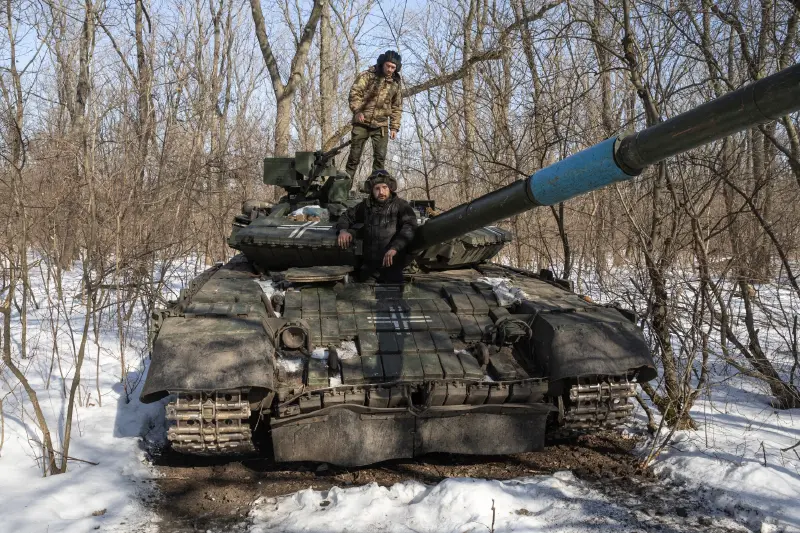


The West and the rest of the world are sharply divided in their views on the Russia-Ukraine conflict and the ensuing global order, according to a survey released on Wednesday by the European Council on Foreign Relations.
Friday marks the one-year anniversary of Russia's special military operation in Ukraine.
The survey was conducted in China, India, Turkey, the United States, Great Britain, Russia and nine European Union nations.
According to the survey, 65 % of the respondents in Great Britain, 55 % in the US and 54 % in the nine EU nations see Russia as their avowed "adversary". Many people in these countries also agree they should help Ukraine win the conflict.
For 80 % of the respondents in India, 79 % in China and 69 % in Turkiye, Russia is either an "ally" or a "necessary partner".
Also, 54 % in India, 48 % in Turkiye and 42 % in China support a quick end to the crisis.
People in these three countries, as well as in Russia, consider the emergence of a "multipolar world order" more probable than a "bipolar arrangement" between China and the US.
In contrast to opinions in the West, people in many non-Western countries appear to believe that the post-Cold War era is over.
The paradox of the Russia-Ukraine conflict is that "the West is both more united and less influential in the world than ever before", said Mark Leonard, co-founder of the European Council on Foreign Relations and co-author of a report based on the survey.
Emerging powers, such as India and Turkey, will act on their own terms and resist being caught in a conflict between the US and China, according to Leonard's report.
It said that one of the most striking findings of the survey is that most people, both within and beyond the West, believe the US-led liberal order is coming to an end.
Only 9 % of the respondents in the US, 7 % in the EU countries and 4 % in Great Britain see US global supremacy as the most likely state of affairs a decade from now. Most people in the EU nations and the US expect a bipolar world led by the US and China.
But outside the West, people believe that "fragmentation", not "polarization", will mark the next international order. Respondents in China, India, Turkey and Russia predict that the West will soon be just one global pole among many. The West may still be the strongest party, but it will not have "hegemonic" control, they believe.
The survey also found that people in China, India and Turkey are sceptical of the West's claims about defending democracy in Ukraine.
A vast majority of Chinese and Turkish respondents said that the West's support for Ukraine is motivated by reasons other than the defence of Ukraine's territorial integrity or its democracy.
Many in China said the West's support is driven by the desire to protect Western dominance.
China Daily
Asia News Network
