
Humanoids reshape global business as China and US race to scale
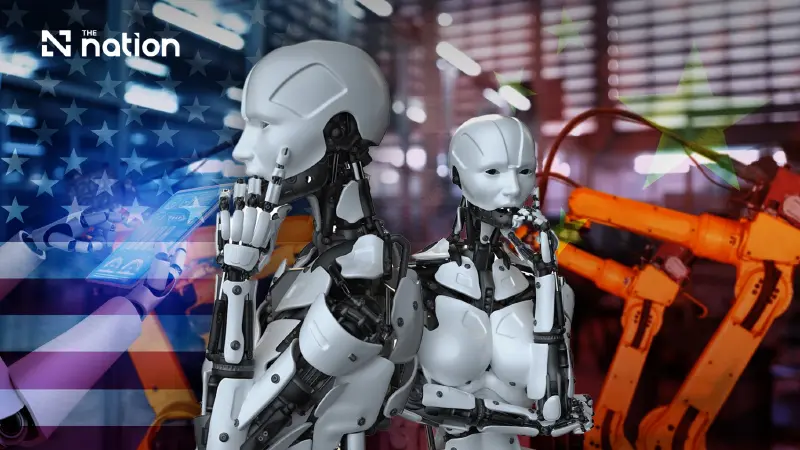


Humanoid deployments are surging as China leverages its industrial supply chain and the US advances AI in a race towards commercial-scale production.
- The humanoid robot industry has shifted from technical demonstrations to a commercial race focused on mass production, cost reduction, and the ability to perform valuable work.
- China is dominating the early stages of scaling, accounting for approximately 85% of new humanoid deployments in 2025 by leveraging its established electric vehicle supply chain.
- The global competition sees the US leading in advanced AI while China holds a significant advantage in manufacturing, supply chain control, and producing robots at a lower cost.
- Rapidly falling production costs and accelerating manufacturing are making widespread adoption in logistics and manufacturing more feasible, with the market projected to be worth at least US$38 billion by 2035.
Humanoid robots are entering a decisive phase, with competition shifting away from demonstrations of whether they can walk, pick up objects or work alongside people towards more commercially important questions: how much real work they can perform, how many can be produced and whether costs can fall far enough for widespread business use.
Data from Barclays show that the number of humanoid robots deployed worldwide rose from about 2,000 in 2024 to 15,000 in 2025 and is expected to reach 60,000 in 2026. China accounted for approximately 85% of new humanoid deployments worldwide in 2025.
TrendForce forecasts that China’s humanoid robot output will grow by as much as 94% in 2026, with Unitree Robotics and AgiBot potentially accounting for nearly 80% of total shipments.
The figures indicate that the industry is moving beyond technology trials into a period in which companies must prove that their robots can generate genuine commercial value.
From single-purpose robots to multi-purpose machines
A key difference between humanoids and conventional industrial robots is flexibility.
Traditional industrial robots are usually designed to perform specific tasks, such as assembling components, welding metal or moving goods. Switching them to another task may require systems to be reconfigured or machinery to be replaced.
Humanoid robots, by contrast, are intended to perform several types of work. Changing their role may require software adjustments or additional training rather than a complete redesign of the hardware.
Another advantage is that most workplaces have been built for people, including factories, warehouses, hospitals and offices. Robots with human-like forms and movement can potentially operate within existing environments without businesses having to rebuild their facilities around an entirely new automation system.
Barclays estimates that about 33% of jobs worldwide involve lifting, while 53% require precise handling and manipulation. Humanoids could therefore enter working environments where conventional automated systems have struggled to operate effectively.
Over the next five years, however, deployment is expected to remain concentrated in manufacturing, logistics and warehousing. Wider use in services, including healthcare and elderly care, is likely to follow as the technology becomes more reliable.

China competes across the entire industrial ecosystem
China’s emergence as a leader in humanoid robots is not the result of any single company. It reflects an industrial foundation developed through other sectors, particularly electric vehicles.
Kyle Chan, a researcher at the Brookings Institution, said China’s robotics industry was building directly on the electric-vehicle ecosystem.
Batteries, motors, cameras, sensors and semiconductors originally developed for EVs can also be used in robots, creating what Chan described as “overlapping industrial ecosystems”.
XPeng, the Chinese electric-vehicle manufacturer, is one example of a company expanding into robotics. It unveiled a humanoid robot called Iron in 2025.
Chan said China was using strengths developed in established industries to enter new markets ranging from humanoids and industrial robots to delivery robots.
Barclays reported that 70% of robotics inventions worldwide since 2000 originated in China. The country also has a supply chain extending from raw materials to critical components.
China produces more than 90% of the world’s refined rare-earth materials used in magnets, accounts for more than 22% of exports of actuation systems and represents 45% of global battery exports.
The competitive advantage therefore lies not only in who can build the most intelligent robot, but also in who can produce robots faster and more cheaply while securing enough components for mass production.
Production accelerates as costs fall
Unitree and AgiBot illustrate the industry’s transition towards manufacturing on an industrial scale.
Unitree’s prospectus showed that revenue from humanoids exceeded that generated by its quadruped robots for the first time in 2025, accounting for more than 51% of total revenue.
The company aims to expand its annual humanoid production capacity to 75,000 units.
AgiBot delivered its 10,000th Expedition A3 general-purpose embodied-AI robot in late March. Its production capacity increased from 1,000 units in 2025 to 5,000 and then to 10,000 within only three months.
TrendForce attributed the acceleration to standardised supply chains, flexible production based on orders, joint development with partners and the allocation of specialised components.
Orders from the automotive, electronics and logistics industries are also increasing.
Costs are declining rapidly. Barclays said the price of humanoids produced by Western manufacturers had fallen approximately thirtyfold over the past decade to about US$100,000 per unit, while Chinese manufacturers could offer robots for approximately US$50,000.
Goldman Sachs Research estimated that production costs, previously expected to range from US$50,000 to US$250,000, had fallen to between US$30,000 and US$150,000. That represents a reduction of about 40% from its earlier forecast.
Lower component prices, more supply-chain options and improvements in robot design and manufacturing processes have driven the decline.
Unit costs could fall further should the industry move from low-volume output to highly automated production lines.
Real-world data becomes fuel for physical AI
Barclays said training artificial intelligence required vast quantities of data and humanoid robots had an advantage in the enormous volume of existing information about human movement.
YouTube alone contains video with a combined duration equivalent to approximately 280,000 years. Much of it shows people interacting with tools, objects and their surroundings.
Video data alone, however, are insufficient because robots must also learn from performing tasks in the physical world.
Steve Xi, chief executive of Lightwheel, said the robotics industry did not yet have the enormous volume of real-world robot data available to Tesla, which can collect information from millions of vehicles operating on roads.
“Physical AI will require 1,000 times more data than large language models or autonomous-driving systems,” Xi said.
He argued that software-based environmental simulation was currently the only scalable route for accelerating robot training.
One world faces labour shortages while another fears job losses
The expansion of humanoids comes as economies face ageing populations, urbanisation and declining interest among younger workers in repetitive, physically demanding or dangerous jobs.
United Nations data show that the global population aged 65 or over is expected to increase from about 900 million today to 1.6 billion by 2050, reducing the working-age population relative to the number of elderly people.
Barclays said those trends were creating labour shortages in agriculture, healthcare, elderly care, manufacturing and logistics.
Robots are already being used in Britain to address labour shortages. Geek+, which produces autonomous mobile robots for warehouses, has worked with British partner MotionTech to deploy more than 2,000 robots across 10 warehouses.
Tesco, Asda and Next are among the companies using the systems.
Barry Pemberton, MotionTech’s customer care director, said clients wanted solutions that could be installed quickly.
“They want high storage capacity, faster picking and, ultimately, to use less space while reducing the number of workers required,” he said.
“We now appear to be facing a major labour shortage in Britain. These technologies are extremely important for keeping businesses operating and enabling them to meet demand.”
At the same time, Britain’s Trades Union Congress has called for robots to be used to improve productivity and job quality rather than merely to reduce labour costs.
The union body has also urged employers to involve workers in decisions concerning automation and to invest in reskilling.
Goldman Sachs described the tasks initially most suitable for humanoids as repetitive, physically demanding and risky work, collectively known as the “dangerous, dirty and dull” jobs.
Examples include mining, disaster response, nuclear-reactor maintenance and chemical production, where work may be unattractive or expose people to serious hazards.
Barclays divided humanoid deployment into two waves. The first would cover manufacturing, logistics, construction and repetitive tasks.
The second could expand into healthcare, elderly care and other services once robots become better at switching between jobs, making decisions according to context and interacting with people.
Zornitsa Todorova, head of thematic research covering fixed income, currencies and commodities at Barclays, said industrial applications were likely to dominate over the next five years, but the greater long-term opportunity could lie in consumer-facing work.
China, US and Europe enter a new industrial contest
As humanoids come to be regarded as part of the future labour infrastructure, competition is extending beyond technology into economics and geopolitics.
China has strengths in manufacturing and supply chains. The United States has advanced AI and robotics companies, while Europe has a strong industrial base and engineering expertise but must accelerate the development of data capabilities and physical AI.
Jeff Cardenas, chief executive of Apptronik, said the industry was entering a worldwide contest.
“It will be a global race, and I think everybody still has a chance to win,” he said.
Cardenas compared the current stage of the robotics industry with the early personal-computer era of the 1980s, when companies still had to prove that the technology could deliver genuine business benefits.
The competition is also taking place amid technology tensions between China and the United States.
The US has prohibited imports of some advanced new-generation robots from overseas, citing national-security concerns. The Chinese embassy in Washington responded that China opposed the politicisation of trade issues and the use of sanctions based on what it described as unfounded arguments.
Humanoid market could reach US$200 billion
Barclays estimates that the humanoid robot market could be worth about US$40 billion by 2035. Under a scenario in which production expands rapidly, its value could reach as much as US$200 billion.
Goldman Sachs Research has forecast a market value of US$38 billion.
Expansion will nevertheless depend on the industry overcoming significant obstacles involving safety, reliability, energy consumption, costs, component production and the ability of AI to control robots operating in unpredictable real-world environments.
The humanoid race is therefore shifting away from the question of who can build the most technically impressive robot.
The more important contest is now over who can manufacture enough machines at sufficiently low cost, prove that they can perform real work and gather enough data to help them learn faster.
China, in particular, is attempting to turn the strengths of its existing industrial sectors into an entirely new manufacturing chain for humanoid robots.
Source: Krungthep Turakij
