
China’s humanoid robots storm past runners in the Beijing race
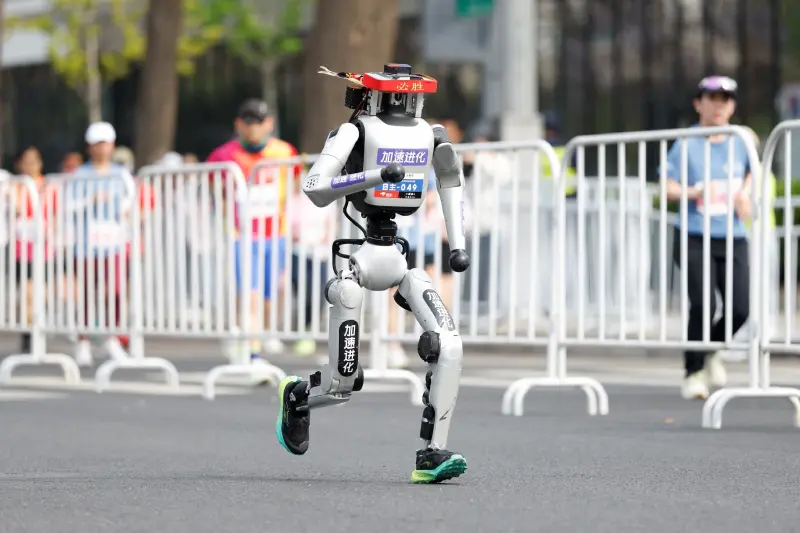


Chinese humanoid robots beat human winners in Beijing, while nearly half tackled the tougher 21-km race on their own rather than by remote control.
- In a Beijing half-marathon, several Chinese-made humanoid robots finished more than 10 minutes ahead of the human winners.
- The winning robot, developed by Honor, completed the race in 50 minutes and 26 seconds, a time faster than the official human half-marathon world record.
- The robots' performance showed a dramatic improvement from the previous year, when most failed to finish and the winner was more than twice as slow.
- Nearly half of the humanoid entrants completed the course autonomously using self-navigation, rather than relying on remote control.
Chinese-made humanoid robots delivered a striking display of speed and self-navigation at a half-marathon in Beijing on Sunday (April 19), overtaking human winners and underlining the pace of progress in the sector.
The change from the race’s debut edition last year was dramatic. In 2025, the event was marked by multiple mishaps, and most robots failed to finish. The winning robot then needed 2 hours and 40 minutes, more than twice the time recorded by the human winner in the standard race.
This year, the field expanded sharply, with the number of teams rising from 20 to more than 100. Several of the leading robots finished more than 10 minutes ahead of the human winners, while nearly half of the humanoid entrants completed the more difficult 21-km course autonomously rather than relying on remote control. To avoid collisions, the robots ran on parallel tracks alongside 12,000 male and female participants.
The winning robot, developed by Chinese smartphone maker Honor, completed the race in 50 minutes and 26 seconds, several minutes quicker than the half-marathon world record set by Ugandan runner Jacob Kiplimo in Lisbon last month.
Honor, a Huawei spin-off, swept all three podium positions, with each of its top robots running entirely through self-navigation.
Du Xiaodi, an engineer on the winning team, said the robot had been under development for a year. It was fitted with legs measuring 90 to 95 centimetres, designed to resemble those of elite human runners, and used liquid-cooling technology adapted from Honor’s smartphones.
Du said the industry was still at an early stage, but he believed humanoid robots would eventually reshape sectors, including manufacturing.
“Running faster may not seem meaningful at first, but it enables technology transfer, for example, into structural reliability and cooling, and eventually industrial applications,” Du said.
For spectators, the wide range of humanoids on display, each with different sizes and running styles, served as a visible sign of China’s improving robotics capabilities.
“The humanoid robots' running posture I saw was really quite impressive... considering that AI has only been developing for a short time, I'm already very impressed that it can achieve this level of performance,” said Chu Tianqi, a 23-year-old engineering student at Beijing University of Posts and Telecommunications.
“The future will definitely be an AI era. If people don't know how to use AI now, especially if some are still resistant to it, they will definitely become obsolete,” he said.
Another spectator, 11-year-old schoolboy Guo Yukun, said the race had inspired him to pursue a university degree in robotics. He said he regularly studies robotics theory and programming at his elite Beijing school and is part of his school’s team for the International Olympiad in Informatics, a global programming competition for high school students.
Even so, commercially viable uses for humanoid robots remain largely in the trial stage. While the half-marathon highlighted their physical potential, from hazardous work to battlefield roles, Chinese robotics firms are still trying to develop the AI software needed for humanoids to match the efficiency of human factory workers.
Experts said the abilities shown in the race, while impressive and entertaining, do not yet amount to the kind of advances required for large-scale industrial deployment, where manual dexterity, real-world perception and the ability to go beyond small, repetitive tasks remain crucial.
China is seeking to establish itself as a global leader in this emerging industry, backed by policies ranging from subsidies to infrastructure investment aimed at supporting domestic companies.
That ambition was also on display in February during the CCTV Spring Festival gala, China’s most-watched television programme, when more than a dozen Unitree humanoids staged an extended martial arts performance using swords, poles and nunchucks near child performers.
Reuters
