
Thailand Highlights Fiscal Resilience to Global Rating Agencies at IMF-World Bank Meetings
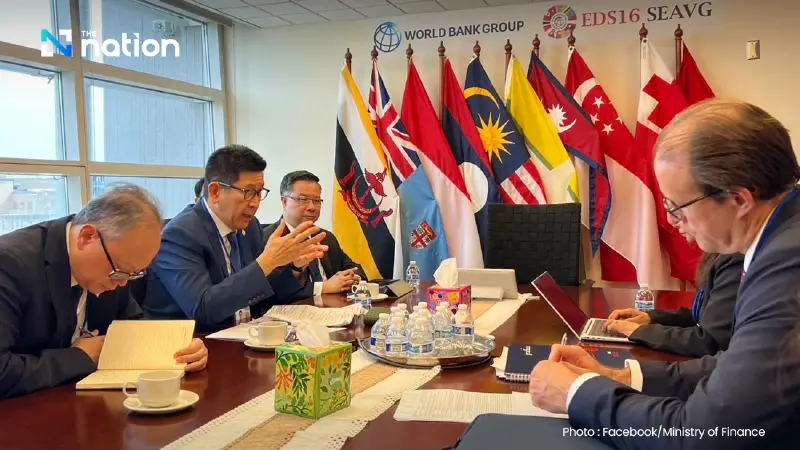


Deputy PM Ekniti Nitithanprapas affirms Thailand’s stability, noting international reserves are 2.5 times higher than short-term external debt
- At the IMF-World Bank meetings, Thailand's Deputy Prime Minister met with the "big three" credit rating agencies (Fitch, S&P, Moody's) to affirm the country's fiscal strength.
- A key point of resilience highlighted was that over 99% of Thailand's public debt is denominated in its local currency, significantly reducing risk from global interest rate changes.
- The country showcased its strong international reserves of over $280 billion, a figure that is nearly 2.5 times its short-term external debt, providing a buffer against external shocks.
- Thailand outlined a disciplined fiscal strategy focused on targeted spending, transitioning to clean energy, and investing in the digital economy to ensure long-term stability and growth.
Deputy PM Ekniti Nitithanprapas affirms Thailand’s stability, noting international reserves are 2.5 times higher than short-term external debt.
Thailand has reasserted its fiscal strength on the global stage, with Deputy Prime Minister and Minister of Finance Ekniti Nitithanprapas meeting with the world’s "big three" credit rating agencies to highlight the nation’s robust economic buffers.
During the 2026 World Bank and International Monetary Fund (IMF) Spring Meetings last week, Ekniti held high-level discussions with executives from Fitch Ratings, S&P Global Ratings, and Moody’s Investors Service.
The talks focused on Thailand’s ability to withstand external shocks amidst a volatile global financial landscape.
A central pillar of the briefing was Thailand’s liquidity and debt structure. Ekniti informed the agencies that nearly all of the country’s public debt—exceeding 99 per cent—is denominated in local currency, significantly mitigating risks from global interest rate fluctuations.
Furthermore, Thailand’s international reserves currently stand at over $280 billion, a figure nearly 2.5 times the nation’s short-term external debt.
Accompanied by a consistent current account surplus, these reserves serve as a critical buffer against global economic uncertainty.

The minister outlined a disciplined fiscal approach rooted in the Medium-Term Fiscal Framework, which balances sustainability with the flexibility needed to absorb external shocks.
The government’s forward-looking economic policy is being driven by three key strategic imperatives:
Targeted Measures: Enhancing the efficiency of government spending through precise, high-impact fiscal interventions.
Energy Transition: Restructuring the economy to prioritise clean energy and reduce a long-standing dependency on imported oil.
Economic Transformation: Driving long-term growth through aggressive investment in the digital economy, human capital, and "industries of the future".
By maintaining high reserve levels and a low-risk debt profile, the Ministry of Finance aims to ensure Thailand remains a stable and attractive destination for international investment as the global economy undergoes structural shifts.

