
Japanese researchers unveil Buddhist AI robot to assist monks
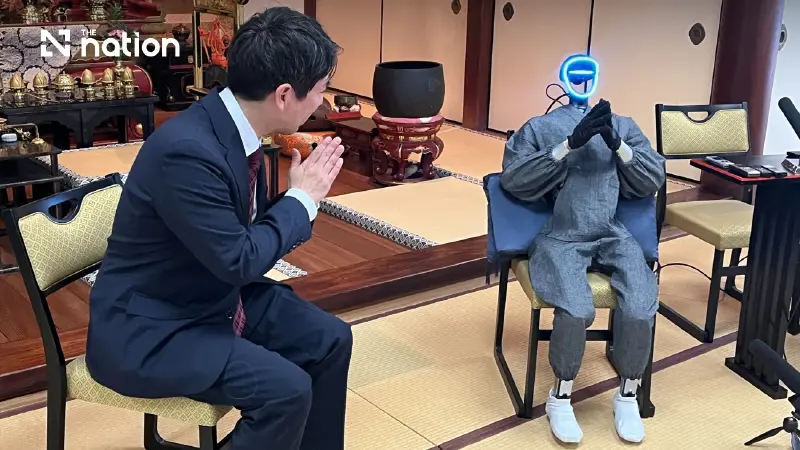


A Kyoto University team has created Buddharoid, an AI humanoid that gives Buddhist advice, performs rituals, and could support Japan's declining population of monks.
- Japanese researchers, including a team from Kyoto University, have unveiled 'Buddharoid', an AI-equipped humanoid robot designed to answer people's questions from a Buddhist perspective.
- The project aims to address a potential shortage of monks in Japan, with developers hoping the robot might eventually assist with or even perform certain religious rituals.
- The robot can engage in voice dialogue, walk, and perform physical actions like praying, powered by an AI trained on Buddhist scriptures and enhanced with OpenAI's ChatGPT.
- While currently a prototype and not for sale, the move to a physical form was prompted by feedback that a physical presence is crucial for religious settings.
A research group including Kyoto University has unveiled 'Buddharoid', an artificial intelligence-equipped humanoid robot designed to answer people's concerns from a Buddhist perspective.
The project aims to address a potential crisis in Japan, where up to 30 per cent of temples could close by 2040 due to a shortage of monk successors. Developers hope the robot might eventually assist with, or even take over, certain religious rituals.
Unveiled to the press in February at Shoren-in Temple in Kyoto, western Japan, the robot stands roughly 130 centimetres tall and weighs approximately 35 kilogrammes.
Dressed in 'samue', the traditional work clothing frequently worn by Buddhist monks, Buddharoid can engage in voice-based dialogue. It can also walk on two legs and execute movements such as pressing its palms together in prayer and performing acts of worship.
During the presentation, the robot conversed with its lead developer, Seiji Kumagai, a professor at Kyoto University's Institute for the Future of Human Society, alongside Koshin Higashifushimi, the chief steward of Shoren-in Temple.
"Japan has had a lot of gloomy news lately. How can people find happiness?" Kumagai asked.
Buddharoid responded, "Putting your own state of mind in order leads to the path of happiness, even in a world full of troubling news."
When Higashifushimi enquired, "What Buddhist teachings are needed in society today?", the robot replied: "Today's society needs teachings that encourage people not to hurt each other, to follow rules and to calm their minds. Such teachings can bring us closer to a peaceful and harmonious world."
The humanoid is the result of a collaboration between Kumagai's team and Teraverse Inc., a university-born startup. Its origins trace back to 2021 with the creation of 'BuddhaBot', an AI dialogue chatbot trained on Buddhist scriptures detailing exchanges between the Buddha and his disciples.
The initial system allowed users to consult an AI iteration of the Buddha regarding their worries. By 2023, the researchers upgraded the software by integrating OpenAI's generative AI model, ChatGPT. This enhanced version, named 'BuddhaBot Plus', provides scriptural passages alongside interpretations and additional explanations.
The transition to a physical robot was spurred by feedback from Bhutan, where Buddhism is the state religion. After the Dratshang Lhentshog, or the Commission for Monastic Affairs, launched a project to implement BuddhaBot Plus, researchers learned that having a physical form would be crucial for religious settings.
Despite this progress, the research group remains cautious regarding a rapid rollout. Buddharoid is not currently for sale, and its use is restricted to specific events.
"Even when people have worries that are difficult to share with others, they may feel able to consult a robot," Kumagai noted. "It's also conceivable that the quality of dialogue in religious rituals could change as robots acquire a physical presence."
Emphasising a measured approach, he concluded, "First, we need to use it together with specialists such as monks, and then deepen discussions on the extent to which assistance or substitution should be permitted in the future."

[Copyright The Jiji Press, Ltd.]
